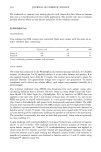
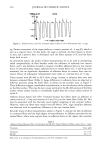
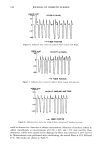
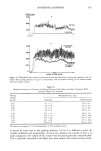
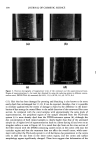
392 JOURNAL OF COSMETIC SCIENCE (a) (b) (c) (d) (e) (f) (g) (h) (i) 142 176 183 100 150 200 Temperature(øc) Figure 5. PDSC responses for the untreated hairs and the cured hairs prepared by using various reducing systems at pH 9.20 and, in different concentration ratios, DTDG:TGA (parentheses show the calculated value corresponding to the concentration ratio), followed by the values of the extent of supercontraction, L o in %: (a) untreated hair (b) 0:5 (0), 18.0 (c) 1:6 (0.167), 8.5 (d) 1:5 (0.2), 9.9 (e) 2:7 (0.286), 7.5 (O 3:8 (0.375), 7.0 (g) 2:5 (0.4), 6.6 (h) 4:9 (0.444), 4.0 (i) 3:5 (0.6), 4.6. shown by curve b. This indicates that almost all of the o•-crystallites have been disrupted by the treatment. Curves c-i are the responses for the samples obtained from the bicomponent system. As the concentration ratios increase, the peak heights gradually increase, while the peak temperatures decrease up to about 176øC. For all of the cured

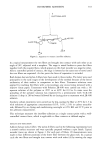
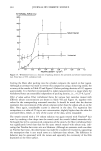
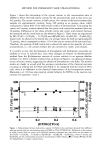
METHOD FOR PERMANENT HAIR STRAIGHTENING 393 samples, a broad exothermic peak ranging from about 100 ø to 160øC can be observed on each PDSC curve, although the exotherm is absent from the untreated sample. The correlation between the magnitudes of the exothermic and endothermic peak areas is uncertain. However, it seems that in the series of the bicomponent system, except for sample d, the smaller the endothermic area of the melting peak, the larger the exother- mic area. The evolution of heat in the exotherm increases with decreasing o•-helix content and is likely concerned with the randomization of the keratin chains or the thermal stability of the cross-linked structure of the cured hair. It has been shown (2,3) that the exothermic peak disappears for the PDSC samples of cured hairs pretreated by soaking in an aqueous solution of 10 -2 M of N-ethylmaleimide as a strong blocking agent for the free thiol groups in keratin fibers (15,16). When hairs are reduced to break down the disulfide bonds and subsequently oxidized to reform the disulfide bonds in new positions on the randomized chains, internal strains may occur within the network structure under the conditions of relatively high-speed drying. For a moderate condition such as raising the temperature of the hair sample enclosed in the PDSC pan, the keratin chain commences the molecular motion near Tg, and the strain energy stored in the network chains is dissipated by the mechanical scission of disulfide bonds to generate thiyl radicals (17). The radicals may transform to thiol groups through hydrogen abstraction from the environment. It is reasonable to consider that the thiol groups are oxidized into disulfide bonds or sulfonic acid groups in the presence of air and absorbed water in the PDSC sample pan, resulting in an exothermic response. A detailed report on this mechanism will be presented in the future. 2O 15 [] 0 5 10 15 AH m (J/g) Figure 6. Relationship between the degree of supercontraction, Lc, and the enthalpy of melting, AH•n: (¸) untreated hair, ([•) cured hairs obtained by using various reducing systems.
Purchased for the exclusive use of nofirst nolast (unknown)
From: SCC Media Library & Resource Center (library.scconline.org)