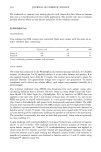
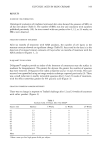
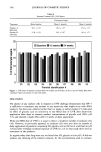
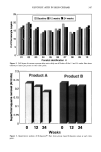
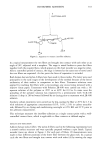
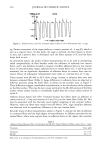
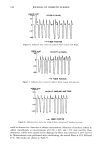
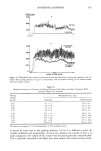
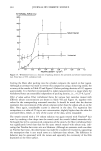
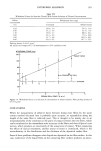
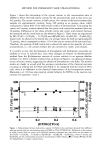
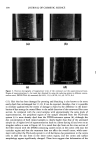
394 JOURNAL OF COSMETIC SCIENCE Figure 6 shows the relationship of supercontraction, L c to the enthalpy of melting, AH•n. An approximately linear relationship is obtained. The intercept of the straight line extrapolated to the Lc axis is about 10%. For higher values than this, the smoothness of the hair surface and even the circular shape of the fiber tend to be lost, as shown in Figures 3 and 4. This indicates that the supercontraction within about 10% is respon- sible for the breakdown of the tx-crystallites. On the contrary, the higher contractions follow unwanted alterations resulting from the changes in the matrix components in the cortex as well as in non-keratin components in the cell membrane complex. DEGREE OF CRYSTALLINITY OF CURED HAIR Figure 7 shows the x-ray diffraction photographs of the untreated hair (a) and the cured hairs supercontracted up to 8.4% (b) and 12.5% (c). For the untreated hair, the reflection characteristic of tx-keratin fibers appears in the equatorial spot at 0.98 nm and in the meridianal arc at 0.51 nm. It can be observed, however, that for the supercontracted fiber no discrete reflection exists on a diffused scattering ring near 1 nm, suggesting that the tx-crystallites were either changed in part into amorphous materials or crystallites ar- ranged in an unoriented state or both. To demonstrate the crystal forms and the degree of crystallinity in further detail, x-ray diffraction analyses were carried out accoMing to the method reported by one of the present authors (18,19). Figure 8 shows the scattering intensities from the untreated hair at azimuthal angles at q = 0 ø, 75 ø, and 90 ø in the range of the Bragg angles, 2 0 from 5 ø to 30 ø. It has been shown that for keratin fibers, the diffracted intensity from the amorphous materials is based on the azimuthal angle at q = 75 ø. The degree of crystallinity can be estimated by using equation 12: 100(Ato t - Aamor)/Ato t (12) where hto t is the total area under the curve of the diffracted intensity at 2 0 = 5 ø to 30 ø, and Aamor is the corresponding area under the base line. The degree of crystallinity was estimated to be 29.0%. From a similar treatment of the intensity curves for the cured hair shown as an example in Figure 9, the corresponding values obtained were 16.0%, 12.2%, and 5.8% for the supercontracted fibers at 8.4%, 9.9%, and 12.5%, respectively. This suggests that the amount of crystalline material decreases considerably with in- (a) (b) (c) Figure 7. High-angle x-ray diffraction photographs of the untreated and the supercontracted hairs at different extents of supercontraction, L o in %: (a) untreated, (b) 8.4, (c) 12.5.

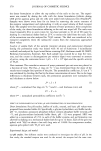
METHOD FOR PERMANENT HAIR STRAIGHTENING 395 250 200 150 100 5O 1 3 2 1 I I I i I i I 0 5 10 15 20 25 30 35 20(degree) Figure 8. X-ray diffraction intensities versus 2 0 curves for the untreated hair. Curves 1, 2, and 3 denote the azimuthal angels at q• = 0 ø (equator), 75 ø, and 90 ø (meridian), respectively. creasing supercontraction. A minor difference either between the diffracted intensities or the diffraction angles due to structural changes occurring in keratin containing a large amount of amorphous material cannot be easily detected in the curves of these simple diffraction traces. In fact, as seen in Figure 9, there is an uncertainty for the existence of the reflection from the [•-crystal at 2 0 = 19.1 ø. A reliable quantitative treatment has been performed by introducing an approximation of the relative intensity defined as an index of the x-ray intensity diffracted from the crystallites in the fibers (19). The relative intensity, Ire•, was calculated as the ratio of the intensity diffracted from the cured hairs to that from the untreated fiber. Here, Ire• = 100(Icr/Ic•O), where Ic• is the intensity above the amorphous baseline at a given spacing, and Icr ø is the intensity in the 0.98-nm equatorial or-reflection (2 0 = 9.6 ø) for the untreated hairs. The results are shown in Figure 10. The intensity of the meridianal diffraction at 0.51 nm (2 0 -- 17.4 ø) corresponds to about a quarter of the intensity at 0.98 nm. It is noted that for the cured hairs supercontracted up to 8.4%, 9.9%, and 12.5% as typical samples already shown, (i) the equatorial peak positions are shifted by 2 0 = 9 ø from 2 0 = 9.6 ø observed for the untreated fiber (ii) the intensities near 2 0 = 9 ø drop up to about 47.0%, 33.2%, and 13.4% for the respective samples (iii) the 0.51-nm or-reflections disappear, sug- gesting less ordered situations of the ot-helices and (iv) the [•-reflections at 0.465 nm (2 0 = 19.1 o) appear in about 12%, -0%, and 7%, respectively. In the x-ray photographs in Figures 7b and 7c, more or less unoriented [•-reflections can be differentiated from the
Purchased for the exclusive use of nofirst nolast (unknown)
From: SCC Media Library & Resource Center (library.scconline.org)