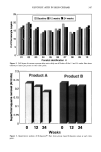
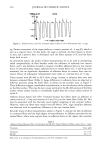
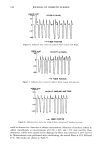
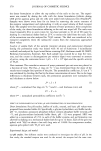
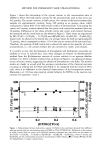
348 JOURNAL OF COSMETIC SCIENCE 250 Product A Product B m 200 .o_ '- 150 o. 100 o m 50 0 12 24 0 12 24 Weeks Figure 4. Stratum corneum barrier integrity after long-term daily use of AHA products. Bars show group mean peak response to Trafuril challenge at each time point. products (less than 10% and pH above 3.5) AHAs appear to remove dry flakes from the surface but do not remove underlying layers. Higher concentrations at lower pH values can, of course, cause deeper exfoliation (13). The D-Squame © results corroborate that the quantity of scales removed is slightly reduced, and this reflects a beneficial effect that leaves the stratum corneum smoother and more moisturized. Trafuril challenge also failed to show impairment of the stratum corneum barrier. This is an indirect measure of barrier integrity (8). This finding is consistent with previous evidence that demonstrates that four weeks of twice-daily application of 5% lactic acid (pH 4.0) to the volar forearm increased stratum corneum resistance to sodium lauryl sulfate (14). CONCLUSION This study demonstrates that long-term use of cosmetic creams containing up to 8% glycolic acid at pH 3.8 and SPF 4 sunscreen does not thin the stratum corneum or impair barrier integrity. SPF 4 sunscreen added to these products gives complete protection to one MED of solar simulating irradiation.

GLYCOLIC ACID IN SKIN CREAMS 349 REFERENCES (1) E.J. Van Scott and R.J. Yu, Control of keratinization with alpha-hydroxy acids and related com- pounds, Arch. Dermatol., 110, 586-590 (1974). (2) M. Dahl and A. Dahl, 12% Lactate lotion for the treatment of xerosis: A double-blind clinical evaluation, Arch. DermatoL, 119, 27 (1983). (3) E.J. Van Scott and R.J. Yu, Alpha-hydroxy acids: Therapeutic potentials, Can. J. Dermatol., 1(5), 108-112 (1989). (4) M. L. Elson, The utilization of glycolic acid in photo-aging, Cosmet. DermatoL, 5, 12-15 (1992). (5) E. M. Jackson, Update on AHA-containing products, Cosmet. Dermatol., 7, 29-30 (1994). (6) CIR, Final report on the safety assessment of glycolic acid, ammonium, calcium, potassium, and sodium glycolams, methyl, ethyl, propyl, and butyl glycolams, and lactic acid, ammonium, calcium, potassium, sodium, and TEA-lactates, methyl, ethyl, isopropyl, and butyl lactates, and lauryl, myri- styl, and cetyl lactates, Int. •. ToxicoL, 17(Suppl. 1), 1-242 (1998). (7) E. Christophers and A.M. Kligman, Visualization of the cell layers of the stratum corneum, J. Invest. DermatoL, 42, 407-409 (1964). (8) G. L. Grove, M. J. Grove, C. R. Zerweck, and J. L. Leyden, Determination of topical tretinoin effects on cutaneous microcirculation in photoaged skin by laser doppler velocimetry,J. Cutan. Aging Cosmet. DermatoL, 1, 27-32 (1998). (9) H. Schatz, A.M. Kligman, S. Manning, and T. Stoudemayer, Quantification of dry (xerotic) skin by image analysis of scales removed by adhesive discs (D-Squames), J. Soc. Cosmet. Chem., 44, 53-63 (1993). (10) R.M. Lavker, D. A. Veres, C.J. Irwin, and H. H. Kaidbey, Quantitative assessment of cumulative damage from repetitive exposures to suberythemogenic doses of UVA in human skin, Photochem. PhotobioL, 62, 348-352 (1995). M. Stiller, J. Bartolone, et aL, Topical 8% glycolic acid and 8% L-lactic acid creams for the treatment of photodamaged skin: A double-blind vehicle controlled clinical trial, Arch. Dermatol., 132, 631-636 (1996). Unilever Research U.S., A double-blind, vehicle controlled, randomized study to evaluate the efficacy and safety of 8% L-lactic acid and 8% glycolic acid in the cosmetic improvement of the signs of photodamaged skin, (URUS-93-MG-1). Part 7: Evaluation of sunburn cell formation. Unpublished data submitted by CTFA. Cited in Cosmetic Ingredient Review (Washington, DC, 1998). W. F. Dial, Use of AHAs add new dimensions to chemical peeling, Cosmet. DermatoL, 3, 32-34 (1990). A. V. Rawlings, A. Davies, et al., Effect of lactic acid isomers on keratinocyte ceramide synthesis, stratum comeurn lipid levels and stratum corneum barrier function, Arch. DermatoL Res., 288, 383- 390 (1996). KGL, Inc., 1996a: An investigation of the short-term effects of topical treatments on the sensitivity of human skin to UVR. KGL, Inc., 1996b: A study to investigate the effects of several topical treatments on the sensitivity of human skin to UVR. In "34th Report of the CIR Expert Panel--Safety of Alpha Hydroxy Acid Ingredients," Int. •. ToxicoL, 17, Suppl 1, 185-191 (1998). (11) (12) (13) (14) (15)
Purchased for the exclusive use of nofirst nolast (unknown)
From: SCC Media Library & Resource Center (library.scconline.org)