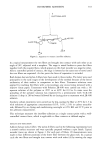
j. Cosmet. Sci., 51, 351-366 (November/December 2000) Measurement of interfiber adhesion Y. K. KAMATH and H.-D. WEIGMANN, TRI/Princeton, P.O. Box 625, Princeton, NJ 08542. Accepted for publication October 25, 2000. Synopsis Two methods of evaluating interfiber adhesive interactions are discussed. A single-point contact method measures the force of separation between two fibers that had been brought into contact with each other at a right angie under a defined contact pressure. After the application of topical treatments, reproducibility of the separation force along the length of the same fiber is poor. This has been attributed to the nonuni- formity of surface deposition and to the uncertainty of the area of contact. The nonuniformity problem disappears when liquids are deposited on the fiber surface. In this case, capillary forces dominate the separation forces, although the uncertainty about the area of real contact between the two fibers still exists. The second method is a multipoint contact method in which the signal is much larger and which represents an average of the adhesive interactions between a single fiber and its neighbors in a hair assembly. The parameter measured is a "withdrawal" or pull-out force from a hair bundle with a defined packing density, which can help in the prediction of compressibility behavior describing hair body. INTRODUCTION Interfiber adhesive forces play an important role in fiber assembly behavior such as bending and compression of fiber bundles. When a fiber assembly is subjected to deformation strains, single fibers slip past one another at their points of contact, thus minimizing the extent of deformation of individual fibers. The efficiency with which this is achieved depends on the forces of interfiber friction that arise as a result of adhesion at the points of contact. The force of adhesion between fibers is difficult to measure and is usually quite inac- curate, mainly because of the uncertainty of the conditions at the points of contact. Kul and Smith (1) have made an attempt to measure adhesive interactions between mohair fibers after treating them with various spinning oils to determine which properties of the oils were important for the properties of the yarn. The principle of their method is shown in Figure 1. Fiber A is mounted on the stationary support D and fiber B is mounted underneath fiber A on a bow. The two fibers are brought into contact with each other at an angle of 90 ø. Fiber B is moved downwards until it separates from fiber A. The force required to bend A (like a cantilever) to the position of detachment of B is measured and treated as the force of adhesion between the two fibers. For fibers coated with spinning oils, the force of adhesion in this arrangement should be equal to the product of contact 351

352 JOURNAL OF COSMETIC SCIENCE Figure 1. Interfiber adhesion apparatus of Kul and Smith (1). perimeter and the surface tension of the oil. However, the measured forces were three to five times higher than those calculated. The drawback of the method is that the normal force with which the fibers are brought together is not controlled, and hence the reproducibility of contact is poor. An attempt has therefore been made to develop a method for measuring forces of interfiber adhesion by a modification of the above technique. The ultimate aim is to be able to measure forces of interfiber adhesion that are relevant to the radial compression of hair assemblies as experienced during hair body evaluations. We have also investigated a dynamic pull-out method that gives a realistic force of interfiber cohesion in a fiber assembly. These are described separately in Parts I and II of this communication. PART I: SINGLE-POINT CONTACT ADHESION FORCE MEASUREMENT EXPERIMENTAL The apparatus developed for the interfiber adhesion force measurement is shown sche- matically in Figure 2. One of the fibers is mounted on a bow that in turn is mounted on the weighing arm of a Cahn recording electrobalance and tared to zero. The other fiber is hung horizontally over two glass rods that are supported by a dish. Two equal weights are mounted on each end of the fiber to keep it taut in the work reported here, 2- and 5-g weights were used. The dish with the fiber mounted on the glass rods is placed on a reversible stage (Burleigh Instruments Inc.) that moves up or down at a controlled rate (-3.0 lam/s).
Purchased for the exclusive use of nofirst nolast (unknown)
From: SCC Media Library & Resource Center (library.scconline.org)