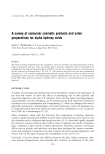
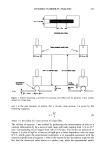
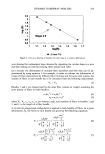
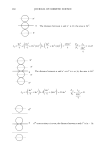
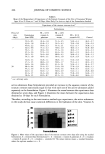
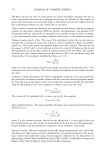
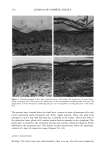
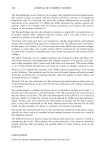
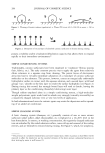
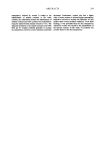
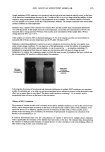
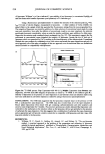
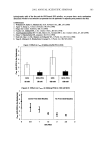
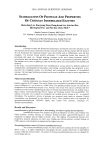
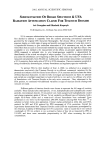
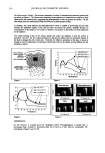
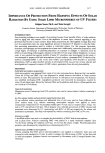
DYNAMIC HAIRSPRAY ANALYSIS 2 5 7 direction of deformation Cross Section Moment of Inertia • 4 • I 2 Stiffness Ratio Direction of deformation Cross Section Moment of Inertia I = 2.5•r 4 Stiffness Ratio 5 • 60 degrees I = 2.0xr 4 I = 5•r 4 5 direction of deformation Cross Section Moment Stiffness Ratio 4• of Inertia • 35 4 11.67 I=• ]ir I = 21 l! r 4 21 Figure 7. Calculation of an area moment of inertia for various model fiber assemblies.

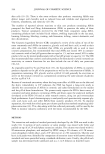
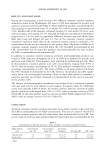
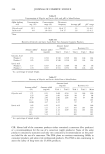
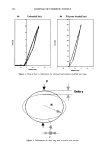
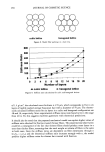
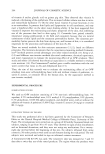
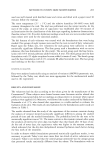
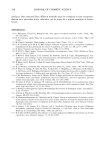
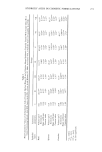
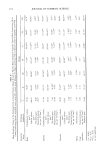
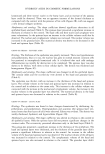
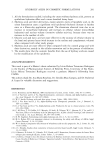
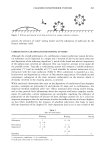
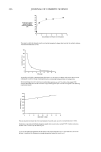
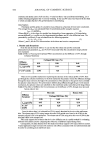
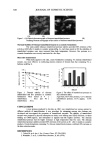
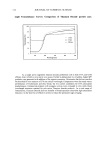
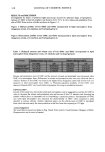
258 JOURNAL OF COSMETIC SCIENCE cubic lattice hexagonal lattice Figure 8. Model fiber packings in a hair tress. 600 I 500 400 300 200 lOO o 0 2 4 6 8 10 12 14 16 18 20 Number of layers m cubic lattice -•- hexagonal lattice Figure 9. Stiffness ratio calculations for cubic and hexagonal lattices. of 1.4 g/cm 3, the calculated tress thickness is 376 pm, which corresponds to five to six layers of tightly packed average Caucasian hair with a diameter of 70 pm. The theoret- ically calculated stiffness ratios for six layers in a cubic and hexagonal configuration are 48 and 36, respectively. Since experimental stiffness ratios were found to be in the range from 20 to 50, this suggests excellent agreement with theoretical predictions. It should also be noted that the proposed mechanical model can explain higher values of stiffness ratio observed for fixative-treated thinner fibers. This experimental observation could be a consequence of the fact that thinner fibers should produce more layers in a tress than thicker fibers, assuming that the total weight or volume of fibers is the same in both cases. Since the stiffness ratios are dependent on fiber dimensions through n (n•/n 2 = r2/r•) , and the theoretical stiffness ratio increases strongly with n, the model predicts higher stiffness ratios for thinner hair treated with fixatives.
Purchased for the exclusive use of nofirst nolast (unknown)
From: SCC Media Library & Resource Center (library.scconline.org)