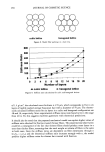
j. Cosmet. Sci., 53, 249-261 (September/October 2002) Dynamic hairspray analysis. III. Theoretical considerations j. JACHOWICZ, International Specialty Products, Wayne, NJ 07470. Accepted for publication March 15, 2002. Synopsis Model mechanical calculations were carried out to simulate the properties of hair fiber assemblies operating in the bending mode. It was assumed that the fibers were in omega-loop configuration (as in experimental work), and the theory of deformation of thin rings provided a fundamental relationship between stress and strain. A dependence on the stiffness of multi-fiber assembly was derived and verified empirically. Theo- retical bending stiffness for fixative-treated hair was calculated for various model fiber distributions by calculating their area moment of inertia according to the parallel axis theorem. General equations for stiffness of fiber assemblies were derived for cross sections placed on cubic and hexagonal lattices. The results suggest a good agreement between the theoretical and experimental data. INTRODUCTION Quantitative analysis of various parameters related to the bending deformation of hair fibers as well as the effect of fixatives on bending has been recently presented in the literature (1-4). New sensitive instrumentation such as dynamic mechanical analysis and texture analysis has enabled the measurement of the mechanical properties of hair with great precision both as individual single fibers as well as fiber assemblies. This work is important from a theoretical as well as a practical point of view. Theoretical description of the bending behavior of single fibers as well as of multiple fiber assemblies is relevant to the behavior of hair on the scalp, to its properties after styling, and to the effect of styling products on hair properties. In commercial practice, there is a great interest in parameters such as hair stiffness or flexibility after modification with a styling resin, the effect of high humidity on the ability of hair to maintain style (hold), curl memory, curl snap, etc. These quantities define the performance of a product or its key ingredients and are frequently employed in product descriptions or in advertising. In this paper we are mostly concerned with a theoretical definition and interpretation of the parameters obtained in a technique referred to as dynamic hairspray analysis, which employs hair shaped into "omega-loops" to quantify the mechanical properties of un- treated and polymer-modified hair. The most important of those is so-called hair stiff- ness, which was previously quantified by a parameter referred to as the stiffness ratio (4,5). It was defined as a ratio of the measured maximum force at 6.25% deformation (within the elastic region of force vs deformation dependence) for treated and untreated hair. The stiffness ratio was shown to increase 10-20-fold after treatment with styling 249

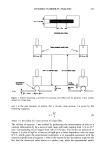
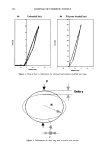
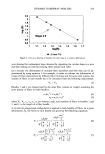
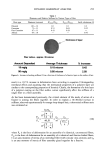
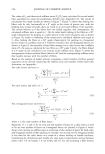
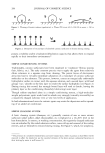
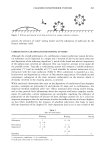
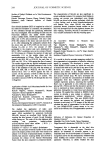
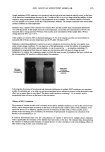
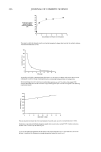
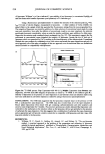
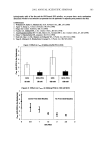
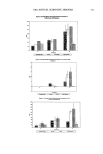
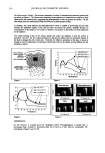
250 JOURNAL OF COSMETIC SCIENCE polymers. This paper attempts to provide a theoretical explanation of the magnitude of this increase and other factors affecting the stiffness of hair. RESULTS AND DISCUSSION EXPERIMENTAL The instrumentation and experimental procedures were described in previous reports (4). We employed a texture analyzer, Model TA-XT2, from Texture Technologies Corp. to measure the mechanical properties of hair under controlled conditions of humidity. Hair tresses were in the form of omega loops prepared by using wet hair and special holders to impart omega loop configuration. The hair was dried on the roller to form a perma- nent set. The diameter of the loop was approximately 16 mm. The mechanical measurements were carried out by oscillating a plastic probe between the fiber surface and the calibration height of 4 cm (Figure 1). After touching the surface of the hair and sensing a 2.0 G force (a trigger value of force as shown in Figure 2a), the probe produces an additional 1-4 mm additional deformation (6.25-25%) of the loop before rising to the calibration height. One millimeter deformation is typically within the elastic limit of both untreated and resin-modified hair. Four millimeter deformation (25%) usually results in irreversible damage to polymer-treated hair and is employed to study the flexibility of styling products. This area is covered in detail in our recent papers but is not discussed in this publication. The raw data from the experiment include the values of force and distance as a function of time. The presentation of data as force as a function of time gives a series of peaks, with each peak corresponding to one deformation cycle of a hair loop. Plotting force as a function of distance provides an immediate test of linearity and allows one to make a judgment about the elasticity of a given treatment. For most of the systems investigated in the range of 0-6% deformation, the mechanical response was a linear plot of force = f (distance) (Figure 2a,b). It is usually reversible, showing a small hysteresis. A typical force corresponding to 1 mm deformation for untreated hair varies from 10 to 15 G, depending on the batch of hair and its type. After treatment with styling solutions, this value increases 10 to 40 times. A parameter to characterize the stiffness of hair after treatment was defined as a ratio of the measured maximum force at 1 mm deformation for treated and untreated hair. For the set of data presented in Figure 2a and 2b, it is equal to 161/12.1 = 13.3. THEORETICAL CONSIDERATIONS The mechanical analysis of deformation of omega loops prepared from hair can be described, in approximation, by the theory of deformation of thin rings (6). The theory gives the following dependence between deformation, By, and the force, P (Figure 3): a• =-•- -• (1) where E is the modulus of the ring material, R is the radius of a ring (or a loop of hair),
Purchased for the exclusive use of nofirst nolast (unknown)
From: SCC Media Library & Resource Center (library.scconline.org)