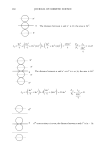
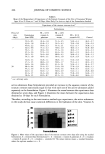
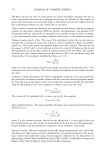
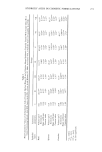
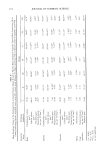
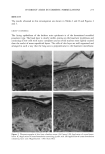
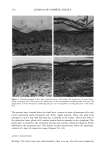
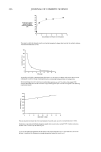
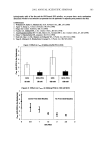
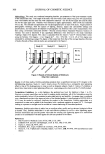
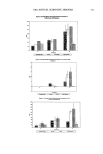
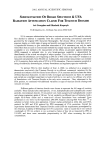
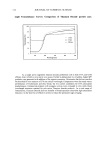
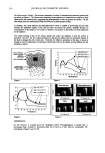
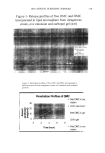
2002 ANNUAL SCIENTIFIC SEMINAR 311 Figure 2: Avocado Sterois Don't Decrease the Production of PGE2 Due to UVB Exposure t2 24 Time (Hours) ß Avocado Lo•on • L•(ion m UV13 A•Ot• E•No Treatment ] Figure 3: Avocado Sterois Decrease the Production of IL-lcr Due to UVB Exposure tooo lOOO 14oo ioo 4o0 o 24 [ i• AvoCado LO•(xt (• Lotion 3 UVB • NO Trlamlent ] Figure 4: Avocado SteroIs Decrease the Production of iL-8 Due to UVB Exposure Time (Hours)

312 JOURNAL OF COSMETIC SCIENCE SUNLIGHT AND SKIN: AN IMMUNOLOGIST'S POINT OF VIEW Paul Bergstresser, M.D. University of Texas Southwestern Medical Center The sun emits a spectrum of electromagnetic radiation (solar spectrum) with profound effects on the earth and it's biomass. The principal wave lengths that affect skin are found in the visible (400 to 800 nm) and ultraviolet (295 to 400 nm) regions. We have learned over the last two decades that ultraviolet radiation (UVR) has the capacity to distort immune responses that are initiated and expressed in skin. Events of relevance to humans include surveillance against skin cancer and against the infectious diseases, as well as hypersensitivity reactions against foreign chemicals. Importantly, UVR is also used as a therapeutic tool in diseases such as psoriasis, mycosis fungoides, and atopic dermatitis. Normally, immunity in skin is initiated by dendritic cells, including epidermal dendritic cells (Langerhans cells) and dermal dendritic cells. When a dendritic cell encounters elements derived from necrotic cells or from infectious agents, portions are metabolized into small immunogenic peptides (antigens). This is accompanied by cell activation as the dendritic cell moves from skin to draining lymph nodes. Within nodes, lymphocytes reactive against these antigens are recruited, activated, and then expanded greatly in number. These lymphocytes then circulate via blood and lymph, ready to kill or to cause inflammation wherever such antigens may be found. UVR distorts this process at several points. It causes the production of cytokines that tend to suppress the development of immunity for example, IL-10 inhibits the activation ofThi (CD4+) cells. It causes the immigration into skin of antigen-presenting cells that promote the development of suppression. It also causes the photo-isomerization of trans-urocanic acid, a normal constituent of skin, into cis-urocanic acid, which tends to suppress immunity. UVR even has the capacity to distort antigen presentation by Langerhans cells, and it has directly detrimental effects on lymphocyte survival. Recently there has been debate concerning the extent to which UVR-absorbing sunscreens are able to prevent these detrimental effects. Ultimately, knowledge of UVR-mediated effects in skin will allow us to protect and perhaps even to reverse it's effects. That is the goal of contemporary research in photoimmunology.
Purchased for the exclusive use of nofirst nolast (unknown)
From: SCC Media Library & Resource Center (library.scconline.org)