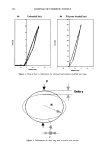
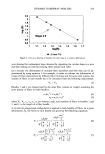
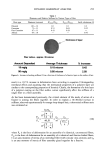
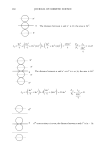
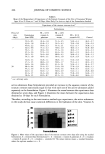
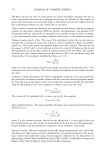
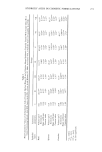
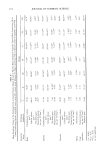
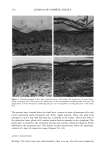
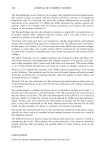
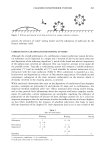
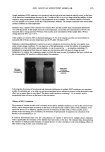
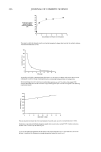
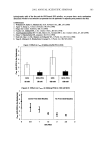
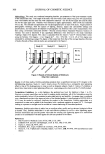
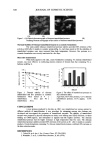
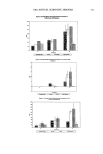
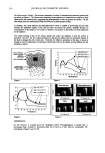
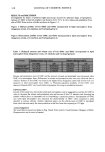
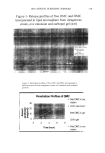
2002 ANNUAL SCIENTIFIC SEMINAR 303 hydrodynamic radii of the free and the PEG-bound SDS micelies, we propose that a steric mechanism determines whether or not micelies can penetrate into the epidermis via aqueous pores presem in the skin. 5. References 1. Wilhelm KP, Surber C, Maibach HI, Arch. Dermatol. Res., 281, 293 (1989) 2. Agner T, Serup A, J. Invest. Dermatol., 95, 543 (1990) 3. Rieger M, Cosmet. Toiletries, 110, 31 (1995) 4. Faucher JA, Goddard ED, J. Soc. Cosmet. Chem., 29, 323 (1978) , 5. Ananthapadamanabhan KP, YuKK, Meyers CL, Aronson MP, J. Soc. Cosmet. Chem., 47, 185 (1996) 6. Nilms Y, Blank•htein DB, Langmuir, 10, 3512 (1994) 7. Peck KD, Hsu J, Li SK, Ghanem A-I-I,Higuchi WI, J. Pharm. Sci., 87, 1161 (1998) 8. Tang I-I, Mitragotri S, Blanic•htein D,Langer R, J. Pharm. Sci., 90, 545 (2001) 7 .E6 •..5 •4 •3 3 0 Figure 1: Effect on C,,t. of Adding 2.5wt% PEG to SDS SDS 50 mM SDS+PEG 50 mM SDS 100mM SDS+PEG 100 mM Figure 2: Effect on C•m of Adding PEG to 100 mM SDS 7 Some Free SDS Micelies 0 0.5 I 1.5 wt% PEG No Free SDS Micelies 2 2.5

304 JOURNAL OF COSMETIC SCIENCE FERMENTATION AND BIOTRANSFORMATION: PROMISING ROUTES TO NOVEL ACTIVES FOR THE COSMETICS INDUSTRY Jon Anderson, Ph.D. Actives International, LLC Development of novel active ingredients requires innovative, reliable and affordable sourcing. With recent concerns over BSE and a general move away from animal derived compounds coupled with the shortcomings of plant derived extracts (such as seasonal supplies and year to year variability) alternative methods of production need to be accessed. Fermentation and Biotransformation are promising routes for the discovery and large scale supply of ingredients for the cosmetics industry. Fermentation is a controlled process to grow microorganisms with the proper environment, nutrients and carbon source so as to provide a target compound. The microorganisms include a variety of bacteria, fungi, and microalgae the target molecules range from macromolecules such as proteins and polysaccharides to• small hydrocarbons and heterocyclic compounds. The target molecules can be endogenous constituents of l the microorganisms such as hyaluronic acid, [3-glucans, and phytosphingosines. The target molecules also l can be constructed by altering the chemical "building blocks" or by altering various biosynthetic pathways to provide, for example, unique ceramides. Additionally., interesting peptides or proteins of animal origin can be produced through fermentation by inserting the genes responsible for coding into the vector genome, thus l allowing cross family production of low yield or rare compounds. Biotransformation or biofermentation can be described as the structural modification of one compound (usually abundant, affordable, and inactive) into another compound with significant activity. This structural modification is achieved through specific enzymatic processes of the microorganism such as oxidation, reduction, esterification or ring formation during the fermentation process. Enzymatic synthesis is a variation of this process where the specific enzymes have been isolated from the microorganism and, for example, immobilized on a matrix for synthesis without fermentation. Several examples of the production of value- added compounds will be presented. Higher plants have also been a good source for active compounds however several shortcomings are apparentl with cultivation seasonal variation of quality and concentration, etc. Plant tissue culture has provided reliable avenue for controlled production of plant secondary metabolites used in the cosmetics industry sucN as shikonin, saikosaponins, and bryonolic acid. Biotechnology provides a variety of methods to produce high quality active ingredients in a reliable andl controllable way. This technology, however, has to be balanced by cost. This presentation will discuss various aspects of the biotechnological production of compounds for the cosmetics industry.
Purchased for the exclusive use of nofirst nolast (unknown)
From: SCC Media Library & Resource Center (library.scconline.org)