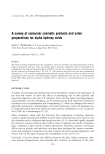
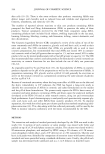
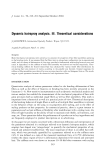
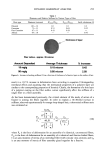
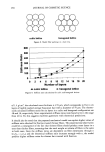
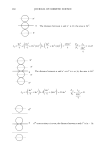
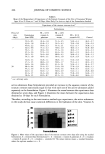
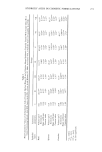
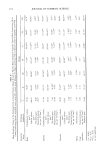
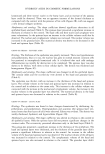
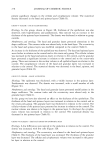
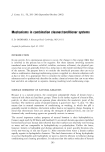
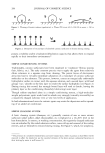
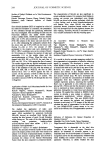
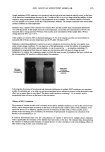
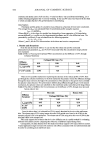
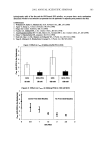
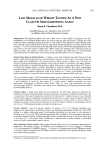
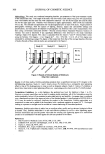
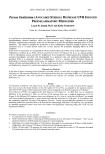
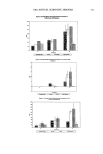
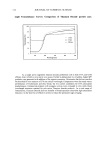
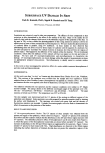
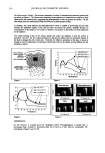
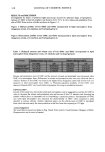
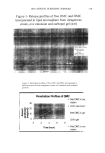
266 JOURNAL OF COSMETIC SCIENCE Table I. Mean of the Measurement of Capacitance of the Stratum Corneum of the Skin of Caucasian Women Ages 30 to 45 Years, at 7 and 30 Days, After Daily Use (twice a day) of the Formulation Studied Capacitance of the stratum corneum (a.u.) • Formulations Period of FB + 0.5% FB + 2.0% time Formulation vitamin A vitamin E FB + 0.1% (days) (base) (FB) palmitate acetate ceramide III Control 3O 59.4 + 0.5 41.6 + 1.8 51.4 + 4.5 54.0 + 3.3 46.2 + 2.7 43.8 + 1.8 63.8 + 2.3 56.2 + 4.3 70.0 + 2.8 32.6 + 2.9 45.8 + 2.2 50.4 + 2.3 55.4 + 2.1 62.2 + 3.7 36.8 + 1.1 62.6 + 4.4 75.2 + 2.3 70.0 + 2.9 48.6 + 1.5 43.8 + 0.8 56.2 + 1.3 49.4 ñ 3.6 55.2 + 1.6 46.6 + 1.7 42.4 + 3.3 45.2 + 2.6 57.0 + 1.9 61.6 + 2.6 66.2 _+ 1.9 36.2 + 2.3 50.2 + 2.3 56.4 + 4.8 48.8 + 4.3 58.0 + 2.3 36.8 + 1.3 54.2 + 1.8 49.4 + 3.1 50.4 + 1.8 62.4 + 3.9 42.4 + 1.5 52.8 + 3.3 33.8 + 1.1 38.8 + 1.3 53.6 + 1.8 36.6 + 1.5 37.2 + 1.5 48.6 _+ 1.9 50.0 + 1.7 55.2 + 3.1 40.2 + 2.5 44.8 + 1.6 39.0 x 2.1 61.4 + 2.1 52.6 + 1.1 41.6 + 2.7 60.4 + 4.4 52.4 + 2.5 51.0 + 2.0 57.0 + 3.9 42.6 + 1.3 44.2 + 3.6 51.4 + 3.0 37.8 + 1.6 45.0 + 3.5 32.6 + 1.1 42.6 + 1.1 54.0 + 1.2 50.6 + 2.9 54.4 + 1.l 26.8 + 0.8 43.4 + 1.7 43.4 + 3.8 48.2 + 1.6 55.8 + 2.9 34.8 + 1.5 50.4 + 1.5 42.0 _+ 0.7 45.2 + 1.3 53.0 + 4.6 38.6 + 1.1 t a.u.: arbitrary units. active substances (base formulation) provided an increase in the aqueous content of the stratum corneum statistically equal to that with each one of the active substances added separately to the formulation. Figure 1 illustrates the mean between the capacitance data obtained at seven days, and Figure 2 illustrates the mean between the capacitance data obtained at 30 days for each formulation. Therefore, according to the non-invasive method-type capacitance, the active substances in the study did not cause statistical differences in the hydration of the skin. Vitamin A .-. 80V• :5 6o •' 40 • 20 • 0 • T • T Formulations IE [] E+A : laE+E , alE+C ,, Ill Control Figure 1. Mean values of the capacitance data of the stratum corneum seven days after using the studied formulations. E = emulsion (base formulation) E + A = emulsion + vitamin A palmitate E + E = emulsion + vitamin E acetate E + C = emulsion + ceramide III. The values indicate means _+ standard deviation, where the replicate number is n = 8.

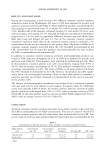
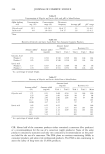
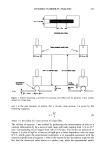
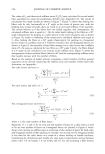
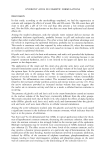
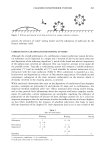
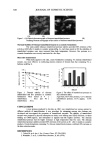
METHOD TO STUDY SKIN MOISTURIZERS 267 .-, 80[ 6o = 40 m 20 (J 0 Formulations mE [] E+A [] E+E [] E+C mControl Figure 2. Mean values of the capacitance data of the stratum corneum 30 days after using the studied formulations. E = emulsion (base formulation) E + A = emulsion + vitamin A palmitate E + E = emulsion + vitamin E acetate E + C = emulsion + ceramide III. The values indicate means _+ standard deviation, where the replicate number is n = 8. palmitate, vitamin E acetate, and ceramide III behaved in a statistically similar way, and the presence or not of these active substances in the base formulation presented no statistical difference for the hydration of the stratum corneum. Thus, the studied for- mulations at the concentrations and period analyzed were not effective in the hydration of the stratum corneum. The cosmetic raw material market has types of ceramides such as ceramide II and ceramide III in different concentrations. The suppliers suggest using ceramide II in concentrations between 0.2% and 1.0% and concentrations between 0.05% and 0.5% for ceramide III. Moreover, these can be prescribed by dermatologists in different con- centrations in agreement with the patient's need. The concentration of ceramide III of 0.1% was within the recommended amount, and was a balance between cost and benefit. In regard to the vitamin A palmitate, Maia Campos and collaborators observed an increase in the intra- and extracellular hydration in the deeper layers of the epidermis (7). However, the results of our study cannot be compared with those obtained by Maia Campos et al., because the capacitance method did not allow us to measure the vitamin A palmitate hydration properties on the skin surface. Likewise, the capacitance method was not appropriate to evaluate the expected moisturizing effort of the 2% vitamin E acetate, known for its beneficial hydration effects. Considering the hydration effects observed for the three active-enriched formulations, there were no differences from the formulation without it, suggesting that the concen- tration of moisturizing raw materials in the formulation used as a vehicle masked the moisturizing property of the vitamin A, vitamin E, and ceramide IIl when used at the concentrations evaluated. The non-invasive capacitance method was also utilized by L6den and Lindeberg (17) to evaluate the hydration effect of different topical formulations. They documented that the emulsions of interest increased the capacitance of the stratum corneum in a similar manner. AccoMing to them, the presence of different active ingredients (glycerine, pyrollidone carboxylic acid, and urea) does not significantly alter skin capacitance, thus suggesting that non-absorbed components influence the capacitance values. Therefore, electrical measurement, such as the capacitance method, used to evaluate skin moisture is not sufficiently appropriate to determine the effect of moisturizer cosmetic
Purchased for the exclusive use of nofirst nolast (unknown)
From: SCC Media Library & Resource Center (library.scconline.org)