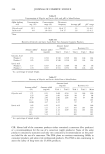
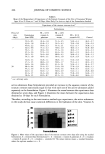
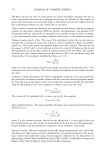
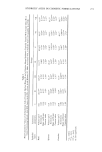
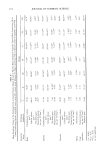
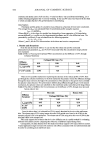
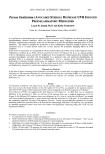
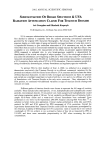
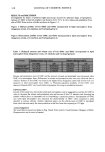
246 JOURNAL OF COSMETIC SCIENCE Table II Concentration of Glycolic and Lactic Acid, and pH, in Salon Products Alpha hydroxy Concentration Concentration Occurrence acid avg. (%) range (%) frequency Average pH • pH • range Glycolic acid Lactic acid 10.5 0.9-28.5 16 of 17 3.3 4.0 1.0-14.0 5 of 17 3.6 1.3•4.6 3.2•4.2 1Neat. Table III Recovery of GIycolic and Lactic Acids From Two Consumer Cosmetic Products Amount added I Amount added (%) (mg/ml) Amount found (mg/ml) Recovery (%) Trial 1 Trial 2 Trial 1 Trial 2 Mean GIycolic Acid Product 1 Product 2 Lactic acid Product 1 Product 2 1.53 0.523 0.546 0.539 104 104 104 1.65 0.523 0.548 0.536 105 103 104 1.57 0.537 0.525 0.504 98 94 96 1.70 0.537 0.531 0.552 99 103 101 • As a percentage of sample weight. Table IV Recovery of Glycolic and Lactic Acids From a Salon Product Amount found (mg/ml) Recovery (%) Amount added • Amount added (%) (mg/ml) Trial 1 Trial 2 Trial 1 Trial 2 Mean Glycolic acid Lactic acid 1.71 0.51 0.48 0.54 94 106 100 3.25 1.02 1.00 0.99 98 97 98 9.49 2.93 2.90 2.85 99 97 98 12.2 3.78 3.89 103 103 14.88 4.47 4.35 97 97 1.85 0.55 0.55 100 100 3.53 1.11 1.14 1.14 103 103 103 12.9 3.97 4.12 4.09 104 103 104 12.1 3.65 3.71 102 102 16.5 5.13 5.39 105 105 • As a percentage of sample weight. CIR. About half of the consumer products either contained a sunscreen (five products) or a recommendation for the use of a sunscreen (eight products). None of the salon products contained a sunscreen and only two contained a recommendation on the prod- uct label for the use of a sunscreen. The FDA plans to continue monitoring AHAs in consumer products and salon style professional products. The FDA is also continuing to assess the safety of long-term use of AHA products.

ALPHA HYDROXY ACIDS 247 REFERENCES (1) H. H. Roenigk, Jr., Dermabrasion: State of the art,J. Dermatol. Surg. Oncol., 11, 306-314 (1985). (2) H. Murad, A. T. Shamban, and P.S. Premo, "The Use of Glycolic Acid as a Peeling Agent," in Dermatologic Clinics, J. B. Pinski and K. S. Pinski, Eds. (W. B. Saunders, Philadelphia, 1995), Vol. 13, pp. 285-3O7. (3) I. Ghersetich, P. Teofoll, M. Gantcheva, M. Ribuffo, and P. Puddu, Chemical peeling: How, when, and why?J. Eur. Acad. Dermatol. Venereol., 8, 1-11 (1997). (4) W. P. Coleman III and H.J. Brody, "Advances in Chemical Peeling," in Dermatologic Clinics, J. H. Prystowsky, Ed. (W. B. Saunders, Philadelphia, 1997), Vol. 15, pp. 19-26. (5) R.K. Roenigk and D. G. Brodland, "Facial Chemical Peel," in Cosmetic Dermatology, R. Baran and H. I. Maibach, Eds. (Williams & Wilkins, Baltimore, 1994), pp. 439449. (6) R. G. Glogau and S. L. Matarasso, "Chemical Peels: Trichloroacetic Acid and Phenol," in Dermatologic Clinics, J. B. Pinski and K. S. Pinski, Eds. (W. B. Saunders, Philadelphia, 1995), Vol. 13, pp. 263- 276. (7) J. W. Slavin, Considerations in alpha hydroxy acid peels, Clinics Plastic Surg., 25, 45-52 (1998). (8) H. H. Roenigk, "Treatment of the Aging Face," in Dermatologic Clinics, J. B. Pinski and K. S. Pinski, Eds. (W. B. Saunders, Philadelphia, 1995), Vol. 13, pp. 245-261. (9) G.D. Monheit, "The Jessner's-Trichloroacetic Acid Peel: An Enhanced Medium-Depth Chemical Peel," in Dermatologic Clinics, J. B. Pinski and K. S. Pinski, Eds. (W. B. Saunders, Philadelphia, 1995), Vol. 13, pp. 277-283. (10) R.K. Roenigk and D.G. Brodland, "A Primer of Facial Chemical Peel," in Dermatologic Clinics, B. H. Thiers, Ed. (W. B. Saunders, Philadelphia, 1993), Vol. 11, pp. 349-359. (11) D. G. Brodland and R. K. Roenigk, Trichloroacetic acid chemexfoliation (chemical peel) for extensive premalignant actinic damage of the face and scalp, Mayo Clinic Proceedings, 63, 887-896 (1988). (12) E.J. Van Scott and R.J. Yu, Control of keratinization with alpha hydroxy acids and related com- pounds. I. Topical treatment of ichthyotic disorders, Arch. Dermatol., 110, 586-590 (1974). (13) E.J. Van Scott and R.J. Yu, "Substances That Modify the Stratum Comeurn by Modifying its Formation," in Principles of Cosmetics for the Dermatologist, P. Frost and S.N. Horwitz, Eds. (C. V. Mosby, St. Louis, 1972), pp. 70-74. (14) D.A. Davis, Alpha hydroxy acid-based cosmetics: Pace-setter in skin care, Drug Cosmet. Ind., 30-34 (January 1995). (15) S. Sargisson, The AHA phenomenon, Drug Cosmet. Ind., 24-30 (January 1994). (16) M.J. Stiller, J. Bartolone, R. Stern, S. Smith, N. Kollias, R. Gillies, and L. A. Drake, Topical 8% glycolic acid and 8% L-lactic acid creams for the treatment of photodamaged skin, Arch. Dermatol., 132, 631-636 (1996). (17) W. Smith, Stratum corneum barrier integrity controls skin homeostasis, Int. J. Cosmet. Sci., 21, 99-106 (1999). (18) H. L. Hood, M. E. K. Kraeling, M. G. Robl, and R. L. Bronaugh, The effects of an alpha hydroxy acid (glycolic acid) on hairless guinea pig skin permeability, Food Chem. Toxicol., 37, 1105-1111 (1999). (19) E. Berardesca, F. Distante, G. P. Vignoli, C. Oresajo, and B. Green, Alpha hydroxyacids modulate stratum corneum barrier function, Br. J. Dermatol., 137, 934-938 (1997). (20) W. Bergfeld, R. Tung, A. Vidimos, L. Vellanki, B. Remzi, and U. Stanton-Hicks, Improving the cosmetic appearance of photoaged skin with glycolic acid, J. Am. Acad. Dermatol., 36, 1011-1013 (1997). (21) M. Fartasch, J. Teal, and G. K. Menon, Mode of action of glycolic acid on human stratum corneum: Ultrastructural and functional evaluation of the epidermal barrier, Arch. Dermatol. Res., 289, 404-409 (1997). (22) E.J. Van Scott and R.J. Yu, Hyperkeratinization, corneocyte cohesion, and alpha hydroxy acids, J. Am. Acad. Dermatol., 11,867-879 (1984). (23) P. Perigini, I. Genta, F. Pavanetto, B. Conti, S. Scalia, and A. Baruffini, Study on glycolic acid delivery by liposomes and microspheres, Int. J. Pharm., 196, 51-61 (2000). (24) M.P. Bousquet, R. M. Willemot, P. Monsan, and E. Boures, Enzymatic synthesis of AHA derivatives for cosmetic application, J. Molec. Catalysis, 5, 49-53 (1998). (25) E. M. Jackson, AHA-type products proliferate in 1993, Cosmet. Dermatol., 6, 22-26 (1993). (26) B. A. Gilchrest, A review of skin aging and its medical therapy, Br.J. Dermatol., 135,867-875 (1996). (27) V. DeBenedette and Y. Appa, A six month clinical study to evaluate the long-term efficacy and safety of an AHA lotion, Cosmet. Dermatol., 9, 33-40 (1996).
Purchased for the exclusive use of nofirst nolast (unknown)
From: SCC Media Library & Resource Center (library.scconline.org)