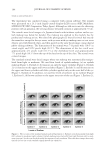
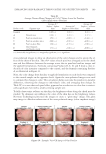
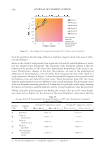
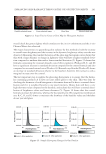
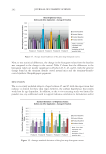
JOURNAL OF COSMETIC SCIENCE 162 perceived differently from real in terms of shape and/or size, then that can also be consid- ered a visual illusion. A good example is eye makeup that causes the eyes to appear larger than they really are. Although many previous psychological studies have investigated the impact of makeup on facial impressions (e.g., 2,9,10,15–18) and on gaze direction (19), virtually nothing is known about the illusory aspect of makeup. However, for at least three reasons, the eye size illusion induced by eye makeup merits scientifi c investigation. First, eyes are an important determinant of facial attractiveness. Previous facial identifi ca- tion experiments showed that information about the eye and eyebrow regions of facial stimuli was most clearly linked to observers’ ability to discriminate those faces (20–22). Moreover, large eyes are viewed as more attractive than small eyes. For example, Baudouin and Tiberghien (7) showed that wider eyes make female faces more attractive (also 23,24). Altering perception of eyes can cause a dramatic change in the overall facial impression, and most women emphasize their eyes above other features when applying makeup (25). Mulhern et al. (17) found that eye makeup is one of the most signifi cant contributors to the enhancement of female facial attractiveness. Second, although many makeup artists claim that eye makeup can make the eyes appear larger than they really are (e.g., 26–29), this claim has not yet been quantitatively dem- onstrated. One purpose of eye makeup is to make small eyes appear larger (e.g., 28–30). In fact, eye-enlarging makeup techniques are hugely popular among young Japanese women these days. However, so far, the effectiveness of these techniques has been sup- ported only by makeup artists’ experiences and subjective impressions. No scientifi c study has investigated such effects. The eye size illusion induced by eye makeup has yet to be quantitatively measured. Third, if experiments demonstrate to what extent eye makeup increases the perceived eye size, there are a number of practical implications. For example, quantitative as- sessment of eye makeup may facilitate comparing/evaluating different items of cos- metics and proposing effective makeup techniques to consumers. Quantitative assessment can also help develop new cosmetic products that are more effective in making eyes appear larger. Furthermore, including numeric data in advertising ren- ders more objectivity and credibility to an advertisement, thus increasing its appeal to consumers. Psychophysics is a branch of perceptual psychology and vision science. It specializes in quantitatively measuring the perceived intensity or quantity of stimuli as a function of the physical intensity or quantity of the stimuli. Psychophysical methods are particularly useful for measuring the magnitude of visual illusions. If eyes appear larger than they re- ally are as a result of eye makeup, it is a kind of illusion. Therefore, the effects of the makeup can be measured by psychophysical methods (31,32). One such psychophysical method is called the staircase method, also known as the up- and-down method. To measure visual illusions induced by eye makeup, we used a variant of the staircase method in which two faces are presented in each trial. An observer judges, which face appears to have larger eyes. One face is a standard stimulus with eye makeup, whereas the other is a comparison stimulus without eye makeup. If the observer judges that the comparison stimulus has larger eyes, then on the next trial, the comparison stimulus is replaced with another comparison stimulus. This comparison stimulus has eyes one step smaller than the previous eyes, and the same process is then repeated. When

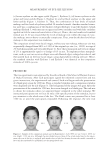
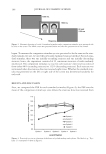
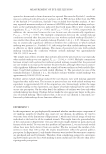
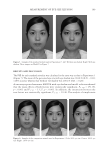
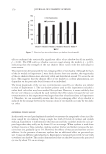
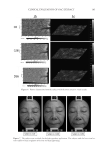
MEASUREMENT OF EYE SIZE ILLUSION 163 the observer judges that the standard stimulus eyes are larger, the staircase direction re- verses and on the next trial, the comparison stimulus is replaced with another comparison stimulus having eyes one step larger than the previous eyes, and the same process is then repeated. If the observer judges that the comparison stimulus eyes are larger, this triggers another reversal. When this procedure is repeated, the comparison stimulus eye size oscil- lates around the perceived eye size of the standard stimulus. The comparison stimulus eye size perceived as equal to the standard stimulus eye size is called the point of subjective equality (PSE). The PSE can be calculated as the average of the eye size values where the staircase direction is reversed from upward to downward or vice versa. Using this method, we can measure the actual size of eyes without makeup that are perceived to be the same as those with makeup. Eye makeup is mainly composed of eyeliner, mascara, and eye shadow, which work in concert to defi ne and enhance the eyes. Eyeliner surrounds, reshapes, and accentuates the palpebral fi ssure. Mascara elongates, thickens, and darkens eyelashes this is said to make the eyes appear larger and brighter. Applied to the eyelids or the skin around the eyes, eye shadow is a colored cosmetic that increases the eyes’ prominence. Makeup artists claim that eye makeup can cause the eyes to be perceived as larger has not been quantita- tively substantiated. This study examines whether eyeliner, mascara, and eye shadow actually induce an assimilative illusion of larger eye size, and if so, to what degree eye size is overestimated. EXPERIMENT 1 In this experiment, we measured the perceived eye size of facial images with various degrees of eyeliner and eyelash makeup (i.e., mascara and false eyelashes), using the experimental paradigm originally developed for studying visual illusions. If eyeliner and eyelash makeup assimilate the eye, the eye with makeup should appear larger than it really is. We used the staircase method to measure the PSE. This method uses two groups of stimuli: standard stimuli and comparison stimuli. Standard stimuli are the objects to be measured. In this experiment, the standard stimuli are images of faces with eye makeup, whereas comparison stimuli serve as a “ruler” or “scale.” In this experiment, the comparison stimuli are images of faces without eye makeup, where eye size is sys- tematically varied. The staircase method is an algorithm that seeks the quantity among the comparison stimuli that is perceived as equivalent to the quantity in a standard stimulus. METHOD PARTICIPANTS Twenty-two undergraduate students (mean age 21.50 years, S.D. = 0.84 8 males and 14 females) voluntarily participated in this experiment. All reported normal or corrected-to- normal visual acuity and normal color vision. All participants were unaware of the purpose of the experiment.
Purchased for the exclusive use of nofirst nolast (unknown)
From: SCC Media Library & Resource Center (library.scconline.org)