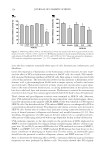
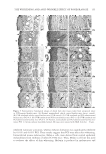
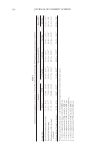
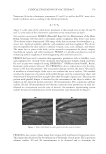
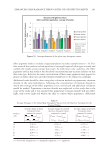
MEASUREMENT OF EYE SIZE ILLUSION 173 perceived eye size was overestimated by about 6% (13% in area) with eyeliner and/or mascara, and about 5% with eye shadow. We concluded that eye makeup causes eye size illusions because of perceptual assimilation and that our experimental paradigm can quantitatively measure these perceptual illusions. ACKNOWLEDGEMENTS This study was supported by a JSPS KAKENHI Grant (number 22530795) to Kazunori Morikawa and a grant from Shiseido Co., Ltd to Kazunori Morikawa. We thank Mamiko Sera for her help in creating the stimuli and collecting the data for Experiment 1. REFERENCES (1) A. Porcheron, E. Mauger, and R. Russell, Aspects of facial contrast decrease with age and are cues for age perception, PLoS One, 8, e57985 (2013). (2) R. Nash, G. Fieldman, T. Hussey, J. L. Leveque, and P. Pineau, Cosmetics: They infl uence more than Caucasian female facial attractiveness, J. Appl. Soci. Psychol., 36, 493–504 (2006). (3) C. L. Cox and W. H. Glick, Resume evaluations and cosmetic use: When more is not better, Sex Roles, 14, 51–58 (1986). (4) N. Guéguen and C. Jacob, Enhanced female attractiveness with use of cosmetics and male tipping be- havior in restaurants, J. Cosmet. Sci., 62, 283–290 (2011). (5) R. Russell, A sex difference in facial contrast and its exaggeration by cosmetics, Perception., 38, 2011– 1219 (2009). (6) J. E. Workman and K. K. P. Johnson, The role of cosmetics in impression formation, Cloth. Text. Res. J., 10, 63–67 (1991). (7) J. Y. Baudouin and G. Tiberghien, Symmetry, averageness, and feature size in the facial attractiveness of women, Acta Psychol., 117, 313–332 (2004). (8) G. Rhodes, A. Sumich, and G. Byatt, Are average facial confi gurations only attractive because of their symmetry? Psychol. Sci., 10, 52–58 (1999). (9) J. A. Graham and A. J. Jouhar, The effects of cosmetics on person perception, Int. J. Cosmet. Sci., 3, 199–210 (1981). (10) N. L. Etcoff, S. Stock, L. E. Haley, S. A. Vickery, and D. M. House, Cosmetics as a feature of the ex- tended human phenotype: Modulation of the perception of biologically important facial signals, PLoS One., 6, e25656 (2011). (11) K. Aucoin, Making Faces. (Little Brown & Co, New York, 1999). (12) J. Cohen, Vogue Make-up (Carlton Books Ltd, London, 2007). (13) T. Goto, I. Uchiyama, A. Imai, S. Takahashi, T. Hanari, S. Nakamura, and H. Kobari, Assimilation and contrast in optical illusions, Jpn. Psychol. Res., 49, 33–44 (2007). (14) T. Oyama, The effect of hue and brightness on the size-illusion of concentric circles, Am. J. Psychol., 75, 45–55 (1962). (15) T. F. Cash, K. Dawson, P. Davis, M. Bowen, and C. Galumbeck, Effects of cosmetics use on the physical attractiveness and body image of American college women, J. Soc. Psychol., 129, 349–355 (1989). (16) R. Korichi, D. Pelle-De-Queral, G. Gazano, and A. Aubert, Why women use makeup: Implication of psychological traits in makeup functions, J. Cosmet. Sci., 59, 127–137 (2008). (17) R. Mulhern, G. Fieldman, T. Hussey, J. L. Lévêque, and P. Pineau, Do cosmetics enhance female Cauca- sian facial attractiveness? Int. J. Cosmet. Sci., 25, 199–205 (2003). (18) S. Ueda and T. Koyama, Infl uence of eye make-up on facial recognition, Perception., 39, 260–264 (2010). (19) S. Ueda and T. Koyama, Infl uence of eye make-up on the perception of gaze direction, Int. J. Cosmet. Sci., 33, 514–518 (2011). (20) F. Gosselin and P. G. Schyns, Bubbles: a technique to reveal the use of information in recognition tasks, Vision Res., 41, 2261–2271 (2001). (21) M. Nagai, P. J. Bennett, M. D. Rutherford, C. M. Gaspar, T. Kumada, and A. B. Sekuler, Compar- ing face processing strategies between typically-developed observers and observers with autism

JOURNAL OF COSMETIC SCIENCE 174 using sub-sampled-pixels presentation in response classifi cation technique, Vision Res., 79, 27–35 (2013). (22) A. B. Sekuler, C. M. Gaspar, J. M. Gold, and P. J. Bennett, Inversion leads to quantitative, not qualita- tive, changes in face processing, Curr. Biol., 14, 391–396 (2004). (23) S. Geldart, D. Maurer, and K. Carney, Effects of eye size on adults’ aesthetic ratings of faces and 5-month-olds’ looking times, Perception., 28, 361–374 (1999). (24) M. Gründl, S. Klein, R. Horczakiwskyj, D. Feser, M. Jung, M. Eisenmann-Klein, and L. Prantl, The “jaguar’s eye” as a new beauty trend? Age-related effects in judging the attractiveness of the oblique eye axis, Aesthetic Plast. Surg., 32, 915–919 (2008). (25) B. Meredith, Vogue Body and Beauty Book, (Penguin Books, New York, 1980), p. 210. (26) S. Barns, About Face: Amazing Transformations Using the Secrets of the Top Celebrity Makeup Artist (Fair Winds Press, Beverly, MA, 2011). (27) J. Kidd, Make-Up Secrets: Solutions to Every Woman’s Beauty Issues and Make-Up Dilemmas (St. Martin’s Press, London, 2012). (28) T. Chang-Babaian, Asian Faces: The Essential Beauty and Makeup Guide for Asian Women, (Perigee Trade, New York, 2007). (29) R. Morris, Makeup: The Ultimate Guide, (Allen & Unwin, Crows Nest, New South Wales, 2008). (30) J. Price and P. Booth, Making Faces (Michael Joseph Ltd., London, 1980), p. 111. (31) K. Morikawa, New directions in research on visual illusions of shape and size related to the human face and body: Illusions caused by makeup and clothing, Jpn. Psychol. Rev., 55, 348–361 (2012) (in Japanese with an English abstract). (32) K. Morikawa, “Geometric illusions in the human face and body,” in Oxford Compendium of Visual Illu- sions, A. Shaprio and D. Todorovic, Eds. (Oxford University Press, New York, 2015, in press). (33) D. J. Weintraub and M. K. Schneck, Fragments of Delboeuf and Ebbinghaus illusions: Contour/context explorations of misjudged circle size. Percept. Psychophys., 40, 147–158 (1986). (34) A. Schwaninger, S. Ryf, and F. Hofer, Confi gural information is processed differently in perception and recognition of faces. Vision Res., 43, 1501–1505 (2003). (35) W. S. Xiao, G. Fu, P. C. Quinn, Y.-H. Sun, N. Xiao, Q. Wang, G. Chen, O. Pascalis, F. Damon, and K. Lee, The eye-size illusion: Psychophysical characteristics, generality, and relation to holistic face pro- cessing, Perception, 43, 265–274 (2014). (36) T. Abe, C. Sato, and M. Endo, Effect of eye shadow on eye size perception: An experimental examination manipulating the position, area and darkness of eye shadow. J. Jpn. Acad. Facial Stud., 9, 111–118 (2009) (in Japanese with an English abstract). (37) S. Matsushita, K. Morikawa, S. Mitsuzane, and H. Yamanami, Eye shape illusions induced by eyebrow positions, Perception (in press). (38) K. Morikawa, S. Matsushita, A. Tomita, and H. Yamanami, A real-life illusion of assimilation in the human face: Eye size illusion caused by eyebrows and eye shadow, Front. Hum. Neurosci., 9:139 (2015). (39) K. Morikawa, An application of the Müller-Lyer Illusion, Perception., 32, 121–123 (2003). (40) R. Russell, “Why cosmetics work,” in The Science of Social Vision, R. B. Adams, N. Ambady, K. Nakayama, and S. Shimojo, Eds. (Oxford University Press, New York, 2010), pp. 186-203.
Purchased for the exclusive use of nofirst nolast (unknown)
From: SCC Media Library & Resource Center (library.scconline.org)