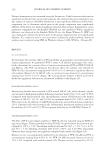
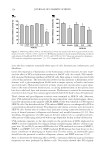
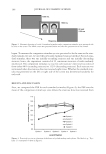
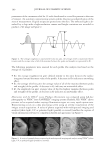
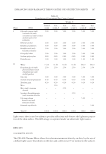
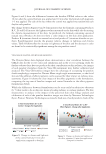
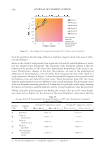
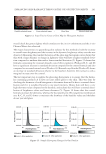
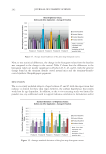
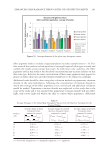
MEASUREMENT OF EYE SIZE ILLUSION 163 the observer judges that the standard stimulus eyes are larger, the staircase direction re- verses and on the next trial, the comparison stimulus is replaced with another comparison stimulus having eyes one step larger than the previous eyes, and the same process is then repeated. If the observer judges that the comparison stimulus eyes are larger, this triggers another reversal. When this procedure is repeated, the comparison stimulus eye size oscil- lates around the perceived eye size of the standard stimulus. The comparison stimulus eye size perceived as equal to the standard stimulus eye size is called the point of subjective equality (PSE). The PSE can be calculated as the average of the eye size values where the staircase direction is reversed from upward to downward or vice versa. Using this method, we can measure the actual size of eyes without makeup that are perceived to be the same as those with makeup. Eye makeup is mainly composed of eyeliner, mascara, and eye shadow, which work in concert to defi ne and enhance the eyes. Eyeliner surrounds, reshapes, and accentuates the palpebral fi ssure. Mascara elongates, thickens, and darkens eyelashes this is said to make the eyes appear larger and brighter. Applied to the eyelids or the skin around the eyes, eye shadow is a colored cosmetic that increases the eyes’ prominence. Makeup artists claim that eye makeup can cause the eyes to be perceived as larger has not been quantita- tively substantiated. This study examines whether eyeliner, mascara, and eye shadow actually induce an assimilative illusion of larger eye size, and if so, to what degree eye size is overestimated. EXPERIMENT 1 In this experiment, we measured the perceived eye size of facial images with various degrees of eyeliner and eyelash makeup (i.e., mascara and false eyelashes), using the experimental paradigm originally developed for studying visual illusions. If eyeliner and eyelash makeup assimilate the eye, the eye with makeup should appear larger than it really is. We used the staircase method to measure the PSE. This method uses two groups of stimuli: standard stimuli and comparison stimuli. Standard stimuli are the objects to be measured. In this experiment, the standard stimuli are images of faces with eye makeup, whereas comparison stimuli serve as a “ruler” or “scale.” In this experiment, the comparison stimuli are images of faces without eye makeup, where eye size is sys- tematically varied. The staircase method is an algorithm that seeks the quantity among the comparison stimuli that is perceived as equivalent to the quantity in a standard stimulus. METHOD PARTICIPANTS Twenty-two undergraduate students (mean age 21.50 years, S.D. = 0.84 8 males and 14 females) voluntarily participated in this experiment. All reported normal or corrected-to- normal visual acuity and normal color vision. All participants were unaware of the purpose of the experiment.

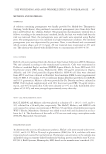
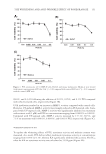
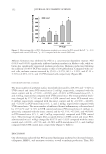
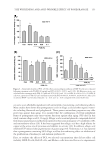
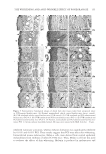
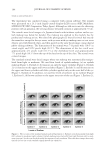
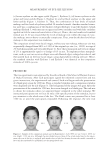
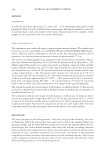
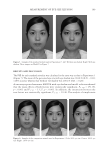
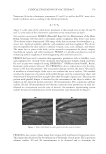
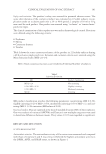
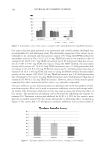
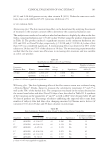
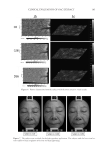
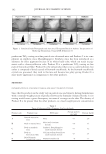
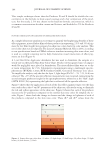
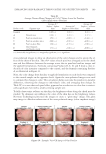
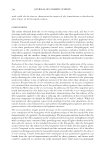
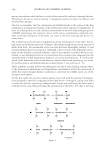
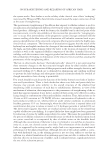
JOURNAL OF COSMETIC SCIENCE 164 STIMULI AND APPARATUS The experiment was conducted using a computer with custom software. The stimuli were presented on a 24.1-inch liquid-crystal-display (LCD) screen (NEC MultiSync LCDPA241W, NEC Corporation, Tokyo Japan). Although we did not secure the observing position with an apparatus, the viewing distance remained constant at approximately 70 cm. The stimuli were facial images of a Japanese female with/without eyeliner and/or eye- lash makeup (see below for details). Eye makeup was applied to the model’s face by professional makeup artists. We edited the photographs so that all stimuli had exactly the same face except for the eye areas each eye area with eye makeup was cut out as an elliptic area with blurred edges, and then pasted on the same facial image, using digital photo editing software. The dimensions of the stimuli were 744 pixels wide (16.0° in visual angle) and 1052 pixels high (22.1°). The dimensions of the face itself were approximately 471 pixels wide (10.3°) at the cheekbone level and approximately 771 pixels high (16.5°) from the top of the head to the tip of the chin. The stimuli were colored images. The standard stimuli were facial images whose eye makeup was systematically manipu- lated from light to moderate. We used four levels of eyelash makeup: (a) no eyelash makeup (Figure 1, Eyelash 1) (b) mascara on only the upper eyelashes (Figure 1, Eyelash 2) (c) mascara on the upper and lower eyelashes (Figure 1, Eyelash 3) and (d) mascara on the upper and lower eyelashes with false eyelashes applied only on the outer half of the eye (Figure 1, Eyelash 4). In addition, we used fi ve levels of eyeliner: (a) no eyeliner (Figure 1, Eyeliner 1) (b) brown eyeliner on the upper inner rim of the eye (Figure 1, Eyeliner 2) Figure 1. The eye areas of the standard stimuli used in Experiment 1. Eyeliner varies horizontally from light (left column) to moderate (right column). Eyelash makeup varies vertically from light (bottom row) to mod- erate (top row). See the text for the detailed descriptions of each condition. Note that these images show only the left eye but the actual standard stimuli showed the whole face.
Purchased for the exclusive use of nofirst nolast (unknown)
From: SCC Media Library & Resource Center (library.scconline.org)