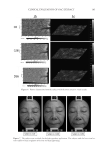
MEASUREMENT OF EYE SIZE ILLUSION 171 Why does eyeliner have no effect on the perceived eye size when mascara is also applied? One possible reason is that eyeliner and mascara share the same space. The eyeliner used in Experiment 1 was thin to moderate. Therefore, when the eyelashes were thickened with mascara, the roots of the eyelashes may have become dark enough to overshadow the eyeliner. Had the eyeliner been thicker, it might have strengthened the eye size illusion caused by mascara. The eye size illusion caused by eyeliner and mascara is likely an illusion of assimilation in which the eye becomes assimilated with eyeliner and mascara. This mechanism seems similar to that of the Delboeuf illusion where the size of the inner circle appears larger than it really is when placed within a somewhat larger outer circle, due to the assimila- tion of the inner circle with the outer circle. The Delboeuf illusion arises even when the outer circle is incomplete (33). In this experiment, the contour of the palpebral fi ssure corresponds to the inner circle, and eyeliner and mascara correspond to the outer circle. There have been reports that face perception is subject to various geometric illusions (31,32,34,35). Many makeup artists believe that one purpose of eye shadow is to add depth to the eyes. The experiment by Abe et al. (36) showed that eye shadow enhances perceived depth and size of the eyes, although they did not measure the illusion’s absolute magnitude. These researchers argued that an increase in subjective distance between the observer and the eyes leads to an overestimation of eye size because of constancy scaling. Constancy scaling implies that the perceived size of an object increases as its perceived distance from the observer increases, even when the actual distance and size of the retinal image generated by the object remain the same. However, the magnitudes of the eye size illusion induced by eye shadow in Experiment 2 are far too large to be explained by constancy scaling. To induce a 4.8% overestimation of eye size at a viewing distance of 75 cm by constancy scaling alone, the eyes would have to be perceived as being 3.6 cm deep in the head this is anatomically impossible. Therefore, we conclude that eye shadow induces effects be- yond merely enhancing the eyes’ depth, such as an illusion of assimilation. What is the mechanism of the eye shadow illusion? Does eye shadow make the eyes ap- pear larger because the eyes are directly assimilated into eye shadow, or because eye shadow enhances the assimilation of the eyes into the eyebrows? Typical eye shadow is darkest along the sharp boundary of the upper eyelid, and gradates to the skin tone to- ward the eyebrow. Possibly then, the eye is assimilated with eye shadow in much the same way as with eyeliner and mascara, which may induce an overestimation of eye size. An- other possibility is that eye shadow enhances the perceptual grouping of the eye and the eyebrow by reducing the difference in luminance between the eyebrow and the skin be- low. The eyebrow alone causes an overestimation of eye size due to a mechanism like the Delboeuf illusion (37,38). Eye shadow possibly bridges the space between the eye and the eyebrow, thereby increasing the assimilation of the eye into the eyebrow. It might be that the eye shadow effect involves both the assimilation of the eye into eye shadow and enhancement of the assimilation of the eye into the eyebrow. Further research is neces- sary to elucidate the exact mechanism by which eye shadow causes the eye to appear larger. Another unresolved issue is whether the illusion caused by eyeliner and mascara and that caused by eye shadow is additive. One limitation of this study is that we did not combine eye shadow with eyeliner or mascara. Eye shadow does not share the same space as eyeliner

JOURNAL OF COSMETIC SCIENCE 172 and mascara. Thus, a possibility remains that application of eye shadow further enhances the eye size illusion caused by eyeliner and mascara. Future research should examine this aspect. Morikawa (31,32) suggested that illusions in the human face and body tend toward as- similation, rather than contrast. One reason for the predominance of assimilative illusions might be that spaces between facial parts or between body parts are fi lled with and con- nected to tissues such as skin, muscles, and bones, unlike the empty spaces between the lines that constitute classical geometric illusions (32). Moreover, the development of dif- ferent parts of an individual’s body is often governed and controlled by the same genetic and hormonal mechanisms. Therefore, if an individual’s eyebrows are drooping, his or her eyes are likely to droop as well. If one part of the body is thin, other parts are also likely to be thin (31,32). We hypothesize that visual perception is affected by these biological co-occurrences and natural correlations. Morikawa (31,32) also observed that, when geometric illusions in the human face and body are psychophysically measured, the maximum illusion magnitudes tend to be around 5%, a sort of a “magic number.” That is exactly what these experiments repli- cated. An illusion magnitude of 5% is small, as compared to well-known geometric illu- sions. Perhaps there exists a natural upper limit to visual illusions in the human face so that the illusions occur only to the extent that the resulting distortions do not appear unnatural. Notably, although a difference of 5% may be numerically small, the difference is perceptually conspicuous, perhaps because the human visual system is especially tuned to detecting fi ne differences in the human face. Identifying and recognizing faces is an extremely important skill in society. We are so sensitive to the confi guration of facial features that we can reliably perceive even a physically small difference (31,32). Historically, most researchers have studied visual illusions with very little relevance to or- dinary life. Most visual illusion stimuli have been highly contrived and unnatural fi gures created artifi cially in laboratories. The human visual system seldom encounters such stimuli in the natural environment or in daily life. However, illusions in natural objects, albeit much less dramatic than artifi cial ones, are far more prevalent in our daily lives than we may think. In fact, some illusions can be very relevant and useful in everyday life (31,32,39). This study investigated visual illusions in the human face, the most natural and socially important stimulus. The results indicated that one mechanism by which cosmetics and makeup alter facial appearances is by inducing visual illusions. Our results demonstrated that cosmetic illusions can be quantitatively measured using psychophysical methods. Russell (40) stated, “Though cosmetics are applied to the face of the wearer, they are de- signed to operate on the visual system of the perceiver.” Because the human visual system judges what is beautiful or attractive, we have to investigate cosmetics and makeup in terms of the perceiver’s visual system. Therefore, research on visual perception can be an important part of cosmetic science. We believe that measurement and analysis of cos- metic illusions will become a new and fruitful fi eld of cosmetic research in the future. CONCLUSIONS Our experiments examined whether eyes with makeup—eyeliner, mascara, and eye shadow—are perceived to be larger than they really are. To this end, we applied an ex- perimental paradigm used in visual illusion studies. Measurements revealed that
Purchased for the exclusive use of nofirst nolast (unknown)
From: SCC Media Library & Resource Center (library.scconline.org)