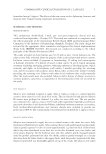
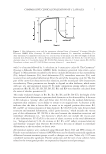
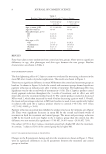
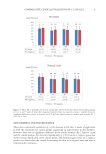
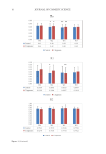
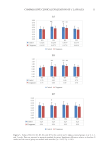
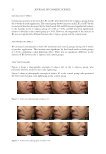
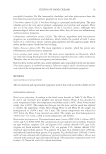
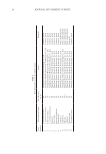
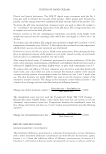
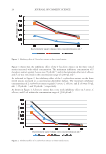
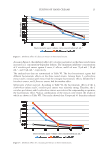
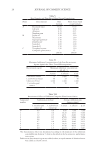
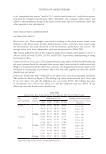
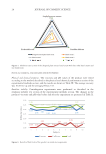
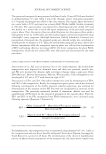
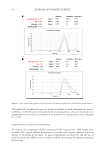
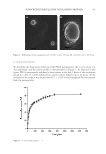
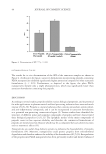
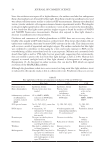
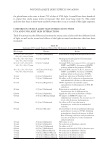
28 JOURNAL OF COSMETIC SCIENCE PHYSICAL, CHEMICAL, AND EMULSIFICATION PROPERTIES Physical and chemical properties. The viscosity and pH values of the product were tested according to the method described in the physical and chemical performance section of the experimental methods section, and the results are shown in Table IX. The average viscosity was 10,307.22 cp and the average pH was 7.53. Emulsion stability. Centrifugation experiments were performed as described in the emulsion stability test section of the experimental methods section. The changes in the products’ viscosity and pH value before and after the experiment are presented in Table X. Figure 5. Inhibition rate (2 min) of the designed plant extract hand cream with four other hand creams and one disinfectant. 3.07 2.95 3.01 2.93 2.92 3.18 3.15 3.20 2.96 3.14 2.04 2.03 2.23 2.07 2.06 2.21 2.14 2.29 2.01 2.17 3.28 3.12 3.14 3.11 3.15 3.14 3.12 3.09 3.28 3.07 2.00 2.25 2.50 2.75 3.00 3.25 3.50 1 2 3 4 5 6 7 8 9 10 Subjects S aureus C albicans E coli Figure 6. Results of field trials of the product on tested microorganisms. Killing log values

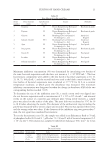
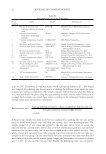
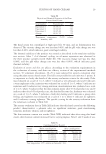
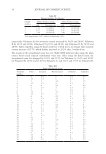
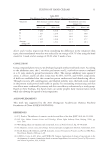
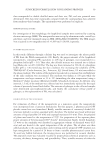
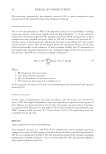
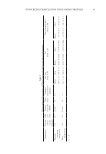
29 TESTING OF HAND CREAMS The hand cream was centrifuged at high speed for 30 min, and no delamination was observed. The viscosity change rate was less than 0.61%, and the pH value change rate was less than 0.40%, which indicates good centrifugal stability. The thermal stability of the product was tested as described in the emulsion stability test section. After 7 d of thermal cycling, no oil-water separation was observed in the three product samples tested (Table XI). The viscosity change rate was less than 0.08%, and the pH value change rate was less than 0.80%, which indicates good thermal stability. Evaluation of sensory and skin care efficacy. According to the evaluation requirements in the evaluation of sensory and skin care efficacy section of the experimental methods section, 30 volunteers (classmates, 20–25 y) were selected for sensory evaluation after using the plant extract hand cream. The full score possible for each item was 5 points. It is important to clarify the details of the sensory evaluation criteria for this study. Odor was evaluated on a scale of 1 to 5, where 5 indicates a very pleasant odor and 0 indicates a very unpleasant odor irritation was evaluated on a scale of 1 to 5, where 5 indicates no irritation and 0 indicates very strong irritation moisturization was evaluated on a scale of 1 to 5, where 5 indicates that the skin remains moist after 0.5 h of product use and 0 indicates that after 0.5 h of product use, the skin had become dry freshness was evaluated on a scale of 1 to 5, where 5 indicates a fresh skin feeling and 0 indicates a greasy skin feeling and tightness was evaluated on a scale of 1 to 5, where 5 indicates no tightness and 0 indicates a strong tightness. The specific scoring for the sensory evaluation from the volunteers is shown in Table XII. The sensory evaluation data in Table XII indicates that this hand cream has the following product characteristics: a pleasant odor, no significant irritation, good moisturizing sensation, moderate oiliness, and no tightness. The skin moisture content test results (Table XIII) indicated that after using this hand cream, skin moisture content increased, but to varying degrees. After 1 and 2 weeks of use, Table IX Physical and Chemical Properties of the Plant Extract Hand Cream Serial number Viscosity (cp) pHa Experiment 1 10,306.11 7.44 Experiment 2 10,309.65 7.61 Experiment 3 10,305.90 7.54 Average 10,307.22 7.53 a Experiment temperature: 25.3°C, relative humidity: 46%. Table X Centrifugation Test Resultsa Sample number Before centrifugation After centrifugation pH Viscosity (cp) pH Viscosity (cp) 1 7.44 10,306.11 7.42 10,351.14 2 7.61 10,309.65 7.59 10,372.45 3 7.54 10,305.90 7.51 10,366.40 a Test temperature: 25°C, relative air humidity: 46%.
Purchased for the exclusive use of nofirst nolast (unknown)
From: SCC Media Library & Resource Center (library.scconline.org)