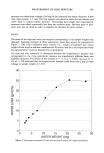
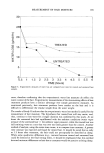
j. Soc. Cosmet. Chem., 43, 179-186 (May/June 1992) Application of electrical hygrometric measures to the evaluation of hair moisturizing products RONALD DROZDENKO, CURT WEINSTEIN, and SIDNEY WEINSTEIN, Pharmaceutical and Cosmetic Evaluations, 36 Mill Plain Road, Danbury, CT 06811 (R.D., C.W.), Western Connecticut State University, Danbury, CT 06811 (R.D.), and NeuroCommunication Research Laboratories, Inc., Danbury, CT 06811 (s.w.). Received June 28, 1992. Synopsis The moisture content of hair can be measured with electrical hygrometric methods (evaporimetry) under conditions of ambient relative humidity and temperature. While measures of absolute water content of hair are restricted by a number of factors, relative measures of the efficacy of hair moisturizers can be obtained under conditions that simulate consumer usage. The application of evaporimetrics is validated against simple hair-sample gravimetrics, and the time course of water loss for treated and untreated hair samples is presented. INTRODUCTION Several currently marketed products purport to moisturize the hair. These products contain ingredients that have moisturizing properties when applied to the skin (e.g., fatty acids), which has led to the speculation that the action of these ingredients on the hair is similarly moisturizing. However, a review of the recent literature found no studies specifically designed to measure hair moisture. Electrical measurements, such as conductance, have been used extensively to measure the moisturizing properties of skin care products. These measures have been validated as measuring the water content of the stratum corneum (1). Several factors, however, that distinguish skin and hair are relevant to applying the methods of measuring skin moisture to hair moisture. The stratum corneum is hydrated by both an "active" eccrine sweat gland mechanism and by "passive" diffusion through the epidermis (2). The physiological system subserving these hydration mechanisms has access to an essentially unending reservoir of water. Conversely, hair hydration is only passive and limited. Hair can absorb a finite volume of water under certain atmospheric conditions or by direct application of water. Addi- tionally, the possibility that moisture may be trapped in the cortex of the hair by an 179

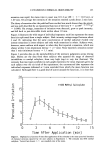
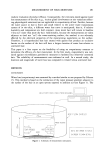
180 JOURNAL OF THE SOCIETY OF COSMETIC CHEMISTS occlusive ingredient cannot be ruled out, because of the structure of the hair cuticle and passive water transport. Hair is dielectrically anisotropic at its surface, that is, polarity of charge is relative to the position of a single fiber relative to a group of hairs (3). This factor may affect the validity of electrical measures. The surface contact area of mea- surement probes also seems to be more critical for hair than for skin, since hair strands are predominately independent conductors while the skin surface is an integrated con- ductor. Because of these potential difficulties with measuring hair moisture electrically, other potential measures were explored. In vivo measurement of transepidermal water loss (TEWL) (4) has been used to evaluate the moisturizing properties of skin care products. In general, products that form an occlusive barrier on the skin impede water loss. Many factors (e.g., skin site, ambient temperature and relative humidity, technique used) affect the absolute TEWL values (5). However, if these factors are held constant across experimental conditions (e.g., active vs control products or untreated sites), TEWL measurement methods can be used to evaluate the relative degree to which a product impedes water loss. Water loss of the skin has been determined gravimetrically in a closed chamber by the change in weight of a hygroscopic medium. However, this method suffers from a number of limitations, including a lack of sensitivity and long response time (5). Nevertheless, directly weighing hydrated virgin hair samples at various points in time can be used to determine the rate of water loss. However, when comparing the moisture retention properties resulting from use of hair care products relative to controls, the weight of product residue on the hair may not be so easily differentiated from water weight. Because different moisturizing ingredients may adhere to the hair in varying amounts, a heavier sample at any point in time may not necessarily reflect a better moisturizer. Further, since hair weight is dependent on ambient relative humidity (6), determination of residue weight by chamber drying may not give a realistic estimate of water loss in normal ambient conditions. Ambient electronic hygrometric methods of measuring water loss (evaporimetry and open-chamber water evaporation gradient method), such as those described by Nilsson (7) and Wilson and Maibach (4), allow water loss to be measured under naturally occurring conditions. This method is based on the principle that a boundary of air develops on the skin (or other moist surface). This boundary layer (zone of diffusion) has a water gradient developed from the moist surface and atmospheric humidity. Water loss can be measured within this boundary layer (approximately 1 cm) from the gradient of vapor pressure and temperature from the following formula (4): Water loss rate = D' dP/dx D' = 0.670 X 10⁻³(mhP)-• dP/dx = vapor pressure gradient (Pa/m) In application, the vapor pressure gradient can be obtained by measuring temperature and relative humidity at two different points within the zone of diffusion (see Methods section and Figure 1 in this paper the method based on this principle is referred to as evaporimetry). Evaporimetry, although widely used to measure skin moisture, seems to be even more suitable to the measurement of hair moisture. Unlike skin, the measurement of hair moisture can be made in vitro (i.e., clipped prior to measurement) and still maintains a
Purchased for the exclusive use of nofirst nolast (unknown)
From: SCC Media Library & Resource Center (library.scconline.org)