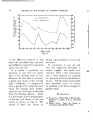
MECHANISMS AND EVALUATION OF ANTISEPTIC ACTIONS 301 counts as long as the G-11 soap such as soap. This is probably continues to be used, but is also the reason why anionic detergents quite conspicuous on counts ob- have been generally of low anti- rained before and after prolonged septic value, and why cationic operations. Inside rubber gloves, antiseptics give the appearance of hands scrubbed with ordinary soaps sterilization at extreme dilutions-- show increased counts, while hands if neutralizing tea. gents are omitted. carrying the G-11 residue show It must be conceded that the wide- values even lower than the small spread use of cationic materials for counts obtained before the interval. sanitizing instruments and surfaces Although these techniques and data as well as for surgical purposes are of outstanding interest in has built up a high degree of surgery, the news is rapidly spread- empirical confidence in their value. ing, and increased use of such The facts remain that as a class combinations by the general popu- they are known to have bacteri- lation is coming. ostatic effects at high dilutions, It may not be superfluous to that these effects are antagonized review briefly the mechanism of by anionic substances, and that detergency and of the antiseptic few, if any, demonstrations have actions here involved. An im- been made of verified killing of portant contribution to this has micro-organisms by them under been made recently by Dr. Blank any conditions. (6), who points out that the skin, Of considerable interest is the soil particles, and bacteria are recent finding that bacteria such likely to be negatively charged. as E. coli may be rendered in- It follows that anionic detergents capable of growth by light around will increase these charges, cause 2600 •., but may then be reacti- a peptization of the soil and bac- rated by exposure to light around teria from the skin and stabilize 3800 •. There is some evidence the peptized particles on colloidal for a correlation of these effects micelies. This is the surface-active with effects on enzymes (8). displacement action of detergents A brief review of some of the generally, involving displacement literature on the removal, inhibi- plus stabilization in solution for tion, and killing of bacteria is of rinsing off. It follows that the interest. Although most students positively charged ions and micelies protest that the phenol coefficient of cationic materials (as pointed is lacking in practical significance, out by Dr. Blank) may tend to it still survives as the most common mordant negative bacteria to nega- standard for the evaluation of tire skin. This will give low bac- antiseptics. Flett (9) has reported teria counts by normal criteria, that organisms presumably killed but the effect is readily reversed by by phenol can be revived by adding small additions of anionic materials sterile charcoal or ferric chloride.

302 JOURNAL OF THE SOCIETY OF COSMETIC CHEMISTS ß At higher concentrations of phenol the organisms did not grow even after such additions and may have been killed, but the fact remains that the official criterion is one of bacteriostasis. Although alcohol is still widely depended on for "sterilizing" thermometers, skin, etc., and although some reports appear to show killing of relevant bacteria in short times, the recent survey by Dr. Price (10) indicates that this should be studied further. He found that the range of 60-90 per cent ethanol had about the same best antiseptic effect, and still supports his earlier choice of 70 per cent ethanol. Certain organisms, 8. albus, however, were not killed by exposures up to ten minutes in any alcohol concentration. His curves seem to show an excitation effect for 10 per cent alcohol, such as has been alleged for organisms more complex than bacteria. Note- worthy has been the promotional ac- tivity behind the quaternaries and some other cationic antiseptics, and they do have outstanding properties. It is not clear that any of them has been fully tested by the criteria mentioned above or by the implantation technique of Dr. Morton. It is to be empha- sized that the designation "steri- lizing" should be reserved for a substance shown capable of killing spores by the criteria above. Now finally you may well ask, "What has all this to do with cos- metic chemists?" The answer is that the scientific as well as the economic interest of each of you lies in formu.lating and offering to the public sound products, ade- quately investigated, appropri- ately formulated, and honestly mer- chandised. "Gyp" products may mulct a lot of money from an uninformed public, but your abid- ing pride and the sound basis of your company's future rests most securely on using all the sciences as well as all the other know-how you can bring to bear on your products. This means that for many of your products you will apply such criteria and tests as have developed for irritations, spe- cial reactions, etc. In addition it means that you will present products likely neither to carry infection nor to promote infection in use. It is not your function to treat infections, nor often to seek sterility, but your purposes will often be served by knowledge of the techniques and materials use- ful for such ends, together with information as to their values and limitations. There are in the above many leads and suggestions that will enable you to contribute effec- tively to the achievement and main- tenance of healthy intact skin on your customers. REFERENCES (1) Valko, E. L., "Surface-Active Agents in Biology and Medicine," ,,'Inn. N.Y. dcad. $ci., 46, 451-478 (1946). (2) Davis, H. L., Bloch, A., and Stonehill, A. A., "Criteria of Sterility," Bull. Nat. Formulary Comm., 41, 69-76 (1948). (3) Davis, H. L., "Introduction to Confer- ence on Mechanism and Evaluation of Antiseptics," Ann. N.Y. dcad. Sci., 53, 3-5 (1950). (4) Morton, H. E., North, L. L., and Engley, F. B., "The Bacteriostatic
Purchased for the exclusive use of nofirst nolast (unknown)
From: SCC Media Library & Resource Center (library.scconline.org)