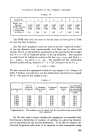
JOURNAL OF THE SOCIETY OF COSMETIC CHEMISTS We see that the samples can be grouped as Nos. 5 and 1 having the smallest particles, Nos. 2, 4, :3 as differing from each other and from 6, 7 which form a pair with the largest mean particle size. However, the other characteristics studied of the emulsions do not appear to have any connec- tion with their particle size distributions as measured by the technique employed by the authors. It is suggested that probit analysis provides a means of specifying the particle size distribution of emulsions. It gives their ED50 value, and its standard deviation, and can define the relation between diameter and number of particles of that diameter. Unless the experimental results are very erratic the distribution can be analysed simply by graphical means. Since it is most likely that particle size is related to the supply of orientated molecules at the particle surface it would be preferable to work with particle surface instead of particle diameter. As particle surface---- •(diameter) 2 it will give a linear probit-log surface graph. It would be expected that the numbers of particles of any selected size would be distributed by chance about a mean size: that the mean size would partly depend on the concentration of surface-active material at the oil/water interfaces and partly on the extent to which the mechanical treat- ment had made use of the surface-active material in dispersing the oil phase: that the range of particle sizes, and thus the value of the constant b used in the probit-log diameter regression line, would depend on the type of mechani- cal treatment (for instance, one would expect an apparatus which depends on pulsating feed pressures developed by a piston to give a greater range of particle sizes than one which functions with an even, non-pulsating feed). We have shown that the particle size distribution is, in fact, represented by a chance distribution and the investigation of the effects of the above factors can be helped by the use of this analytical technique. REFERENCES •0 Finney, D. J., Probit Analysis, Cambridge University Press. n Middleton, A. W., J.S.C.C., IV, 1953, p. 232. •2 Stanko, G. L., Fiedler, %V. C., and Sperandio, G. F., "The Effect of Physical Factors on the Formation of Cosmetic Emulsions," J.S.C.C., V., 1954, p. 39. •8 Fisher, R. A., and Yates, F., "Statistical Tables for Biological, Agricultral and Medical Research." •4 Bliss, C. I., Ann. of Applied Biology, 22, 1935, p. 138 Quat. j•. Pharmacy & Pharmacology, XI, 1938, p. 192. 168

FATTY ACID ALKYLOLAMIDES By W. B. REINISCH, B.Sc., and K. R. DUTTON, B.Sc., A.R.I.C.* TI•ERF. ARE perhaps few classes of chemical compounds more versatile in use, and important in application to chemists engaged in the field of deter- gency, cosmetics and toiletries, than fatty acid alkylolamides. In view of this it might seem surprising how little is really generally known about the properties and scope of this unique group of substances. One of the chief reasons for this state of affairs may be found in the remarkable lack of published information in this field, which is only gradually and more recently beginning to be remedied. This does not mean, of course, that in actual fact in the laboratories of many companies all over the world the most intensive work is not proceeding in relation to this class of materials. In fact, it is no exaggeration to say that rarely has there ever been such a concentrated drive towards patent protection, as discovery follows discovery in a particular field, as there has been in recent times in connection' with fatty acid alkylo- lamides. Therein probably lies the real reason for the reluctance of most workers to disclose information which might prejudice the chances of patent applications. However, be this as it may be, we feel that sufficient evidence has now been accumulated to say with certainty that fatty acid alkylolamides have come to stay for a long period of time as a potent weapon for the chemist dealing with all kinds of surface-active problems. A further complexity in regard to the fatty acid alkylolamides lies in the fact that, in this field more than in any other, the compounds are frequently offered in the form of relatively impure preparations. This is in part due to the fact that the high reactivity of the alkylolamines makes the prevention of side reactions difficult and therefore, from a commercial standpoint, expen- sive. It is, however, also due to the fact that the impure preparations, or at least those containing "desirable impurities" (which are, perhaps, more accurately described as auxiliary ingredients) are actually more effective than the pure compounds. Thus, for example, complexes of lauric acid diethanolamide and diethanolamine, obtained by condensing at an elevated temperature lauric acid with diethanolamine in an amount in excess of that required for equimolecular proportions, are better wetting agents and detergents than the pure lauric diethanolamide. Indeed, it is even possible to take a pure lauric diethanolamide and improve its wetting characteristics by heating for a period with excess diethanolamine. The practical effect of this situation is that, whereas a chemist can normally buy a chemical compound from one source and expect it to behave, within reasonable limits, * Dutton and Reinisch, Ltd., 130/132 Cromwell Rd., London, S.W. 7. 169
Purchased for the exclusive use of nofirst nolast (unknown)
From: SCC Media Library & Resource Center (library.scconline.org)