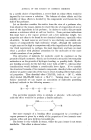
JOURNAL OF THE SOCIETY OF COSMETIC CHEMISTS indicate how certain ingredients occur in each type. Thus phenyl ethyl alcohol, hydroxycitronellal and benzyl acetate are present in all four per- fumes, and amyl cinnamic aidehyde and linalyl acetate in three and the remainder in two. By making simple mixtures of the four basic types many "blends" or bouquets may be formulated. These mixtures may be further modified by ringing the changes with bergamot oil, vetivert, sandalwood, alpha ionone, musk ketone and musk ambrette, from the ingredients origin- ally given to our trainee. Final sophistication will eventually be achieved by careful use of methyl nonyl acetaldehyde. Without doubt, a second perfumer would approach the subject on very different lines and may well consider that important basic raw materials have been neglected or that unnecessary complications have been introduced at an early stage. However, many trainees passing through our perfumery laboratories have benefited from this particular approach. Having reached a stage where he is reasonably well acquainted with the selected raw materials and with an approximate idea of how his four basic floral odours are built up, he now widens his range of raw matehals. He will come to understand the basic odours of other floral perfumes, e.g., carnation typified by clove oil, iso eugenol and eugenol, modified by the rose complex. It will be advisable also to attempt to imitate or modify certain essential oils and in this case lavender is a good example. Lavender oil, offered in many grades, and lavandin are in themselves excellent basic raw materials, especially for soap perfumes, but by themselves they are but indifferent performers. They require "building up," supporting and greatly modifying before they may be considered adequate in soap. At the same time it must always be remembered that the presentation of a perfume in whatever the medium should aim for an individual character: for something that differs from the next preparation. Before passing from the types with which our trainee will become familiar, Colognes should be mentioned. Quite apart from the popular toilet water, the Cologne idiom is used to give the fresh citrus note to many creations. Colognes are essentially based on bergamot, lemon, orange, mandarin, lime and, inevitably, neroli. One of the finest training techniques and, indeed, a necessary qualifica- tion of the perfumer is the matching or imitating of an existing perfume. Quite apart from commercial necessities or training, the olfactory examina- tion of a perfume is a satisfying and exciting business. It is an exercise in the knowledge of raw materials, a test of memory, a battle of wits and, above all, a test of patience. From the trainee's point of view, he starts with simple mixtures, initially of two synthetics or oils in stated proportions, his problem being simply to identify the two ingredients. Gradually more complicated mixtures are presented, complicated in number, type, and proportions. Perhaps no work in perfumery sharpens the wits more effectively than this 188

TALKING OF PERFUMES AGAIN matching of a blend. Most people visiting a perfumery laboratory show a great interest in the identification of ingredients from a complex mixture, and I should like to spend some time on giving my own particular approach to the problem. IMITATING A PERFUME The imitation of an existing perfume may be undertaken simply as an exercise to keep one from becoming rusty, to keep one up to date, as a training technique, but more often from commercial necessity. Of course, one may by chemical or physical analysis obtain a certain amount of information regarding the constituents of a sample. Thus chromatography, which briefly depends upon the separation of individual ingredients from a mixture by means of selective absorption on powder from solvents, offers some help. In this case, it is necessary to keep very much in mind the possible effect of the powder upon the ingredients. Nevertheless, the approach simpli- fies the identification of the mixed ingredients, although it is time-consuming and calls for a delicate handling of an established technique. Some separa- tion may be made (providing the sample in question is sufficiently large) by fractional distillation. The physical constants in certain cases may be of help, although such cases are rare. To know the total alcohol, ester, carbonyl (aidehyde and/or ketone) contents may be of some help, but it is very important to realise that chemical changes are continually taking place in a mixture of chemicals. This is our chemical blending effect. In terms of simple chemical changes we can expect a combination of alcohols and alde- hydes to produce hemi-acetals, aldehydes may oxidise or polymerise, esters may break down or more likely interchange (for instance, alcoholysis may occur). The presence of a high boiling alcohol with an ester formed from a low boiling alcohol may result in a partial exchange of the alcohol radicals. Benzyl alcohol may replace the methyl radical from methyl salicylate to yield methyl alcohol and benzyl salicylate. Such a change in constitution means a considerable change in odour, from the strong wintergreen note of methyl salicylate to the almost odourless benzyl salicylate. Naturally, equilibrium will be reached. In much the same way, radical exchange in esters may occur. Ethyl phenyl acetate and geranyl propionate may well change in part to ethyl propionate and geranyl phenyl acetate. It must therefore be understood that one is not necessarily imitating a mixture as originally compounded. In point of fact, one rarely or never achieves perfection in matching that is, one may arrive at a satisfactory imitation by a route quite different from that pursued by the originator. The final effect is the important thing, and although obviously one must be somewhere in the right region regarding correct ingredients and proportions, different approaches may well bring success. By success is meant the production of an imitation sufficiently close in odour and performance to satisfy both customer and investigating perfumer. 189
Purchased for the exclusive use of nofirst nolast (unknown)
From: SCC Media Library & Resource Center (library.scconline.org)