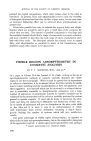
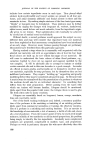
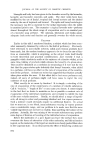
JOURNAL OF THE SOCIETY OF COSMETIC CHEMISTS Strength and body has been given to the lavender accord by the lavandin, lavandin and lavender concretes and spike. The ester notes have been modified by the use of linalyl, terpinyl and bornyl acetate and the alcohol notes by the use of terpineol and borneol. The spike and bornyl acetate give the necessary top lift so essential for the initial impression when the tablet is examined prior to use. The coumarin--a typical lavender note--performs almost throughout the whole range of evaporation and is an essential part of a lavender soap perfume. The oakmoss, labdanum and musks assure adequate back notes and fixation and generally sweeten the whole accord. FIXATION Earlier in this talk I mentioned fixation, a subject which has been some- what summarily dismissed by writers in the field of perfumery. Previously brief references to non-volatile solvents, solids and resinous products have been made, but the modern tendency appears to be to decry the use of fixa-. tives as unscientific, which is surprising, as the subject lends itself ideally to both theoretical and practical considerations. Just recently I read a pamphlet which absolutely scoffs at the existence of a fixative whilst, at the same time, talking of products which enhance the tenacity of a given odour. This could be dismissed as a confusion in terminology if it were not for the fact that the paper states quite definitely that benzyl benzoate, when added to a perfume, will have no effect on the rate of evaporation of the constitu- ents of the perfume. At least one writer has suggested that fixation actually takes place within the nose. If this effect did in fact occur perfumers and, indeed, all users of perfumes might well have cause to regret the very existence of such products. What exactly do we mean by fixation ? It is simply a retarding of the rate of evaporation of the constituents of a mixture of volatile substances. Call it "tenacity," "length of life" or any name you choose, it comes simply to the fact that we desire to maintain as far as possible a constant rate of evaporation of the individual constituents and certainly to inhibit the loss of the more volatile members. Ideally, we should select a range of ingredi- ents, all strong in odour and possessing identical and low vapour pressures. Such a mixture would obviously require no additional fixative. In actual fact we must use, in one blend, many substances varying in vapour pressure over a considerable range, and our problem is to make sure that the more volatile ingredients are not lost too readily, thus upsetting the balance of the perfume. Actually, the very mixing of two or more substances may produce some degree of fixation or lowering of the individual rates of evaporation. Before the molecules of a pure liquid can leave the surface they must overcome the forces of attraction of the other molecules, and this attraction is great, as the molecules of the liquid are much more closely packed than when in the vaporous state. In an ideal system the effect of dissolving a substance 194

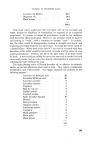
TALKING OF PERFUMES AGAIN in a solvent is to lower the vapour pressure of the latter. In simple form, Raoult's Law states "the relative lowering of vapour pressure is equal to the mole fraction of solute in the solution." The relative lowering of vapour pø_p pressure is given by • where Pø is the vapour pressure of the solvent po and P is the vapour pressure of the solution (solvent plus solute). The mole fraction is the number of molecules of solute divided by the total number of molecules in the solution. This effect is well illustrated by the way the vapour pressure of ether may be considerably lowered by the addition of organic chemicals. Viewed from a perfumery angle this is not as helpful as it seems at first glance. The addition of a second substance has certainly lowered the desire of the molecules of the solvent to leave the surface, but it is virtually only a question of dilution and we are faced with the thought that the more volatile the solute the more effectively we lower the vapour pressure of the solvent, this on consideration of the fact that normally, low molecular- weight bodies are more volatile than those of high molecular weight. If we take two substances A and B of equal molecular weight, then the lowering of the vapour pressure of A will be proportional to the amount of B added. If, however, the molecular weight of B is much higher than that of A, the lowering of vapour pressure will be correspondingly less. An example would be the case of ethyl acetate (molecular weight 88, vapour pressure 72-8 mm. at 20 ø C.) as solvent. If we add to the ethyl acetate one-tenth of its weight of a second substance "B," also with a molecular weight of 88, then we have the following equation according to Raoult's Law. Pø -- P Molecules of substance B __ -- Pø Molecules of ethyl acetate + molecules of substance B 72.8- x 0'6 x 10 TM 72'8 6 x 10 TM + 0'6 x 10 •a x ---- 66.18mm. 6 x 10 •a refers to the number of molecules present in one gram molecule, i.e., 88 gms. of ethyl acetate will contain 6 x 10 TM molecules. In the case of a solute C having a high molecular weight, say, 880, and where an amount equal to one-tenth of the ethyl acetate is added, we have ß Pø -- P Molecules of C Pø Molecules of ethyl acetate 5- molecules of C 72-8- x 0.06 x 10 •a 72'8 6 x 10 •a 5- 0'06 x 10 TM x = 72.08 mm. 195
Purchased for the exclusive use of nofirst nolast (unknown)
From: SCC Media Library & Resource Center (library.scconline.org)