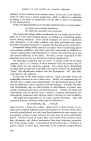
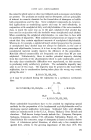
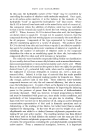
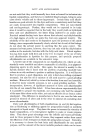
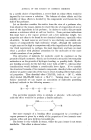
JOURNAL OF THE SOCIETY OF COSMETIC CHEMISTS In other words, an addition of 10 per cent of B (molecular weight 88) has lowered the vapour pressure of ethyl acetate by 6.62 mm., whilst the addition of 10 per cent of C (molecular weight 880) has lowered the vapour pressure by only 0.72 mm. Departing from ideal solutions, that is solutions which obey Raoult's Law, we enter a realm more closely connected with perfumes. In an ideal solution the molecules of the solute are presumed to have no effect upon the intramolecular forces of the solvent, and vice versa. This might be the case if both ingredients in a two-part system were similar in character, e.g., both related polar substances or both non-polar. If, however, the intramolecular attraction of one constituent was much greater than that existing in the second constituent, then the effect would be to increase the vapour pressure of the latter and to force those molecules out of the solution as vapour. Such a case would be exemplified by a mixture of a polar and non-polar compound. On the other hand, the two, constituents of a solution may have a strong attraction for one another then the vapour pressure of both constituents will be lowered not only by virtue of molecular dilution, but also on account of this intermolecular attraction. Figs. I, II, III and IV show how partial and total vapour pressures are affected according to the nature of the ingredients of the solution. Reviewing the four figures we imagine that our effective fixative will therefore have three distinct and important requirements: (a) Low molecular weight. (b) Low vapour pressure. (c) Molecular attraction for the other constituent or constituents. When dealing with a perfume or mixture of perfumery ingredients, it is to be realised that the vapour pressure, or the desire of the molecules to escape, has, for each individual member, already been reduced if only by a dilution phenomenon. Further, if the individual ingredients are so selected that their molecules attract one another, then the fixation of the mixed molecules is enhanced. This is, of course, our physical blending effect. Additional blending effects are obtained by chemical means, e.g., the forma- tion of hemi-acetals between aldehydes and alcohols, Schiff-base formation from aldehydes and amines, etc., but for the time being we are concerned with physical effects. Admitting, therefore, that we are, if our blending technique is good, automatically providing fixation in our perfume, is it possible or even neces- sary to add an additional fixative ? In many cases the answer must be yes. There are so many individual ingredients to be used in one mixture and their chemical and physical characteristics may vary enormously. Whilst one may aim at minimum total and partial vapour pressures in the mixture 196

TALKING OF PERFUMES AGAIN Xn• I MOLE FRACTION X^=O X. =0 X. ,• I Fig. I represents the vapour pressure effect when two substances, similar in character, are mixed. P• TOTAL '" -,.. x N ' X^• I MOLE FRACTION X•,•O Xe •0 Xe FiG. II P7 Fig. II indicates how the total and partial vapour pressures of a system may increase above the normal due to the presence of dissimilar substances in solution. X,• I MOLE FRACTION Xa•O X.=O X. --I Fig. III shows how two substances whose molecules attract one another will tend to possess relatively low total and partial vapour pressures when in common solution. I X^• I MOLE FRACTION X^•0 X.=0 'X.--•I FIG. IV In Fig. IV the effect of mixing two sub- stances possessing intermolecular attrac- tion for one another is again shown, but in this instance one ingredient is non- volatile. p,O _--_ Vapour pressure of pure Liquid A. B = Vapour pressure of pure Liquid B. Xx = Mole Fraction A in mixture. X• -- Mole Fraction B in mixture. 197
Purchased for the exclusive use of nofirst nolast (unknown)
From: SCC Media Library & Resource Center (library.scconline.org)