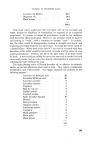
JOURNAL OF THE SOCIETY OF COSMETIC CHEMISTS It is not necessary to tell perfumers, but it may be news to some, that when a perfume is made to a definite formula by two or more people the final result may be different as far as odour is concerned. Mainly, this is due to the fact that whereas commercially pure true synthetics are reasonably standard in quality, essential oils, and more particularly, isolates from these oils, vary with each supplier. What hope then has a perfumer of matching a blend made from materials differing from those he intends employing ? Here we come back to the previously expressed suggestion that one may achieve good results by an alternative route. Each perfumer will have his or her own technique where matching is concerned, dictated by the nature of his training experience and perhaps prejudices. One can only offer one's own ideas. Let us consider we are in possession of a small sample (1 mi. may be sufficient if the task is not too complicated) of a perfume and that the examination is restricted to olfactory analysis only. In the first place, take advantage of every available piece of information regarding the perfume. Can you ascertain its selling price, its origin and very importantly its intended use ? These points may at first glance have little to do with analysis by the nose, but this is a game and every piece of information must be used intelligently and effectively. There is much of the detective to be found in the successful perfumer. This may require further enunciation, but it is helpful to know in advance that the price automatically reduces or cuts out the use of expensive ingredients. Knowledge of the origin of the compound helps because one recognises indi- vidual types and approaches as clearly as one identifies a handwriting. Knowledge of intended use obviously helps to delete products unsuitable to that particular product and to indicate the most likely ingredients. Using only slips of absorbent paper by way of apparatus, one might approach an olfactory analysis in the following manner: (In the selection of these "smelling slips" it is important to keep to one grade so that rate of evaporation from the paper is constant for each examination.) The ingredients present in the sample will each have their own rate of evaporation modified as this rate may be by blending with other ingredients. It follows that if the perfume is exposed to the atmosphere and examined at various intervals we are virtually examining individual fractions in much the same way as if we had performed the fractionation by distillation or absorption. In this case we cannot retain the individual fraction other than as an impression in the nose. Further, the identification is complicated by the intimate presence of other volatile substances, but this is our separation and we make of it the best we can. If time is not an important factor dip a "smelling slip" or "blotter" into the sample and leave it exposed to the atmosphere for a few days. At the end of this period the slip will contain only the relatively non-volatile constituents, i.e., the solids, musks, coumarin, heliotropin, vanillin, etc. resoins, e.g., benzoin, labdanum, oakmoss, 190

TALKING OF PERFUMES AGAIN opoponax, sesqui terpene alcohols and esters, sandalwood, vetivert and patchouli oils. These are now more easily identified as they are no longer masked by the more volatile light and medium odours lost during the period of standing. The examination is made mainly by a contrasting scheme. The perfume is gently rubbed into the back of the left hand (for right-handed people), this to allow freedom for writing and manipulation of the normal hand. The heat of the hand and the moisture present combine to provide a miniature but effective "steam-distillation" apparatus. The volatile products float gently but quickly from the hand and in perhaps twenty minutes have reached a stage of evaporation which might require 24 hours on the blotter. During this time a smelling slip is dipped into the perfume and constant reference to this, the hand and the three-day-old smelling slip, provides the necessary odour contrast so essential as a memory stimulant. Perhaps a seemingly small point, but the method of dipping the perfume is important. Firsfly, try to keep your technique automatically constant. Make your identification marks on the lower end of the slip in a position which will not be seen during examination. This to avoid an unconscious desire to cheat-- a most unhelpful practice. Pinch the end of the slip to form about three- quarter inch of channelling. Smell directly into this channel which concen- trates and directs the odours to the nose. Make sure the perfume does not brush the nose. It has also the advantage of keeping all the papers of a similar appearance as often the slip is dipped into the neck of a small bottle and pouring on to the slip may be a wasteful procedure. Often a difference in colour between original and experimental samples may make it difficult to avoid visual recognition. The first step is to identify the class of perfume involved. In too many cases the name, even when of a well-known floral character, may be mislead- ing, but the important thing is to "get into the mind" of the original com- pounder. Try to fathom just what he had in view. Florals, although varying immensely even for each named type, usually follow some basic pattern and it is not too difficult to strip a perfume of its fineries and to reach this basic accord. Complicated bouquets and fancy creations may be quite another matter and a more searching and critical examination is called for. This may require segregation of the .basic floral notes. Here again we are faced with the fact that ready blended floral perfumes may have been used or, alter- natively, the floral effects may have been brought about by the use of similar type ingredients as shown in the earlier table. Should we be dealing with a fairly simple floral perfume such as lilac, we can automatically expect to encounter phenyl ethyl alcohol, hydroxy- citronellal, anisaldehyde, heliotropin, terpineol and a j asmin complex. Perhaps we have a perfume on our shelves which is reminiscent of the sample. 19I
Purchased for the exclusive use of nofirst nolast (unknown)
From: SCC Media Library & Resource Center (library.scconline.org)