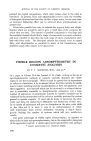
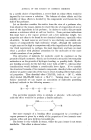
JOURNAL OF THE SOCIETY OF COSMETIC CHEMISTS porated into liquid compositions, which must remain clear in the cold, is restricted. In general, fatty acid alkylolamides tend to raise the viscosity of detergent solutions less than they do that of pure water, but in some cases an increased thickening effect can be achieved when polyphosphates are present also. It has been possible here only to indicate the types of fatty acid alkylo- lamides which are available, and to give a brief idea of the purposes for which they are used. The number of possible compounds is very large and the emulsion chemist should find a range of compounds even more extensive and more valuable to him than the wide range of esters of polyhydric alco- hols with fatty acids. The detergent chemist has already come to regard -[atty acid alkylolamides as essential in many of his formulations, and .doubtless much still remains to be discovered. VISIBLE REGION ABSORPTIOMETRY IN COSMETIC ANALYSIS By T. T. GORSUCH, B.Sc., A.R.I.C.* IN A paper in Volume II of the Journal, G. R. Clark •, writing on the use of spectrophotometric methods in cosmetic analysis, dismisses the visible region in one short paragraph. While it must be agreed that its dependence on colour is a limitation, it by no means follows that this restricts its useful- ness to colour matching and the standardisation of dyes and pigments, as is there suggested. Any matehal which can be converted to a coloured deriva- tive is potentially amenable to absorptiometric estimation, and a large number of substances of considerable interest to cosmetic chemists can be estimated by the measurement of the colour or turbidity produced by various general or specific reagents. It must also be borne in mind that the ultra- violet and infra-red regions have difficulties and limitations of their own: by no means all substances will give an absorption in the ultra-voilet while in the infra-red it is more a case of an embarrassment of riches, with interference from solvent absorption becoming a major factor, greatly limiting the number of systems which will give satisfactory results. One great advantage of visible region absorptiometry, as opposed to ultra-violet or infra-red spectrophotometry, lies in the comparative cheapness of the apparatus required: a visible region spectrophotometer costs, perhaps, * County Laboratories, Ltd., Stanmore, Middx. 178

JOURNAL OF THE SOCIETY OF COSMETIC CHEMISTS porated into liquid compositions, which must remain clear in the cold, is restricted. In general, fatty acid alkylolamides tend to raise the viscosity of detergent solutions less than they do that of pure water, but in some cases an increased thickening effect can be achieved when polyphosphates are present also. It has been possible here only to indicate the types of fatty acid alkylo- lamides which are available, and to give a brief idea of the purposes for which they are used. The number of possible compounds is very large and the emulsion chemist should find a range of compounds even more extensive and more valuable to him than the wide range of esters of polyhydric alco- hols with fatty acids. The detergent chemist has already come to regard -[atty acid alkylolamides as essential in many of his formulations, and .doubtless much still remains to be discovered. VISIBLE REGION ABSORPTIOMETRY IN COSMETIC ANALYSIS By T. T. GORSUCH, B.Sc., A.R.I.C.* IN A paper in Volume II of the Journal, G. R. Clark •, writing on the use of spectrophotometric methods in cosmetic analysis, dismisses the visible region in one short paragraph. While it must be agreed that its dependence on colour is a limitation, it by no means follows that this restricts its useful- ness to colour matching and the standardisation of dyes and pigments, as is there suggested. Any matehal which can be converted to a coloured deriva- tive is potentially amenable to absorptiometric estimation, and a large number of substances of considerable interest to cosmetic chemists can be estimated by the measurement of the colour or turbidity produced by various general or specific reagents. It must also be borne in mind that the ultra- violet and infra-red regions have difficulties and limitations of their own: by no means all substances will give an absorption in the ultra-voilet while in the infra-red it is more a case of an embarrassment of riches, with interference from solvent absorption becoming a major factor, greatly limiting the number of systems which will give satisfactory results. One great advantage of visible region absorptiometry, as opposed to ultra-violet or infra-red spectrophotometry, lies in the comparative cheapness of the apparatus required: a visible region spectrophotometer costs, perhaps, * County Laboratories, Ltd., Stanmore, Middx. 178
Purchased for the exclusive use of nofirst nolast (unknown)
From: SCC Media Library & Resource Center (library.scconline.org)