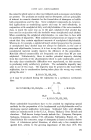
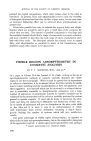
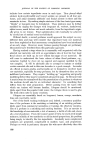
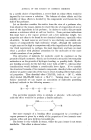
JOURNAL OF THE SOCIETY OF COSMETIC CHEMISTS by a careful choice of ingredients, a severe limit on odour effects would be imposed by too narrow a selection. The balance of odour effects and the stability of these effects is decided by the compounder and therein lies the skill of the perfumer. Let us therefore consider the matter from the view of a perfumer who, from whatever the reason, desires to retard the rate of evaporation of one or more of the ingredients in his perfume he desires to add to his pre-made mixture a substance which we call our fixative. From previous indications this must have a low vapour pressure and a low molecular weight, two properties not often to be found in one chemical substance, especially when oil-soluble. In most cases we are forced to use relatively non-volatile sub- stances of comparatively high molecular weight, although the molecular weight may not be high in comparison with other ingredients of the perfume. Our third requirement is, perhaps, the most important, and here we must select a product with physical attraction for the molecules of the more volatile members of our perfume. This attraction of molecule for molecule could be explained on the grounds of dipole moments that is, an electrostatic attraction between polar molecules or on the grounds of hydrogen bonding, or possibly both. Hydro- gen bonding accounts for the fact that water boils at 100 ø C., whereas other considerations would indicate a considerably lower figure. If we consider the structural formube of two isomeric compounds, dimethyl ether and ethyl alcohol, we gather some idea of the way in which bonding effects their physi- cal properties. Thus dimethyl ether CH•OCH3 boils at --24 ø C., whilst ethyl alcohol CHsCH•OH boils at q-78.4 ø C. Turning closer to our per- fumery materials we can expect an association of molecules possessing hydroxyl radicals in the following manner :-- H R--O .... H 0 .... H 0 .... R R This particular example refers to alcohols or phenols with carboxylic acids the effect would be to produce a double molecule: OH- -0 / % R C C R % o- -- .HO One more example of a bonding effect accompanied by a lowering of vapour pressure is given by a study of the properties of two isomeric com- pounds, ortho and para hydroxy benzaldehyde. The former is very volatile in steam, whilst the para isomer is not steam distillable. This effect is shown below: 198

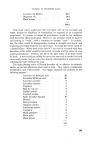
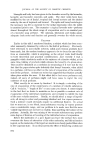
TALKING OF PERFUMES AGAIN o HOH C X H I H ortho hydroxy para hydroxy benzaldehyde benzaldehyde Of course, this bonding or associating effect of molecules is not restricted to alcohols and phenols, but applies to many polar compounds, and it is important to remember that the effect will obtain also between different types of molecules. No doubt the fine blending properties of phenyl ethyl alcohol and certain carbinols can be attributed to a bonding phenomenon. Benzyl benzoate is, perhaps, the most used of our fixatives. It is in- expensive, a good solvent for our solid ingredients, and relatively free from odour. It is not the ideal fixative, but it will be known to all. Let us con- sider its practical function as a fixative. The following simple example demon- strates quite clearly that benzyl benzoate does have the power to retard the rate of evaporation of volatile substances. Six solutions were made as follows: A B C D E F Ethyl alcohol .... 9 8 9 8 8 7 Methyl amyl ketone .. 1 1 - - 1 1 Benzyl acetate .. - - 1 1 1 1 Benzyl benzoate .. - 1 - 1 - 1 The solutions were tested from smelling slips and, ignoring the odour of alcohol and benzyl benzoate, times were recorded for the length of life of the odour of methyl amyl ketone and benzyl acetate. COMPARING A WITH B Initially A was stronger. After 3 minutes B was stronger. In 5 minutes the odour of A had gone. The odour of B lasted for 8 minutes. COMPARING C WITH D Initially C was stronger in benzyl acetate. Gradually the strength approached equality, and at 40 minutes they were at the same strength. D then become stronger with time and after 75 minutes the odour of benzyl acetate in C had disappeared, whilst that in D was still strong. The odour in D remained for at least 3 hours. 199
Purchased for the exclusive use of nofirst nolast (unknown)
From: SCC Media Library & Resource Center (library.scconline.org)