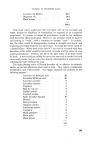
JOURNAL OF THE SOCIETY OF COSMETIC CHEMISTS different angles, and, of course, the forces of attraction in the gaseous state cannot be compared to those existing in the liquid state. IN CONCLUSION It is regrettable that such expressions as "creative genius," "inspira- tion," and similar expressions have figured so little in this talk, but it must be remembered that these are subjective and the aim of this talk has been strictly objective, that is to describe some of the products used by the perfumers, the manner in which they are used and, to some extent, the requirements and training of a perfumer. If the talk has been disconnected and given from a personal view, then that is inevitable when "talking of perfumes." PERFUMERY AND COSMETICS IN ANCIENT AND MODERN INDIA By T. H. CRAWFORD and T. S. NAGARAJAN, B.Sc.* It is not intended in this Paper to touch on what might be called the Western type of perfumery and cosmetics in India, which are undoubtedly used in increasing quantities by Indian women. The writers feel they should confine themselves to the products which have been used since earlier days by the Indian population, still comparatively untouched by Western habits in its home life. At this stage it should be mentioned that the writers' experience has been mostly with South India, where the people are much more orthodox in their religious and private lives than elsewhere. It must always be remembered that India is a vast country, and the habits and customs of the society lady of cosmopolitan Bombay are as different from those of the middle-class South-Indian housewife as are, for example, those of a Parisian lady of fashion and of a Balkan farmer's wife. Almost the earliest use of perfumery in India occurred at the ceremonial fires used in religious rituals. During some of these ceremonies fires of fragrant woods were lighted at the four cardinal points, and the flames were fed with a consecrated ointment. Around the fire would be scattered a scented herb, possibly Rusa or Ginger Grass. It is known that some 2,000 years ago Indian ladies stained their feet, a custom which still prevails among some communities to-day. The use of aromatics in religious cere- monies, particularly in the Hindu religion, is still as widespread as in early times, and the preparation of aromatics for use in these ceremonies has been a trade from time immemorial. * Best & Co. Ltd., Soap Factory, Ma[dras, S. India. 202

JOURNAL OF THE SOCIETY OF COSMETIC CHEMISTS different angles, and, of course, the forces of attraction in the gaseous state cannot be compared to those existing in the liquid state. IN CONCLUSION It is regrettable that such expressions as "creative genius," "inspira- tion," and similar expressions have figured so little in this talk, but it must be remembered that these are subjective and the aim of this talk has been strictly objective, that is to describe some of the products used by the perfumers, the manner in which they are used and, to some extent, the requirements and training of a perfumer. If the talk has been disconnected and given from a personal view, then that is inevitable when "talking of perfumes." PERFUMERY AND COSMETICS IN ANCIENT AND MODERN INDIA By T. H. CRAWFORD and T. S. NAGARAJAN, B.Sc.* It is not intended in this Paper to touch on what might be called the Western type of perfumery and cosmetics in India, which are undoubtedly used in increasing quantities by Indian women. The writers feel they should confine themselves to the products which have been used since earlier days by the Indian population, still comparatively untouched by Western habits in its home life. At this stage it should be mentioned that the writers' experience has been mostly with South India, where the people are much more orthodox in their religious and private lives than elsewhere. It must always be remembered that India is a vast country, and the habits and customs of the society lady of cosmopolitan Bombay are as different from those of the middle-class South-Indian housewife as are, for example, those of a Parisian lady of fashion and of a Balkan farmer's wife. Almost the earliest use of perfumery in India occurred at the ceremonial fires used in religious rituals. During some of these ceremonies fires of fragrant woods were lighted at the four cardinal points, and the flames were fed with a consecrated ointment. Around the fire would be scattered a scented herb, possibly Rusa or Ginger Grass. It is known that some 2,000 years ago Indian ladies stained their feet, a custom which still prevails among some communities to-day. The use of aromatics in religious cere- monies, particularly in the Hindu religion, is still as widespread as in early times, and the preparation of aromatics for use in these ceremonies has been a trade from time immemorial. * Best & Co. Ltd., Soap Factory, Ma[dras, S. India. 202
Purchased for the exclusive use of nofirst nolast (unknown)
From: SCC Media Library & Resource Center (library.scconline.org)