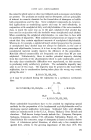
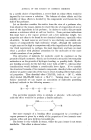
JOURNAL OF THE SOCIETY OF COSMETIC CHEMISTS COMPARING E WITH F Immediately E was stronger, especially of methyl amyl ketone. After 4 minutes E was stronger in both methyl amyl ketone and benzyl acetate. After 6 minutes the methyl amyl ketone was stronger in F but the benzyl acetate was weaker. After 8 minutes only the benzyl acetate was in evidence in E, whilst the methyl amyl ketone was still apparent in F. After 12 minutes E was stronger, but both odours were of benzyl acetate. E remained stronger for 45 minutes and at 60 minutes the odour of benzyl acetate in F was definitely stronger. The benzyl acetate in E had disappeared in 80 minutes, but remained in F for at least 3 hours. On theoretical grounds we could imagine benzyl benzoate having an attraction for methyl amyl ketone as follows ß CH 3 •+ -- •C 0 I C•Hn I 1 OCH2CoH5 I o - + CoH5 Methyl amyl ketone benzyl benzoate For the benzyl benzoate/benzyl acetate association we imagine' C0HsCH•.Ox, C 0 CHa l l OCH•.CoH • 0 -- CoH5 On the evidence of these experiments benzyl benzoate retards the evaporation rate of both methyl amyl ketone and benzyl acetate. Further, the presence of benzyl acetate itself has some fixative properties for the methyl amyl ketone. 200

TALKING OF PERFUMES AGAIN We can safely say that some degree of fixation of certain odorous mole- cules in a mixture can be accomplished, although we must, of course, be reasonable in our definition of the word fixation. Benzyl benzoate, decried in certain quarters, is a fixative, but it is, perhaps, not too difficult, with the requirements already mentioned, to indicate other and more effective sub- stances. Before ending, I must forestall the critics who will inevitably ask "how do you account for the fact that non-polar substances can also act as fixatives?" One could quote the well-known example of paraffin wax in this connection. If volatile solvents such as acetone, ethyl, butyl, and amyl acetates are brushed on to paintwork they are volatilised before adequate softening of the paint takes place. If a few per cent of paraffin wax is added to the stripping solvent, then the rate of solvent loss is inhibited to such a degree that the paint is dissolved or softened and may readily be removed. This could be quite a poser, but one might draw on the experience of certain workers who have described the addition compounds of urea with organic substances. Solid urea complexes with many chemicals were found and whilst these substances include ketones, acids, alcohols and esters, the same effects were found for many paraffins, including normal straight chain mem- bers. Urea apparently lends itself to the isolation and •xamination of its complexes, and whilst other complexes with paraffin may be difficult to investigate, their presence, on the ground of hydrogen bonding, should not be ignored. This particular effect may also account for the fact that the stearoptene bodies of essential oils are in themselves fixatives. Of course, the particular "fixing" effect of paraffin wax in solvents may be due in part to a sealing of the surface. A single perfume may well contain alcohols, esters, ketones, ethers, aldehydes, amines and many more types of chemicals, their structure com- plicated by isomerisation, unsaturation, branched-chain and a host of other considerations. Hence a forecast of the final attraction of the individual molecules and the effect upon vapour pressure would indeed be difficult to make. The problems of fixation might, to some extent, be compared to the problems of fractional distillation, in reverse. The successful lowering of the vapour pressure of one ingredient may well result in an increased rate of vapour release in a second. It is a common experience to find that a substance with a strong odour can only be used in traces in some mixtures and yet in a second mixture it may be added in fairly large quantities without undue prominence. Thus we are unable to select or recommend a universal fixative. The constituents of the mixture in question will decide the type of fixative required, and here again the perfumer comes into his own. That hydrogen bonding will have effects upon the ultimate odour of the perfume is obvious and quite another story. Further, it must be clearly realised that we have discussed fixation as a means of retarding odour loss from a liquid. The final effects upon the olfactory nerves must be considered from completely 201
Purchased for the exclusive use of nofirst nolast (unknown)
From: SCC Media Library & Resource Center (library.scconline.org)