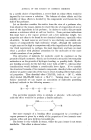
LOOKING AT THINGS set out in expensive, high quality books indicating that the records are considered to be of value. Unfortunately, such books are often closed and their usefulness is greatly curtailed since trends in day-to-day production can be seen only by statistical examination. In the final appraisal, of course, mathematical treatment is necessary, but it demands examination of the figures at regular intervals. It also takes time and the findings may be such that they sort of close the stable door after the horse has escaped. Further, the statistical examination must be done properly and by a competent statistician, for it must be clearly recognised that the correlation of one set of values against another must conform to certain requirements which hax e been adequately investigated by those adept at statistical evalua- tion, and it seldom behoves a novice, unless he be a first-class mathematician, to dabble in this sort of work. The alternative is, however, much more simple, and although it may often lack that precision which the mathematical treatment of the results can give, it will help considerably in the work of controlling quality. It consists of a form of graphical representation. In most of the executive offices of firms it is customary to see, plastered on the wall, graphs showing the daily production and other things. It is worthy of comment, however, that these graphs are all of a type. They are, in fact, graphs in so much as the person interested insists on joining the individual points. This is no sort of business. Its fatuity is well shown by the mere fact that the lines zig-zag with dizzy insistence up and down the paper with time on the bottom axis. To a scientist, a "graph" is a repre- sentation of values which are plotted out in order to show a trend or a relationship. Actually, although time is a very important factor, the graphs have fundamentally little or no relationship with time, and certainly as regards the values obtained in a control laboratory the time at which they were done is often of little moment the value of time only lies in enabling complaints or, what is perhaps more unusual, letters of appreciation of quality to be identified with a particular group of determinations. Since this form of expression is to be used in a statistical manner, it is obviously of importance that as many determinations should be done on each day as is within the power and time of the chemist, and all these points must be indicated on the graph. It is advisable to have the daily spacings close together so that a graph can last for a long period of time. In doing this it has also the merit, which will be easily appreciated, of enabling the variations to be seen more clearly. The method adopted should be a series of marks the first determination should be a black spot or dot and the spacings on the ordinate should be of a distance which has some relationship to the expected experimental error. Where two points fall on the same dot then the fact that it is a dual dot should be indicated by putting a tiny dash to the dot. Each result which fits on this precise spot should be indicated by an addi- tional dash, as, for example, . • L _• +'fi'. ....... ...•(- In this way many 157

JOURNAL OF THE SOCIETY OF COSMETIC CHEMISTS determinations can be registered on one point of the graph. The graph should be inspected daily: a mere glance is often quite sufficient to see whether or not there is any widening of the spaces, which means variations in the particu- lar quality which is being assessed and the density of the marking can be mentally registered so a statistical average and trends can then easily be seen even although the analytical or laboratory method may have quite a gross error. The aim should be to narrow the variations between the dots, which means that the quality is then becoming much more regular and the height of the grouping of the dots should also be examined to see whether or not it is staying steady, going up or going down, depending, of course, on the particular property. It may be a sign of improvement if the trend is upward or, on the other hand, it may even be a fault. Certainly if it is level it means that quality in that respect is being maintained. A very good example of this method of treatment was observed in regard to a particular emulsion where complaints were received that it was not stable. Examination of the facts indicated that the emulsion had been stored in a very hot place, which was some sort of an explanation, but as complaints of this type were unusual, an investigation was carried out in order to try to find any reasons for this untoward happening. The control laboratory figures were inspected for that particular day and they showed no positive sign that anything out of the ordinary was occurring. A series of day-to- day reference specimens was then examined by incubating them at a high temperature. It was found that in certain of them the emulsion broke, while others remained stable. An inspection of the particular control values for those days on which the emulsion broke again disclosed nothing seriously amiss with the product, but on inspection of the dating of the samples it appeared that the earlier ones were more likely to break than those made at the end of the period under examination. The works control values were then examined by grouping them and determining the average values for each week, and it was then noticed that there was a slight trend in so far as the later emulsions were more finely dispersed. This gave an apparent clue to the situation and it was then discovered that the samples which lacked stability were produced on days when the output was very high, with the result that they had not been homogenised according to the standard procedure. If, however, the control values had been plotted accord- ing to the visual plan which has been outlined, this variation would have been seen and steps taken in time to have prevented any sehsibly large number of jars reaching the consumer. To sum up, therefore, I would say to those who are engaged in factory operations that they must never forget that the daily production of any given article is a form of experimentation on the majestic scale. They must remember that the observant eye can detect variations, but cannot assess them in scientific form. Numerical values are scientific, but if these values !58
Purchased for the exclusive use of nofirst nolast (unknown)
From: SCC Media Library & Resource Center (library.scconline.org)