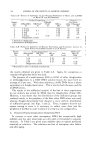
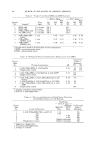
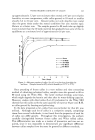
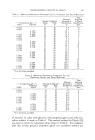
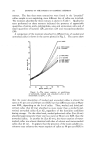
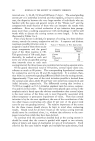
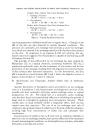
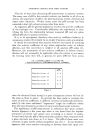
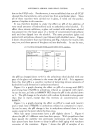
266 JOURNAL OF THE SOCIETY OF COSMETIC CHEMISTS B. Effect of ztdded Humectants on Moisture of Pulverized Callus The hygroscopicity of a substance depends inter alia on the rate of diffusion of water across the vapor-liquid interface. This rate is a function of temperature, concentration, relative humidity, depth of surface area exposed and liquid and vapor film coefficients (25). These factors in- fluence the time required for a material (at equilibrium at a given relative humidity) to reach equilibrium at another (higher or lower) relative humidity. Pilot experiments showed that 100 to 300 rag. of humectant is a convenient sample size and that this weight of sample stored in weighing bottles having an exposed surface area of 314.2 mm. 2 reaches equilibrium in a reasonable length of time. In order to determine the equilibrium moisture absorption of various humectants and their mixtures with callus, the following series of experiments was performed. Glycerol, C.P., crystalline sorbitol, propylene gl, ycol, U.S.P., and callus (Lot #2) freeze-pounded to 40 to 60 mesh, were dried to constant weight in a vacuum desiccator over P205. Duplicate samples of about 100 rag. •)f callus, 300 mg. of humectant and similar amounts of their mixture were accurately weighed into the selected weighing bottles (Parr, 20 X 24 min.). Similarly, samples of 70 per cent sorbitol, dried callus and their mixtures were prepared. All samples were then immediately stored in constant humidity chambers at 45 and 60 per cent R.H. at room temperature, as previously described. Samples of callus, glycerol and callus q- glycerol were also stored at 40 per cent R.H. at 37øC. and at 90 per cent R.H. at room temperature. The studies at 45 per cent R.H. at room temperature were also repeated with washed dried callus (Lot #2 ww, freeze-pounded to 40 to 60 mesh) and mixtures of this callus with glycerol. The callus used in these experi- ments was washed with consecutive portions of distilled water as de- scribed in section C below and dried to constant weight in vacuo over .P205. It was found that liquid humectants penetrated the powdered callus after a few hours of exposure to the humid atmosphere, and no physical mixing was required. In the experiments with crystalline sorbitol, the weighing bottle was closed and shaken to mix the components and subse- quently opened and placed in the appropriate constant humidity cham- ber. The samples were weighed daily until they reached constant weight. The equilibrium moisture sorption data obtained with unwashed callus is shown in Tables 1, 2 and 3. The reproducibility of data of this type ap- pears to be satisfactory. The variation at low equilibrium moisture con- tent is generally about 0.5 per cent, increasing to about 2 per cent at higher equilibrium moisture contents. The rates of moisture sorption by callus, sorbitol, glycerol and propylene glycol at 45 per cent R.H. are shown in the curves in Fig. 2. A comparison between the calculated and the experimentally-found moisture absorption

WATER HOLDING CAPACITY OF CALLUS :267 TAULE 1--MoisTURE SOKPTION Or UNWASHED CALLUS• $ GLYCEROL AND THEIR MIXTURES Time Moisture Required Storage Conditions Absorbed at to Reach -----Composition, gm.----, Temp., R.H., Equilibrium, Equilibrium, Callus Glycerol øC. % % days 0.2175 ... 23 45 0.1851 23 45 ... 0.'1¾72 23 45 0.1539 23 45 0.'13'57 0.2852 23 45 0.1097 0.3077 23 45 0.1055 ... 37 40 0.1228 37 40 ... 0.'1¾18 37 40 0.1787 37 40 0.'68'25 0.3193 37 40 0.1084 0.3134 37 40 0.1690 ... 23 60 0.1738 23 6O ... 0.'1'8'54 23 60 0.2465 23 60 0.'6•97 0.2335 23 60 0.0988 0.1924 23 60 0.1233 ... 23 90 0.1353 23 90 ... 0.'1¾89 23 90 0.1749 23 90 0.'1'1•0 0.2486 23 90 0.1513 0.3397 23 90 6.9 6.7 19.1 19.2 13.5 14.6 4.1 3.6 17.2 17.3 14.1 13.2 11.2 11 7 38 3 38 2 29 6 28 2 34 0 34.0 176.0 178.0 129.0 129.0 4 4 6 6 5 6 1 1 4 4 21 21 6 6 6 6 6 6 12 12 36 36 36 36 * Lot #2, frozen, pounded. TABLE 2--MOISTURE SORPTION' OF UNWASHED CALLUS• • PROPYLENE GLYCOL AND THEIR MIXTURES ,.- Composition, gm. , ,--Storage Conditions--, Propylene Temp., R.H., Callus Glycol øC. Time Moisture Required Absorbed at to Reach Equilibrium, Equilibrium, % days 0.1851 ... 23 45 6.7 4 0.2175 23 45 6.9 4 ... 0.•1'84 23 45 19.2 3 0.2071 23 45 18.7 3 0.'1¾45 0.2952 23 45 15.0 3 0.1417 0.2945 23 45 14.3 3 0.1690 ... 23 60 11.2 6 0.1738 23 60 11.7 6 ... 0.¾519 23 60 32.0 7 0.1858 23 60 31.7 7 0.'1'426 0.2149 23 60 24.4 3 0.0952 0.1944 23 60 25.4 3 * Lot #2, frozen, pounded. of mixtures of callus with glycerol, with propylene glycol and with crys- talline sorbitol is made in Table 4. The method outlined by Flesch (22) was used to obtain the calculated values shown in Table 4. It is indisput- able that neither glycerol, propylene glycol nor crystalline sorbitol po-
Purchased for the exclusive use of nofirst nolast (unknown)
From: SCC Media Library & Resource Center (library.scconline.org)