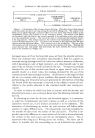
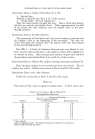
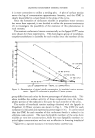
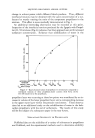
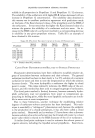
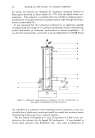
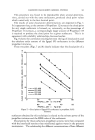
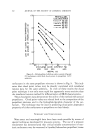
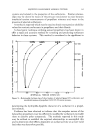
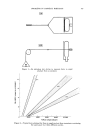
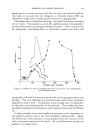
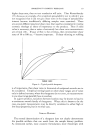
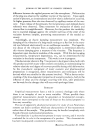
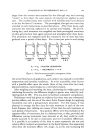
LIQUEFIED HALOCARBON AEROSOL SYSTEMS 555 change in solvent power which different blends produce. Thus, different interfacial tensions may be obtained with the same concentration of a sur- factant by merely varying the ratio of the component propellants in the mixture. This effect is more markedly demonstrated in Fig. 5. An additional interesting observation may be recorded at this point. Inspection of the interfacial tensions produced by the Igepals with Propel- lant 11/12 mixtures (Fig. 4) indicates that they approach zero with increased surfactant concentration. Evidence that solubilization of water in the 60 50 J 4o o m :50 i 20 ø ,0% '50 '40 I•12 MIXTURES Figure 5.--Kauri-butanol values of' propellant 11/12 mixtures compared to interfacial tensions of these propellant-water systems with 0.1% (w/w) CO 530 dissolved in the propellants. propellant layer was occurring at these low points was manifested by an in- crease in volume of the lower propellant layer and a corresponding decrease in the upper water layer within the pressure tensiometer. These observa- tions led to an additional study on the solubilization of water in the halo- carbon propellants with the aid of surfactants. The results of this study will be the subject of a subsequent paper in the near future. SURFACTANT SOLUBILITY IN PROPELLANTS Published data on the solubility of a variety of substances in propellants are ill-defined, and the experimental methods used to determine solubility

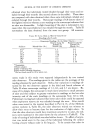
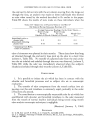
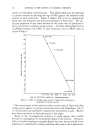
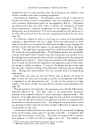
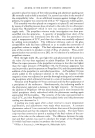
556 JOURNAL OF THE SOCIETY OF COSMETIC CHEMISTS are often ill-designed. In most instances, quantitative data are lacking. Since a major part of this study depended on a knowledge of exact solu- bility data of the surfactants, an investigation was conducted to establish a simple but accurate method for determining solubility in the liquefied halo- carbon propellants. Previous attempts in our laboratory involved a method of withdrawing samples of "saturated" surfactant solutions in propellants which had been equilibrated at 25øC for 24 hours. The propellant was evaporated from an aliquot of the solution, and the residue represented the weight of the "dis- solved" surfactant. Certain inconsistencies in the results obtained by this method indicated that the aliquot samples were not true solutions but were actually very fine colloidal dispersions. Solutions which appeared to be clear to visual inspection demonstrated a Tyndall effect when viewed under a beam of light. This phenomenon had been reported by Becher and Clifton (6), who observed that aqueous solutions of nonionic surfactants manifested the same Tyndall effect. They attributed this to the heterogeneous nature of nonionic surfactants. Attempts to circumvent this phenomenon were inconclusive. Ordinary methods of filtration were considered impractical due to the high volatility of the propellants, even if the undissolved surfactant could be held back by the usual filter media. Centrifugation at high speeds for 20 minutes failed to produce a concentration gradient within the samples, and this approach was discarded. Since optical clarity could not be used as a criterion in solubility deter- minations, it was decided to employ a simple turbidometric technique to obtain a more accurate estimate of solubility. It was noted that, when accurately prepared solutions of known concentrations of surfactants in propellants were examined under a strong beam of light, the slight turbidity of these solutions remained constant until the concentration which exceeded the solubility was reached. The subsequent change in the polarization of the light beam was abrupt and occurred over an extremely narrow concen- tration range. Mixtures of surfactants in propellants were prepared initially in incre- ments of 10% (w/w) concentration and then in 1% (w/w) increments. After rotation for 24 hours at 25øC, these mixtures were examined under a beam of light. The percentage strength of that solution which just pre- ceded the one which demonstrated the marked change in polarization of the Tyndall beam was considered to be the solubility of the surfactant in the given propellant or blend. This method was found to be reproducible to within 1% when several determinations were made on different surfactant-propellant solutions. The Igepal CO surfactants v•ith HLB values up to 10.8 were found to be
Purchased for the exclusive use of nofirst nolast (unknown)
From: SCC Media Library & Resource Center (library.scconline.org)