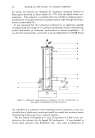
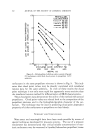
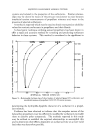
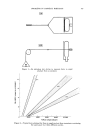
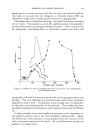
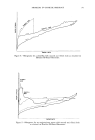
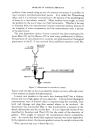
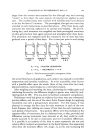
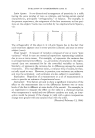
576 JOURNAL OF THE SOCIETY OF COSMETIC CHEMISTS difference between the applied pressure and the atmosphere.. ,Deformation of the plug was observed by capillary motion of the mercury. Upon appli- cation of pressure, an instantaneous and slow elastic deformation occurred. At higher pressures flow also was observed by capillary motion of the mer- cury. Upon release of the pressure, the instantaneous and delayed elastic rebounds were observed. Data treatment for evaluation of elastic and viscous flow is straightforward. However, for this product the variability due to material slippage against the cylinder wall was of the order of the variation between samples, preventing measurements of the needed ac- curacy. Accordingly, an elastic damping measurement was employed. The damping of the vibration of a long needle resting on a flat foot in the mate- rial was followed electronically on an oscilloscope recorder. The logarith- mic decay of the vibration from a displacement is determined directly this viscous damping gives a measure of the viscosity. The frequency is dependent upon the elastic modulus of the sample. With this device aging measurements, temperature dependency, etc., can be determined for the variation in the elastic component. This work is now in progress. The elastometer shown in Fig. 7 has proven to be of great value, both with this product and with many other cosmetic semisolids, in understanding the relative elasticity and degree of recovery possible during solid deformation. As the visco-elastic component of many cosmetic and pharmaceutical preparations is recognized, direct measurements and techniques will be devised which are suitable for the systems involved. With a better under- standing of the time-dependent properties of cosmetic products, both in the influence of shear and the changes occurring with time, safer predictions can be made for the changes that will occur with prolonged time. SUMMARY Empirical measurements have a role in cosmetic rheology only where there is an interplay of two or more variables. Where possible these empirical measurements should be grounded on fundamental concepts. The test must correspond to the rate of shear on the desired property to have any versatility. The use of apparently absolute instruments for study of non-Newtonian systems can lead to artifacts which are characteristics of the measurement rather than of the sample. This problem may be handled completely with the aid of known mathematical procedures. Visco-elasticity is a phenomenon present in many systems, and it must be evaluated for its role in the acceptance of a product. This characteristic has been inadequately considered in cosmetic studies. (Received December 26, 1963)

PROBLEMS IN COSMETIC RHEOI.OGY 577 REFERENCES (1) R. H. Marriott, •e. $oc. Cosmetic Chemists, 12, 89 (1961). (:2) J. H. Wood, G. Catacalos, and S. V. Lieberman, ]. Pharm. Sci., 52, 375 (1963). (3) H. Green, Ind. Eng. Chem. Anal. Ed., 13, 632 (1944). (4) J. H. Wood and E. Lapham, ]. Pharm. $ci., accepted for publication. (5) J. R. Van Wazer, J. W. Lyons, K. Y. Kim, and R. E. Colwell, I•iscosity and Flow Meas- urement, Interscience Publishers, Inc., New York, N.Y., 1963, p. 55 if. (6) Ibid., p. 189 if. (7) R. N. Weltmann, ]. $oc. Cosmetic Chemists, 7, 599 (1956). (8) S. J. Hahn, T. Ree, and H. Eyring, NLGI Spokesman, 23, 129 (1936). (9) G. Levy, ]. Pharm. Sci., 52, 947 (1962). (10) J_. H. Wood, G. Catacalos, and S. V. Lieberman, Ibid., 52, 354 (1963). (11) E. Bantoft, Rheology of Disperse Systems in C. C. Mill, Pergamon Press, Ltd., Irondon, 1957, p. 105. (12) A. Fincke and W. Heinz, Rheol. Acta, 1, 530 (1961). (13) H. Bruss, personal communication. (14) H. Bruss, Parfumerie u. Kosmetik, 41, 141 (1960). (15) N. L. Henderson, P.M. Meer, and H. B. Kostenbauder, ]. Pharm. Sci., 50, 788 (1961). (16) G. Catacalos and J. H. Wood, Ibid., accepted for publication. (17) J. H. Wood and G. Catacalos, ]. $oc. Cosmetic Chemists, 14, 147 (1963). (18) J. H. Wood, Am. Perfumer, 76, No. 10, 37 (1961). (19) H. Heinrich and J. E. Clements, Proc. $oc. Sect. Toilet Goods Assoc., No. 33, 16 (1960). (20) H. B. Kostenbauder and A. N. Martin, •. Am. Pharm. Assoc., $ci. Ed., 43, 401 (1954). (21) G. W. Scott-Blair, A Survey of General and Applied Rheology, Isaac Pitman & Sons, London, 1949, p. 163 if. (:22) M. Reiner, Deformation, Strain, and Flow, H. K. Lewis & Co., Ltd., London, 1960, p. 126ff. (23) D. E. McVean and A.M. Mattocks, ]. Pharm. $ci., 50, 785 (1961). (24) D. E. McVean, Ph.D. Dissertation, Univ. of Michigan, Ann Arbor, 196:2. (25) P. R. Saunders and A. G. Ward, Proc. Sect. Intern. Cong. Rheol. in V. G. W. Harrison Academic Press, Ltd., London, 1954, p. 284.
Purchased for the exclusive use of nofirst nolast (unknown)
From: SCC Media Library & Resource Center (library.scconline.org)