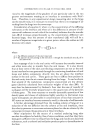
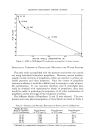
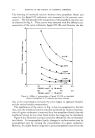
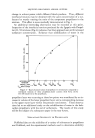
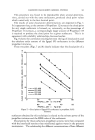
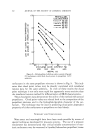
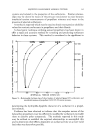
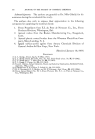
CONTRIBUTION OF I,UNG AIR TO TOTAL ORAL ODOR 543 tional to the magnitude of the gradient of any particular odor in the two gaseous environments meeting at an interface in accordance with Fick's Law. Therefore, in any experimental design measuring odor in the lungs via the mouth route, it is necessary to ensure that there is no stoppage of air rushing from the lungs into the osmoscope. Consideration of equation 1 ( where c is the concentration of the diffusing substances at the interface and where dc is the difference in amount of sub- stance with reference to each side of the interface) indicates that the transfer rate d•,/dt increases proportionately as the concentration difference (tic) becomes large thus the amount of odor transferred (d•) will still be a number of important magnitude at a given point x above the surface as (dr) becomes very small. d• _ _/x (dc) dy, dz (1) dt •fe ' where /x = the diffusion constant of the odor vapor and • -- the amount of odor passing in the direction x through the interfacial area dy, dz in the interval dt. Any stoppage of air in the oral cavity will increase the transfer interval and allow more odor to transfer from the oral tissues. It is also known that at least some of the odor-contributing components are not at the oral tissue interface but are generated through the continuing breakdown of oral tissue and debris components directly into the air above the interface surface in the oral cavity. These gases are free to diffuse from pockets in the oral cavity into the air stream flowing from the lungs. It can be shown that several of the malodorous components encountered are low density gases (densities calculated from molecular weights of less than 200). It may then be demonstrated by Graham's Law that the rate of transfer of such gases will be inversely proportional to the square roots of the densities of those gases. The time necessary to transfer detectable quantities of low density gases and classes of substances highly sensitive to the human nose (some mercaptans are detectable in concentrations of less than one part in 109) across an interface becomes extremely small, in the order of milliseconds. A further advantage obtained from the rushing column of lung air is a reduction of the net diffusion into the column at the oral interfaces, since the velocity pressure to overcome resistance placed on the air column by the osmoscope increases the gas pressure at these interfaces. Other stipulations for the success of a method analyzing lung odor are that the subjects be healthy, free of sinus conditions, and that they have been given sufficient time to release from the lungs and mouth any dissolved substances, such as ethanol and oxidation products prior to detoxification in the liver.

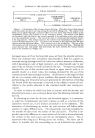
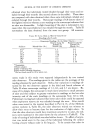
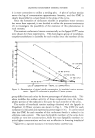
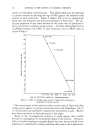
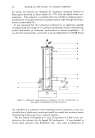
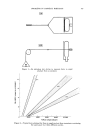
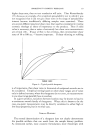
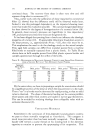
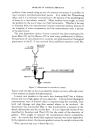
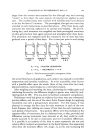
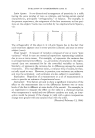
544 JOURNAL OF THE SOCIETY OF COSMETIC CHEMISTS METHODS The experiment designed to determine the relative contribution of lung air to the detectable odor of the mouth was divided into three parts. Equipment used in the study consisted of an osmoscope modified by the addition of a bypass valve which would allow a subject's expired air to be channeled either into the room air in the bypass position or through the osmoscope in the pass-through setting. In this way, the last 1/8 or 1/_0 of his expired volume (reserve lung air) could be directed through the os- moscope. Thus, an uninterrupted flow of air, a necessity in carrying out measurements 1 a. and 1 b. below, could be obtained. For the measurement of nose-expired air in Part II a double tube adjust- able endpiece, fitting tightly into the nostril of the subject, replaced the mouthpiece used in tests which evaluate mouth-expired air. Part I, l a. Measurements of residual lung air (Fig. 1). External air was inhaled through nose into lungs, with the vital lung capacity changed twice. Inspiration of a third volume equal to the lung's vital capacity was allowed to equilibrate with its environment for ten seconds. Total exhalation was then passed through the mouth at a rapid velocity. Part I, lb. Measurement of odor in nose-inspired tidal lung air ex- haled by mouth and pushing mouth, velopharyngeal, and pharyngeal air ahead of it. Instructions Given to Subjects (Procedure 1 a. rs. 1 b.) 1. "Lung" Odor: (Exhaled through mouth) Take two deep breaths through the nose. Take a third deep breath, hold for ten seconds, then exhale slowly. When approximately one- half of the breath has been released, turn the bypass valve from the bypass position to the pass-through position. Instructions Given to the Odor Observers 1. The osmoscope will be inserted at the beginning of the procedure, and the odor observer will make the analysis after the bypass valve has been placed in the pass-through position. 2. Place the osmoscope fitted with the bypass valve and mouthpiece into the subject's mouth. 3. In order not to saturate the odor observer's sense of smell, lung odors are to be run first. Part II, 2a. Measurement of odor in residuallung air inspired through the nose, as described in la. of this section, but exhaled totally through the nose. Part II, 2b. Measurement of odor in nose-inspired air as described in 1 b. of this section.
Purchased for the exclusive use of nofirst nolast (unknown)
From: SCC Media Library & Resource Center (library.scconline.org)