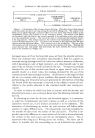
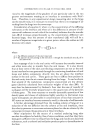
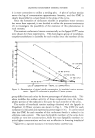
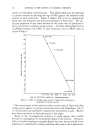
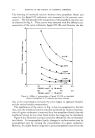
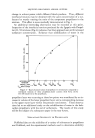
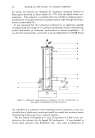
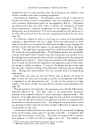
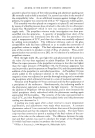
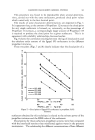
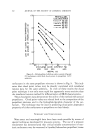
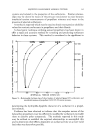
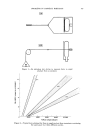
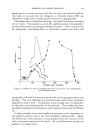
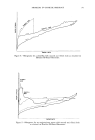
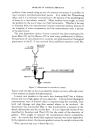
570 JOURNAL OF THE SOCIETY OF COSMETIC CHEMISTS This is typical of the problem that confronts a cosmetic rheologist. What he thought to be an absolute measurement can be so made only by extensive calculations. Even if he is a full-time rheologist, it is doubtful that he can call upon a computing center to help him. Certainly the casual part-time rheologist is completely scared off by such a concept. Thus it seems probable that, for some time to come, rheological studies with couette instruments will be reported in terms of apparent shear rates based on Newtonian concepts. The same consideration holds for the extrusion type rheometer. Since absolute measurements have now become instrument- dependent, it is incumbent always to specify the measuring bob system used or the capillary diameter of an extrusion device. A second problem in the use of any instrument is the time-dependent nature of the sample's rheology. Normally, this is structural breakdown or thixotropy. In such systems, unless an automatic programing for continuous speed increase is inherent in the rheometer, the time profile used to determine a rheogram can affect the results obtained. If a different rate of increase is used, different shear stresses will result. In this respect, an extrusion rheometer has an advantage it is continuously studying a new sample. The problem for the residence time under shears in capillaries of different diameters or of the shear gradient with extrusion rheometers is discussed elsewhere (2, 6). The rate of thixotropic breakdown has been defined by Weltmann by two indices of thixotropic breakdown (7). Both coefl:icients imply that changes in the rate of obtaining the measurement will give different results. It is of interest to realize that the work of the Eyring School (8) in applying the absolute reaction rate theory was capable of predicting, through three shearing cycles, the rheograms for a highly thixotropic cosmetic. Unfortunately, the calculations involved are pro- hibitive for any routine use. There is a parallel phenomenon to thixotropy which often appears to be similar. This is the development of slippage planes, either within the material or at the wall of the rotating member. The development of slippage planes within the material, plug flow, is a true form of yield value. Plug flow occurs when the sample under study is unable to withstand the shear gradient imposed upon it and is easy to recognize on any rheogram. In two studies of montmorillonite gums systems (9, 10) a spur yield value was shown for very low shear. This would appear to be a plug flow. However, wall slippage is another behavior which appears in rheological results to be equivalent but which can be avoided. The use of roughened bobs has been advocated by several workers (11, 12). One commercial instrument, the Rotovisko, ©* has two such bobs available. Bruss (13) has observed that many of the spur value type rheograms can be explained * Brinkman Instruments, New York, N.Y. 11590.

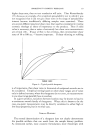
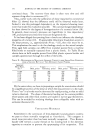
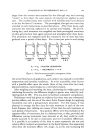
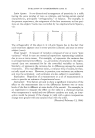
PROBLEMS IN COSMETIC RHEOLOGY 571 SHEAR RATE Figure 4.--Rh½ograms oeor a dcntrifice with smooth and ribbed. bobs as obtained Hercules Hi-Shear Rheometer. II i I i, RIBBED '• BOB Ii ii SHEAR RATE Figure 5.--Rheogrmns for an antiperspirant cream with smooth and ribbed bobs as obtained on Hercules Hi-Shear Rheometer.
Purchased for the exclusive use of nofirst nolast (unknown)
From: SCC Media Library & Resource Center (library.scconline.org)