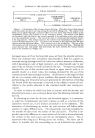
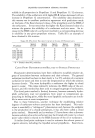
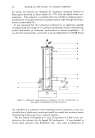
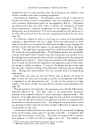
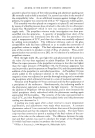
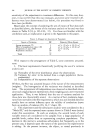
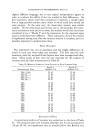
CONTRIBUTION OF LUNG AIR TO TOTAL ORAL ODOR 545 Instructions Given to Subjects (Procedure 2a rs. 2b) 1. Mouth Odor: Method as described for Part I, lb. of this section. 2. "Lung" Odor: (Nostril exhaled air) Take two deep breaths through the nose. 'Fake a third deep breath, hold for ten seconds and exhale slowly. When approximately one-half of the breath has been released, turn the bypass valve to the pass- through position. Instructions Given to the Odor Observers The osmoscope will be fitted with the nostril endpieces inserted into the subject's nose at the beginning of the procedure. The odor ob- server will make the analysis after the bypass valve has been placed in the pass-through position. Part III, 3. A bolus of cinnamon flavored gum was placed in sub- ject's mouth, with instructions to the subject to 6hew bolus slightly but to swallow no saliva. Odor measurement analysis of gum odor followed the procedures described in Parts I, 1 a. and I, 1 b. of this section. Instructions Given to Subjects (On subjects having osmoscope reading of 0). Place the piece of gum in your mouth and chew one minute. Do not swallow any saliva. Follow instructions in Parts I and II of this study. Instructions Given to the Odor Observers Follow the instruction in Parts I and II of this study. RESULTS The results of this study are given in tabular form. Table I shows data TABLE I--LU•qG ODOR rs. MOUTH ODOR STUDY (Readings Before Breakfast) Osmoscope Readings ,. Reserve Lung Air Exhaled Subjects via Mouth (la.) Mouth Odor (lb.) Ca 6.0* Fe 6.05 Hu 6.0 Jo 6.0 Mo 6.0 Ne 5.0 Sc 5.0 Tu 6.0 Wi 6.0J' 6.0* 60 60 60 60 60 60 6.0 6.0 * Odor of garlic. J' Odor of cigarette smoke. No cigarette :1: Had trouble following directions. smoke odor observed in mouth odor.

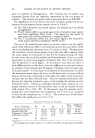
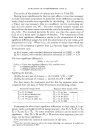
546 JOURNAL OF THE SOCIETY OF COSMETIC CHEMISTS obtained when the individuals tested inhaled through their noses and ex- haled through their mouths (the second column in the table). These data are compared with data obtained when these same individuals inhaled and exhaled through their mouths. Osmoscope readings of 6.0 denote odors of the highest intensity whereas a zero reading on the osmoscope indicates that no odor was discernible. A slight lessening of the odor is indicated in two cases when the nose-inhaled air was exhaled through the mouth. Table II summarizes the data obtained from the same test group. All measure- TABLE II--LusG ODOR US. MOUTH ODOR STUDY (Readings after Lunch) Subjects .--------Osmoscope Readings (In the Order Taken) Reserve Lung Air Reserve Lung Air Exhaled via Exhaled via Mouth Odor (lb.) Nostrils (2a) Mouth (la.) Tu*" 6.0 1.5 5.0 Jo* 6.0 0.0 3.0 Cu*" 6.0 0.0 5.0 Wit" 6.0:• 6.0:• 4.0:• Hu* 6.0 0.0 1.0 Mo* 6.0 0.0 0.5 Sc* 6.0 0.0 0.5 Feõ 6 0 0 0õ 3.5õ * Nonsmoker. •' Heavy smoker. :• Odor of tobacco only. õ Had trouble following directions. "Did not brush teeth for 18 hr before test. ments made in this study were repeated independently by two trained odor observers. The readings given in the tables are the averages of the reading obtained by each observer. Only a few variations in readings ob- tained by the two observers appear in the third and fourth columns o1 Table II where osmoscope readings of 1.5, 0.5, and 3.5 are shown. Be- cause of its design, the osmoscope is much more sensitive to small amounts of odor and thus subject to greater variations in readings at the low odor intensity end of the scale (readings on the osmoscope from 1.0 to 4.0). Preliminary testing had indicated that lower odor values could be expected when expiratory reserve air was exhaled through the nose. After mouth odors were tested in the manner described in Part I, lb. of the Methods section (column 2, Table II), the odor observers waited ten minutes to allow their noses to become clear for the evaluation of slight odors. So that the odor observers would have maximum sensitivity to odor, the sub- jects were examined in the order shown by the columns in Table II. The order of testing of individuals was also held as shown. No effect of satura- tion was noted even in the case of the individual following the subject having a heavy tobacco odor in his lung air. To be certain that odors in
Purchased for the exclusive use of nofirst nolast (unknown)
From: SCC Media Library & Resource Center (library.scconline.org)