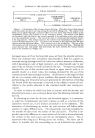
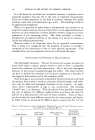
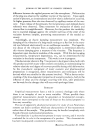
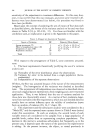
584 JOURNAL OF THE SOCIETY OF COSMETIC CHEMISTS sensitivity of the experiment to treatment differences. In this case, how- ever, it was not felt that this was necessary, and since some treatment dif- ferences were later demonstrated (see below), this procedure was found to have been justifiable. Based upon the concept of analyzing the sets of means of four data each as described above, the format of the variance analysis to be used was that shown in Table ! (13, p. 131-132 15). For those not familiar with the symbolism used, an explanation is given in the Appendix to this paper. TABLE I--FOr, MAT or ANALYSIS OF VARIANCE Source of Variation DF Expected Mean Square Among treatments (T) Effect of reapplication (days) (D) Treatments X days (TD) Replication (residual) Total 3 v? + (2) v•d + (2) (5) 4 o-? + (2) a•d + (2) (4) 12 a, • --I- (2) 20 39 With respect to the arrangement of Table I, some comments are perti- nent: 1. The basic requirements theoretically justifying the use of a variance analysis are: (a) Normality of the error distribution about the observations (b) Variance for error to be derived from a single population (homo- scedasticity) (c) Independence of the separate observations Of these, the first was assumed because of the nature of the measurements (weights). The homogeneity of the variances was checked as described later. The requirement of independence was observed as described above, since each original datum represented a fresh weighing and a new treatment application. Thus, it was believed that the use of variance analysis for these data was theoretically sound. As a matter of fact, moderate depar- tures from normality (the first requirement, which was not checked directly) usually have no serious influence upon the validity of conclusions drawn from an analysis of variance (13, 14, 17 chapt. 10). 2. This experiment and the subsequent analysis were considered to be a "Model II," and the expected mean squares shown in Table I were derived under this assumption. In such an analysis, the several levels of each variable tested are considered to be samples from a large population of possible levels, rather than as representing complete populations. The decision in this matter is sometimes self-evident, but frequently, as in the present case, it depends upon the nature of the questions the experimenter is asking. In the present instance, the object, as stated previously in

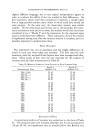
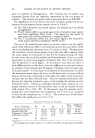
EVALUATION OF ANTIPERSPIRANT DATA (I) 585 slightly different language, was to test typical antiperspirant agents in order to evaluate the ability of the test method to find differences the four treatments chosen were thus considered to represent a sample taken from a large possible number, many others of which could have served the same purpose. In the same way, the observation periods were similar samples. On the other hand, had interest lain in the particular four treat- ments and periods used and in no other, the analysis would then have been considered to be a "Model I" and the expressions for the expected mean squares would have been different. These expressions dictate the method of significance testing used after the variance analysis is complete, and it is therefore important to predetermine them. DATA OBTAINED The experiment was run as described, and the weight differences ob- tained in each case were coded and recorded. The four data for each treatment, each day and each Latin Square were then averaged and tabu- lated. These means of four were the raw materials for the analysis of variance used, and they are presented in Table II. T.•sts II--Ms.•ss or CoMrtS'rs LAT• SquAgss or Four. SuBjsC'rS E.•CH Square I Square II Treatment and Time (Subjects 1-4) (Subjects 5-8) T•D• ( 3 hr) 25.63 21.60 T•D2 (27 ") 21.08 15.30 %Ds (51 ") 25.53 20.03 T•D4 (75 ") 22.80 15.63 T•D5 (99 ") 20.55 25.13 %D• 18.48 16.35 %D• 13.38 11.65 T•Da 18.10 14.15 T2D4 12.88 10.40 %D5 10.80 13.83 TaD• 24.35 13.28 TaD2 16.90 10.48 TaDs 15.43 14.00 TaD4 12.90 11.20 TaD• 13.95 15.45 T4D• 30.38 23.23 T4D• 20.55 14.78 TaDs 24.18 19.78 TaDs 32.38 16.75 T4D• 28.28 21.58 ANALYSIS OF DATA A conventional analysis of'variance was carried out on the data of Table 1I:' The computational work included a Bartlett test for homoscedasticity (18, pp. 38-39), and significance tests as detailed below (the Bartlett test
Purchased for the exclusive use of nofirst nolast (unknown)
From: SCC Media Library & Resource Center (library.scconline.org)