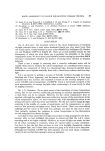
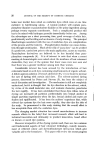
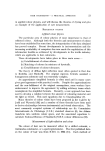
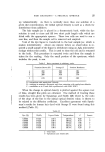
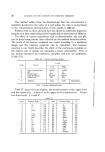
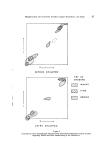
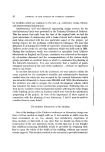
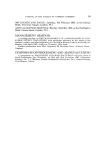
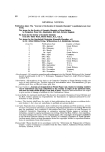
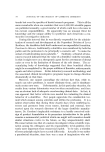
26 JOURNAL OF THE SOCIETY OF COSMETIC CHEMISTS This method suffers from the disadvantage that the concentration is implicitly involved in the value of A and unless the rate is proportional to the concentration, interpretation of the results is difficult. Further work on nitro and acid dyes has shown no noticeable departure from the root time relationship which is applicable to short times of diffusion. The effect of various ingredients such as alkanolamide, salt and pH, can be found using kinetic data collected by the method described above. The levels of the factors examined are varied according to a statistical design and the response equations can be calculated. The response equation is one which describes the effect of the continuous variables on the relative rate of uptake (A) assuming a linear relationship. Five of the [actors examined are continuous variables and two are qualitative (Table III). Table III Factors and their levels Level Code Factor Low High __ A Dye concentration 0.03% 0.09•o • pH 7 11 Temperature 20 øC 40 øC F Hair treatment Normal Permed G Added salt 0% 6% --• Additive None CDE I Morpholine CDE - Coconut diethanolamide Table 1 V sho•vs the run number, the factors present at the upper level and the values of A. A factor I in the upper level is denoted by i. Factor has three levels, 1, S and S •. Table IV Code Factors High A Code Factors High A 1 fg 6.0 17 Is 2.9 2 a 3.3 18 ags 1.9 3 b 1.9 19 bgs 7.7 4 abfg 3.8 20 abfs 1.5 5 c 5.6 21 cgs 3.8 6 acfg 3.6 22 acfs 1.9 7 bcfg 6.4 23 bcfs 1.7 8 abc 5.7 24 abcgs 5.9 9 g 4.2 25 S 2 2.5 10 af 3.9 26 afgS" 3.5 11 bf 2.1 27 bfgS" 3.3 12 abg 4.7 28 abS a 0.8 13 cf 3.1 I 29 cfgS • 2.7 14 acg 7.7 30 acS 2 3.8 15 bcg 6.3 31 bcS"' 1.7 16 abcoe 1.6 32 abcfgS • 5.1

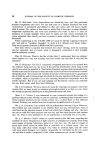
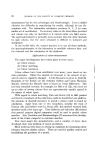
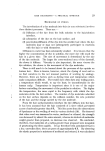
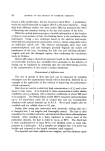
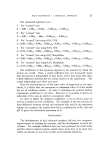
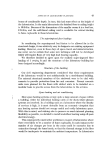
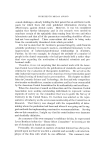
HAIR COLOURANTS- A PRACTICAL APPROACH 27 The calculated equations are: 1. For "normal" hair A = 4.80 + 1.02x G -4- 0.84Xc + 0.62x•xG + 0.35x^x c 2. For "permed" hair A = 3.90 + 1.02x G --.06x c + 0.62x•xa q- 0.35x^x c 3. For "normal" hair using 0.5% CDE A =3.62 + 1.02x• +0.84x c q-0.62XBX •-- 0.50X A q-0.50XB-- 0.40XAX G q-0.35XAX c 4. For "permed" hair using 0.5% CDE A =2.72 + 1.02xG-- 0.06x c q- 0.62x•xc,-0.50x ^ q- 0.50xt•-- 0.40X^XG q- 0.35x.ax c 5. For "normal" hair using 0.5% Morpholine A =3.62 + 1.02x• + 0.84x c q-0.62x•x• +0.50x A- 0.50x• q- 0.40xAx G + 0.35XAX c 6. For "permed" hair using 0.5% Morpholine A --2.72 + 1.02x• -- 0.06x c +62xsx• +0.50x A-- 0.50x• + 0.40XAX G + 0.35XAX c The coefficients of the equations depend on the amount by which the factors are varied. Thus, a small coefficient does not necessarily mean that the process is independent of that factor, but it does mean that there is little difference between the two values chosen for the experiment. The actual relationship may show curvature. Since the interactions are of the same order of magnitude as the main effects, it is likely that the maximum or minimum value of A lies within the set of conditions chosen. In order to determine its position further experiments would have to be done. However, it is possible to derive an indication of the area in which to concentrate effort. In order to define the optimum conditions, a set of criteria must be used to evaluate the best conditions. For example, if the two criteria (a) least difference between treated and untreated hair and (b) the maximum uptake are accepted, the results show that a combination of 6% salt and pH 11 gives the theoretical maximum of A. CONCLUSIONS The developments in hair colourant products fall into two categories, improvements to existing dye systems, and the development of novel dye systems. For example oxidation dyes are now produced for retail trade, and the solvent assisted systems enable many more dyes to be used, dyes which are already in use in the textile and foodstuffs industries.
Purchased for the exclusive use of nofirst nolast (unknown)
From: SCC Media Library & Resource Center (library.scconline.org)