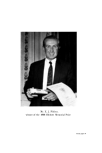
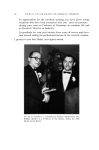
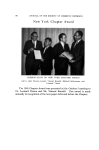
EIGHTEENTH MEDAL AWARD Acceptance of Medal Sob D. G•RSHON, Ph.D. 77 I am delighted and proud to be the recipient of the coveted Medal Award of the Society of Cosmetic Chemists. I accept it, deeply con- scious of the signal honor conferred by its presentation. This recogni- tion brings a warm glow of satisfaction and a transitory sense of achieve- ment. To be the recipient is both an overwhelming and a humbling ex- perience. Humility and a sense of unworthiness have been expressed in one way or another by almost all previous Medalists. For perhaps better reasons than those who have appeared before me, I share these feelings. Custom decrees that the Medalist have his ego buttressed prior to the Award. This has been performed admirably by Dean Webster and Professor Phillips. The Medalist is then expected to expound learnedly upon his area of scientific endeavor and to elaborate on the multitude of problems that exist and, in most instances, that he has not been able to attack, let alone solve. All of this is to be done in less than fifteen minutes and, because of the mixed audience, should not be too technical in character. It is quite apparent that those who wrote these specifica- tions will not tolerate aimless verbosity nor mistake it for eloquence or pertinence. Before I initiate the technical part of this talk, I would like to express a few gratitudes, inadequate as they may be. Throughout my career, my efforts have been intertwined with the efforts of many other scien- tists, scientists who have contributed significantly to work cited in this recognition. To mention all to whom I am indebted, without omissions, would be difficult for me and tedious listening for you. Without in any way minimizing the contributions of these associates, I plan to express but three gratitudes. My first is to those who nominated me for this Award, to the Medal Award Committee and to the Society for making the Award possible. An accolade from the members of one's own profession is a great reward for one's efforts. A substantial part of the scientific work cited on my behalf was per- formed during my association with Lever Brothers Company. My second gratitude is extended to the management of this Company for

78 JOURNAL OF THE SOCIETY OF COSMETIC CHEMISTS providing the opportunity to do the work involved, for providing the facilities, funds, confidence and, most important, for providing capable colleagues to contribute, challenge, and perform experimental operations. My third and last gratitude is the exception, since unlike the previous instances, it will be directed to a specific individual--one whom I have known for many years, who has been my advisor and whom I have con- sulted freely one who has been able to discriminate important consider- ations from those of lesser consequence one who has earned, in fact, the capital A in this Award. With deep appreciation, respect, love and gratitude, I hope to share this Medal and all that it entails with my wife, Esther Gershon. Now, with apologies to the ladies, we can pursue, briefly, some tech- nical considerations. The marked growth of the cosmetic industry, the fruitful cosmetic research, the resultant excellent new products and the substantial in- crease in the professional status of cosmetic chemists during the past four decades have been discussed well and at length on occasions comparable to the one we are enjoying this evening. I do not plan to attempt to ex- pand on these topics but rather, as some of you would expect, plan to spend the remaining time commenting on several aspects of oral hygiene research. Eventually, most people acquire dental caries (tooth decay) and/or periodontal (gingival, gum) problems. The results of at least two studies indicate that tooth decay and gum disorders account for about 93% of the teeth we lose. Up to the age of 40, most of the teeth lost are extracted because of tooth decay, with gum disorders occupying a minor role. In individuals beyond age 40, however, gum disorders become the major cause of tooth loss. Gum disorders do not wait until age 40 to begin. In a report on a 1962 survey conducted in the United States, it was pointed out that over 20 million of the approximately 110 million adults no longer had any teeth. Three out of four of the remaining 90 million adults had some form of gum disorder. It is not surprising, then, that oral disease is recognized as the number one chronic disease problem in countries like the one we live in. As cosmetic and pharmaceutical chemists we are interested in the role of dentifrices and related products in the prevention and mitigation of these diseases. Prior to 1950, a dentifrice was considered as a mixture used on the teeth in conjunction with a toothbrush solely to assist the toothbrush in cleaning the accessible surfaces of the teeth. Dentifrices were stated to have no demonstrated medicinal, curative, or prophylactic
Purchased for the exclusive use of nofirst nolast (unknown)
From: SCC Media Library & Resource Center (library.scconline.org)