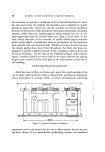
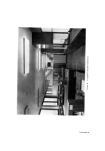
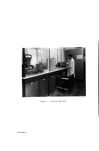
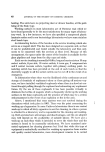
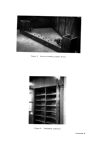
ASPECTS OF LABORATORY PLANNING 49 out by the manufacturers of these machines before they are really suitable for cleaning glassware and other apparatus from research laboratories, where there is a wide variety of soils to be contended with. Opinion was also divided on flooring materials. Since we had decided t'o use underfloor heating, much care was taken in the choice of flooring. In the laboratory areas we have hardwood block floors, and in the corridors reinforced linoleum tiles. The selection of the hardwood for the blocks was not easy on the one hand we required as much resistance to indentation by stiletto heels as possible, on the other hand a high degree of dimensional stability was demanded on account of the underfloor heating. However, we were eventually recommended to use padauk, a hardwood from south east Asia. The floors of this timber have proved to be generally satisfactory in use although there has been quite a lot of indentation from stiletto heels in heavy traffic areas. It seems that the problem of floor damage is with us as long as stiletto heels remain fashionable if the flooring surface is suffici- ently hard to resist indentation, then there is the attendant risk of it becoming regarded as slippery and consequently hazardous, especially in areas where chemicals and apparatus are being handled. A third unresolved issue of general interest was the minimum space requirements per operator for different types of work. From our experience with the 5-module laboratory already mentioned, we consider that such a laboratory will afford adequate facilities for 8 workers, i.e. an area of 138 sq. ft per person. This figure is below the 150 sq. ft frequently recommended as the minimum space per worker, but it will be recalled that we have removed practically all of the equipment which occupied floor space in many laboratories so that we are much nearer the recommended figure than would at first appear. Final/y, I would like to indicate the time scale appropriate to the first stage of our project. The outline plans for the overall redevelopment of the site were prepared and accepted in principle in March 1962. Then followed a period of about six months during which the architectural and servicing details of the laboratory building were worked out. This pro- gramme enabled the contractors to commence actual building operations on site in November 1962 and the first 180 ft length of the laboratory building was occupied by us on the scheduled date in June 1964. The move of the laboratories from existing buildings on the site into the new building was completed within three weeks and at the end of this period the work of the laboratory was proceeding normally. This last matter serves to emphasise the complexity of the operation of

50 JOURNAL OF THE SOCIETY OF COSMETIC CHEMISTS designing and commissioning of a modern laboratory - an operation which imposes considerable demands on the whole of the design team and those who are concerned with the execution of the design. (Received: 14th April 1966) REFERENCE (1) Marriott, R. H. y. Soc. Cosmetic Chemists 11 221 (1960).
Purchased for the exclusive use of nofirst nolast (unknown)
From: SCC Media Library & Resource Center (library.scconline.org)