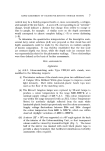
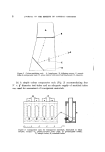
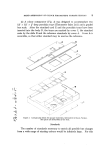
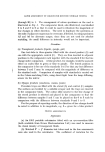
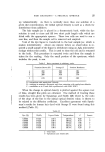
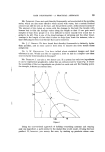
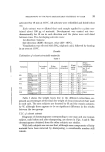
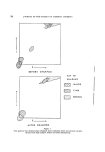
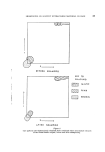
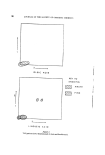
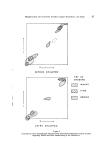
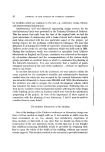
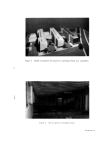
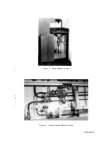
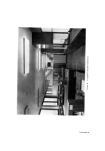
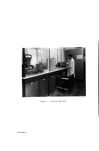
RAPID ASSESSMENT OF COLOUR FOR ROUTINE STORAGE TESTING (through 30) to 1. The arrangement of colour specimens on the card is illustrated in Fig. $. The comparator block, also illustrated, was labelled 0 to 5 and 5 to 0 so that it could be used to illustrate the magnitude of hue changes in either direction. The need to duplicate the specimens at the ends of adjacent ranges may be overcome, if desired, by using specimens A5 and A6 for alternate ranges since they are not used for absolute matching, the small difference in intensity would not be important. Procedure (a) Transparent products (liquids, syrups, gels) One test-tube is three-quarter filled with the stored product (S) and one with the appropriate control (C). They are then inserted in adjacent positions in the comparator rack together with the standard 0 for the hue change under comparison. A blue product, for example, would be assessed either on scales blue to green or blue to purple. The fourth position in the comparator is for one of the standards 1 to 5 so that any hue difference between S and C may be compared with the magnitude of difference on the standard scale. Comparison of samples with standards is carried out in the Colour-matching Units, using direct light from the lamp diffusing- screen via the mirror. (b) Opaque products (emulsions, creams, pastes) Porcelain trays are filled with the stored (S) and control (C) samples. The surfaces are levelled by a suitable scraper and the trays are inserted in the comparator block. The colour slide nearest to the hue change of the stored product is selected and placed in the comparator so that the difference between samples S and C can be placed on the 0 to 5 scale by comparison with the difference between standards 0 and 1 to 5. For the purpose of reporting results, the direction of hue change should be noted in addition to its magnitude, e.g. 3-• green for a blue product. DEPTH ASSESSMENTS Apparatus (a) An EEL portable colorimeter fitted with an eye-correction filter (both available from Evans Electroselenium Ltd.) was used to measure the visual density of transparent fluids. (b) Matched 3" x •4,, diameter test tubes used in the hue assessments were also used in the colorimeter. The coefficient of variation for the

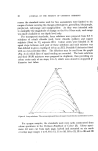
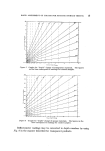
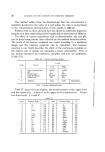
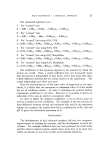
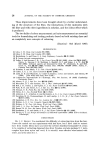
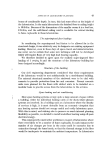
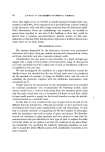
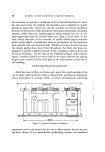
12 JOURNAL OF THE SOCIETY OF COSMETIC CHEMISTS colorimeter readings with specially-matched tubes was 1.0%. Such tubes are rather expensive for multiple testing, but it was found that four out of five ordinary test tubes taken from one batch were within the same limits. By using the colorimeter and a suitable solution, a large number of satisfactory tubes may be rapidly selected. (c) An EEL Mark III reflectometer head, fitted with its eye-correction filter, lens and mask accessories was used to determine the visual density of opaque materials in 1«" x 1«" x «" deep porcelain trays. Readings were obtained on an EEL Unigalvo Type 20. (d) The porcelain trays were accommodated in the special comparator already described for hue assessment and shown in Fig. 3. Procedure (a) Transparent products If hue assessments have already been carried out, the same test tubes are measured in the colorimeter. It is particularly important to eliminate air bubbles for depth measurement, although small bubbles would not interfere with hue assessments. Densities of the storage control (C) and stored samples (S) are read in the colorimeter against a water blank. The readings are converted to "depth" numbers for reporting by using the series of graphs shown in Fig. 5. The appropriate line is selected according to the reading for the control sample, intermediate lines being interpolated as necessary. The colorimeter readings for the stored samples (on the ordinate) may then be correlated with the number for the colour depth change by reading off the selected line. Note that the colour depth scale is divided into zones for the nearest whole number, since fractional values are not required. Points lying to the left or the right of the •hart would be read as -5 or +5 respectively. (b) Opaque products The porcelain trays already assessed for hue in the comparator block may be measured for depth without removal from the block. The Reflecto- meter head is connected to the Unigalvo which is zero-adjusted to read infinity on the logarithmic scale when the head is placed on a black tile and sensitivity-adjusted to read zero when the head is placed on a clean standard magnesium carbonate block. Subsequently readings of the storage control (C) and stored samples (S) may be made by positioning the head centrally over the appropriate apertures.
Purchased for the exclusive use of nofirst nolast (unknown)
From: SCC Media Library & Resource Center (library.scconline.org)