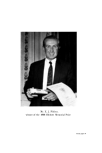
EIGHTEENTH MEDAL AWARD 73 If it be accepted that, to a certain extent, one of the criteria of identi- fication for a Medelist be a career distinguished by a multidisciplinary professional life, I offer that Dr. Sol Gershon is indeed qualified. His publications include papers on the stability of certain agents, synthesis, organic derivatives and homologues, catalysis, and the reactions of fluo- ride with tooth structure. Those publications reflect a competence in the sciences of pharmacy, surface phenomena, organic, inorganic and physical chemistry and clinical research methodology. Nor has this re- search been without substance or objectivity. Lord Chesterton recently remarked: "A great deal of research is rather like a blind man in a dark room looking for a black hat that isn't there." Not so the literature contributions of Dr. Gershon. For example, these researches have re- suited in nine United States patents with seven pending and 32 foreign patents, 20 still pending. The patents are diverse and range widely over the field of hair dressings and treatment formulations, dentifrice and denture cleanser products, and methods of preparing certain oils. To a dental scientist, this breadth of knowledge and the successful integration of various disciplines into a meaningful research career is of particular significance, because dental research itself has only within the past 20 years come of age, no longer isolated from the other basic or health sciences. It was at the time that Dr. Gershon was intimately in- volved in dental-oriented investigations that this metamorphosis took place. It is not by chance that the scientific attitude and the constant demands for excellence, as exemplified by a relatively few individuals such as Dr. Gershon, did much to raise dental research out of the partial vacuum which existed to a level now equal to that of the rest of the scien- tific community. It was a postulation of Dr. Gershon that the very complexity of the oral cavity demanded a systematic approach to its problems and that it must encompass fundamental and applied research from most of the physical and biological sciences. Furthermore, it was his contention that the uniqueness and formidability of oral disease would be a sufficiently challenging factor so that outstanding researchers in the basic sciences would utilize oral disease as the framework for their studies. And this cross-fertilization did indeed occur. Dentistry may be thankful to the handful of Sol Gershons, who by example, vision and persuasion, initiated and stimulated the first truly horizontal research programs in dentistry. It was a distinct loss when, eventually, Dr. Gershon's activities carried him outside of the realm of day-by-day contact with dental research. However, I am continually amazed how knowledgeable he remains, not only in regard to the general

74 JOURNAL OF THE SOCIETY OF COSMETIC CHEMISTS trends but even the specifics of dental research programs. This is all the more remarkable when one considers that over 4,000,000 scientific papers are published annually, a great number of which could have relevance to his current responsibilities. He apparently has an unusual thirst for knowledge and the unique ability to synthesize such detail into a con- structive investigative endeavor. During this interval that he was directly responsible for the adminis- tration of research and development at the Pepsodent Division of Lever Brothers, the dentifrice field itself underwent an unparalleled transition. Previous to this era, traditionally a dentifrice was considered by both the public and the profession to be principally a cosmetic aid: "to make the ordeal of toothbrushing more palatable." Suddenly, a flourish of labo- ratory research indicated that the value of a dentifrice could be extended, in that it might serve as a therapeutic agent for the arrestment of dental caries or even in the limitation of diseases of the soft tissues. The ac- cumulating body of knowledge suggested that these beneficial effects might be accomplished by the proper addition of fluorides, antienzymatic agents and other systems. Entire laboratory research methodology and the associated clinical investigative programs began to change direction dramatically at that time. However, one cannot camouflage the obvious fact that, while re- search can solve problems, it cannot eliminate them, and it simultane- ously creates new ones. Unfortunately, in this particular situation, the results from various laboratories were too often contradictory, and there was an obvious lack of adequate corroborating clinical data. In fact, it was apparent that better criteria were needed for evaluating the clinical behavior of a dentifrice. Few people appreciate the considerable tur- moil which ensued, among scientists and within the profession. It is a salient observation that during those chaotic days when conflicting in- terests and pressures from every source, internal and external, were exerted upon the research directors of the larger dentifrice manufac- turers, Dr. Gershon's implacable resistance to a hastily conceived rede- sign of product formulation or its premature introduction to the public remains a monumental yardstick which one might well remember should similar situations evolve in the future, as they unquestionably shall. His conservatism was that of a mature investigator whose scientific repu- tation among his colleagues and his responsibility to his position were vastly more important than commercial exploit. To be sure, a scientist of lesser principle might have reacted differently. Actually it was rather a paradoxical situation, since here was a man of imagination who wel-
Purchased for the exclusive use of nofirst nolast (unknown)
From: SCC Media Library & Resource Center (library.scconline.org)