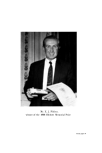
70 JOURNAL OF THE SOCIETY OF COSMETIC CHEMISTS and received admission to the College of the University of Chicago and continued his studies toward a bachelor's degree in Chemistry while teaching a full schedule for the School of Pharmacy and working part time in a pharmacy. His career as a teacher was, as you might expect, brilliant and re- warding. The qualities of personality which gained him acceptance by his classmates in spite of his extremely high scholarship, which is some- times resented by the less industrious students, made him a superb teacher. Students came to him for help and were never given a curt answer or a discourteous hearing, no matter how thoughtless or antag- onistic their question might seem. Even an impertinence was given the full scientific treatment. For example, a student was doing a gravi- metric determination of iron as ferric oxide. The process includes a tedious filtration and washing of a gelatinous hydroxide. The student was not impressed with the importance of the task or hopeful of its being concluded in any foreseeable future and said so in words of one syllable. Sol recommended perseverance and patience and, quoting someone, perhaps, said: "You can do anything if you have patience." The student thought this over resentfully for a few minutes and then said triumphantly, "I know something you can't do even if you have patience." "What?" said Sol. "Carry water in a sieve," said the student. This didn't stump our Medalist, who promptly replied: "Oh yes, you can, if you have the patience to wait until the water freezes.' ' It was in this period that his courtship of Esther Goodman achieved a marriage which, after more than thirty years, gives every evidence of being permanent. The new family moved to the Hyde Park district to be near the University of Chicago and its laboratories. Sol continued his association with the School of Pharmacy, which became a bacca- laureate college in 1932, and found time to complete the requirements for a doctorate in Organic Chemistry under the direction of Professor J. w. E. Glattfeld by evening study and Summer Quarters. A program of study and research of this intensity requires for its completion a dedication only rarely seen. In this case, it was almost complete. The exceptions were those times spent in good weather competing as a member of a soft ball team, in poor weather and in winter in basketball and handball. I am told that he also bowled a respectable series and shot a good game of pool. The handball courts were under the west stands of Stagg Field where, a few years later, the first con- trolled atomic fission reaction was carried out.

EIGHTEENTH MEDAL AWARD 71 His dedication to work reminds me of a story about another such scientist whose wife became worried that he'had worked too intensively and too long and urged him to take a vacation. The scientist was not much interested and replied: "Where would I go for a vacation?" The wife said, "Just think of some place you would rather be than any other place in the world go there and enjoy yourself." The scientist thought it over for a few moments and said, "I know, and I'll do it." So next morning he got up early and went to his laboratory. In 1943, Dr. Gershon resigned his position as Assistant Professor of Chemistry in the College of Pharmacy to begin his distinguished career as a cosmetic chemist and inventor with the Pepsodent Company. This was a great loss to pharmaceutical education and a cause of great regret to all of us who had been associated with Sol over the years. It was understandable that the challenge of an opportunity and, yes, of pressure for research backed up by funds and equipment which we then lacked should have attracted him. The starting salary, which exceeded the highest then paid in our department, was part of the inducement because the Gershon family now included a charming daughter Elaine, who was followed soon by Barbara Lynn. We have all watched with best wishes and pride his continuing success because we can say that we knew him in his early career and predicted this would happen. His career as a teacher did not stop with his resignation from the Faculty. His associates and colleagues in the laboratory continue to learn from his directives and his Socratic questioning in the scientific and technical conferences. He is a born teacher and can no more stop teaching than he can stop breathing. He and Mrs. Gershon have transmitted not only their genetic qual- ities to their daughters but have, by precept and example, taught them to think in the scientific method. Elaine holds a degree, with honors, in Chemistry from Cornell University and is presently doing research at Rockefeller University, while Barbara Lynn holds a degree in Zoology from Pennsylvania State University and is employed in product develop- ment work by a cosmetic manufacturer. Daughters and parents are to be congratulated. I shall leave to Dr. Phillips the privilege of describing the contribu- tions which Dr. Gershon has made to chemistry and particularly cos- metic chemistry. They have been many, and they have been im- portant. This simple chronicle is meant to be a tribute to our friend and colleague as a man who is that most desirable combination
Purchased for the exclusive use of nofirst nolast (unknown)
From: SCC Media Library & Resource Center (library.scconline.org)