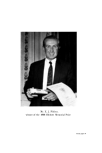
68 JOURNAL OF THE SOCIETY OF COSMETIC CHEMISTS largely removed to other neighborhoods. By 1940, another ethnic wave predominated, and presently most of the old buildings have been cleared to build the Medical Center of Chicago. He lived with his twice- widowed mother and a brother in a crowded flat above a pharmacy owned and operated by Dr. Barnett who, though a licensed physician, preferred to earn his living as an office physician who seldom left his drug store. The circumstance of Sol's association with the drug store seems to be of significance, since we can attribute to this the origin of his interest in a career in Pharmacy. Another establishment, the Chicago National League ball club, had its playing field only a few streets away from his home until Sol was seven years old. This, undoubtedly, was of great importance in stimulating a lively interest in baseball, both as a participant and as a spectator sport. Dr. Gershon is well remembered by his contemporaries as a first baseman of skill and a 0.300 batsman. It is just possible that his early developed skill and interest in mathematics stemmed from his boyhood interest in the batting averages of the Chicago Cubs. Blessed as he was with a brilliant and inquiring mind, a retentive memory, and boundless energy, the young Sol Gershon was a premier student in grammar school and high school and likewise developed the physical coordination which enabled him to be a worthy competitor in athletic games. He was graduated from his high school at the tender age of fifteen and entered the University of Illinois School of Pharmacy the following year. The School was conveniently situated for him in the immediate neighborhood of his home, which enabled him to attend while continuing his after-school and weekend work in the drug store, thereby contributing to the family income. He was one of three hundred such ambition-filled young people who enrolled in the School of Pharmacy that September of 1927. He soon demonstrated that not only was he one of the three hundred but he truly was number one in the class. As an instructor in the courses in Chemistry, I can tell you that it was a joy to read his answers to exam- ination questions. The answers were not only responsive to the direct question, but they often cast light on aspects of the subject which were not intended to be answered. Among the members of that entering class was another youthful genius, Louis Gdalman, who quickly became a close friend of Sol Ger- short. They were among the youngest five in the class and, by all measurements, the numbers one and two scholastically. The differ-

EIGHTEENTH MEDAL AWARD ences were small but significant. Our Medalist maintained his primacy seemingly without effort, while his companion achieved his competitive position by concentrated work. This friendship continued during the years that the two were in graduate school and, while each has gone his separate way to a challenging career, it endures to this day. I bear special greetings and congratulations from Mr. Gdalman to you. The future Doctor of Philosophy established many enduring friend- ships and developed many of the characteristics of a balanced social being even while meeting the pressures of superior scholarship and continuing to contribute to the family maintenance by part time work. During his second year of college, he and his mother moved to the uptown neighborhood of Chicago, a fateful move, since it was in the home of mutual friends in this area that he met Esther "Goody" Goodman, who became Mrs. Gershon. Our Medalist completed the three-year curriculum in Pharmacy in a blaze of scholastic glory at the head of the class at the age of nineteen and a half. He could have been awarded any one or all of several prizes on the basis of grades but, by vote of the Faculty, was presented with the prize in Chemistry. He also received one for excellence in Materia Medica and, in a written competition with representatives from Schools of Pharmacy across the nation, won a five hundred dollar Fairchild scholarship. While Sol, as a student, was always prepared for his examinations and laboratory work, he was never one to overlook the element of chance. He prepared for his tests thoroughly but would never arro- gantly predict his eventual success. In this respect he reminds me of the story told about Niels Bohr, the early atomic scientist who nailed a horseshoe above the door of his laboratory. A friend noticed this and said, "Dr. Bohr, surely you don't believe in that superstitious non- sense, do you? .... No," was the reply, "but I have been told that it brings good luck whether you belie ve in it or not." He was active in what student social life was possible under our conditions. He became a member of a professional fraternity and was a popular member, particularly noted for his smooth and graceful danc- ing. Upon receiving his certificate of graduation, he was invited to accept appointment as an Assistant in Chemistry in the School of Phar- macy, which he accepted. He needed a few months more than a year to reach legal majority so that he might receive his University degree and be permitted to take the licensing examination. He applied for
Purchased for the exclusive use of nofirst nolast (unknown)
From: SCC Media Library & Resource Center (library.scconline.org)