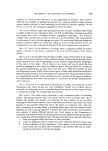
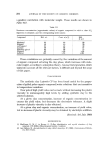
L.-IPONITE CLAY--A SYNTHETIC INORGANIC GELLING AGENT 239 Table I Chemical and physical data on Laponite CP (typical values) Composition % (on dry weight basis) SiO2 MgO Li 2 ø Na20 Fe203 CaO SO3 CO2 H20 (structural) Formula Cation exchange capacity, me/g Morphology 60.40 26.00 1,10 3.00 0.02 0.20 0.I0 0,29 6.90 [Sis Mgs. l Lio. 6 H4.6 024] 0.6- . Nao.6 0.79 plat•] -l•l•:•haped -- Size of average primary particle 40 x I 0 x I nm Moisture (at IOSøC) 8% -- pH of 2 • dispersion 8.8 True density, g cm-3 2.53 Apparent bulk density at 8 • moisture gcm- 3 1.0 Surface area by nitrogen adsorption, m2 g-• 354 Refractive index t 1.54 Dispersion can be achieved by simple mixing. When it is complete, all primary crystallites having only 1 nm thickness, combined with much greater length and •vidth, are thought to be separated. The large number of anisometric particles thus produced are able to form rigid open structures at low clay concentration. The interparticle bonds are not strong, and are readily broken down temporarily by external forces, hence thixotropic gels are obtained. Unlike many thickened systems, the structures formed from Laponite CP are insensitive to temperature variations. Like all colloidal dispersions containing charged particles, the clay dispersions are sensitive to changes in the liquid phase. The presence of electrolytes or polar organic compounds affects the state of dispersion and rheological properties. EXPERIMENTAL Materials used Laponite CP, as described above, was the gelling agent used in all ex- periments.

240 JOURNAL OF THE SOCIETY OF COSMETIC CHEMISTS Organic compounds The following were studied:- Methanol Ethanol isoPropanol Acetone Ethylene glycol Glycerol Sorbitol B.P. grade, 100% Industhai methylated spirit, 95% Standard laboratory reagent, 100% Technical grade, 100% May & Baker laboratory chemical, not less than 95% May & Baker laboratory chemical, not less than 95% Howsorb No. 1, 70% Distilled water was used for making up solutions of these, and the concentrations quoted are expressed on a weight basis of the pure organic compound. Electrolyte Sodium chloride was chosen as a typical electrolyte. Work performed with other electrolytes in pure aqueous systems (to be published later) has indicated that there is no fundamental difference between the effects of all electrolytes on clay dispersions. Methods Preparation of dispersions The aqueous solutions of the organic compounds were prepared first, and the sodium chloride, when used, was added to it. The clay powder was then stirred in at room temperature, using a high speed stirrer (ap- proximately 3,000 rev min-1) for about 15 min, until visually dispersed. The dispersions were then allowed to stand for 16-24 h. Rheological properties The rheological properties were tested with a Ferranti-Shirley visco- meter. Details are as follows:- Cone 3.5 cm radius, "36 I•m particle" cone Maximum speed 1000 rev min-1 _-- shear rate of 18,300 s-• Sweep time 60 s Temperature of plate 25øC. The flow curve was recorded after reaching equilibrium by applying an initial up-down cycle. A tangent was drawn to the linear upper portion
Purchased for the exclusive use of nofirst nolast (unknown)
From: SCC Media Library & Resource Center (library.scconline.org)