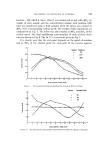
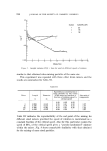
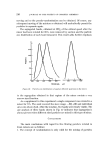
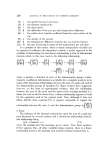
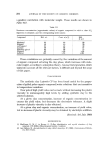
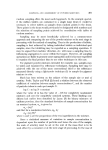
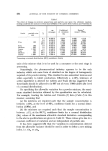
LAI'ONITE CLAY--A SYNTHETIC INORGANIC GELLING AGENT 243 The concentrations selected for further work are shown in Table 11. Table I [ Solutions of polar organic compounds studied Organic compound Methanol Ethanol isoPropanol Acetone Ethylene glycol Glycerol Sorbitol % (w/w) 40 and 25 40 and 25 40 and 25 40 50 •0 5½ Two different concentrations of the alcohols were used. The 40% con- centration selected according to the original plan was found to be too sensitive to electrolyte, so the work was repeated at 215%. The results obtained on the various systems are discussed individually. Methanol/water ( raphs for the 25% and 40% methanol systems are shown in Figs. and $. 150.• 0 ioo z • •o 2_%cloy -- I • I I Z 3 4 5 0 0-5 1.0 Clay concentration, % Sodium concentration, me Figure 2 Effect of clay and electrolyte concentration on methanol/water (25/75) systems 3o 4o 5o •- o. o 6o 7o

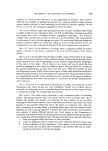
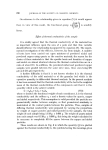
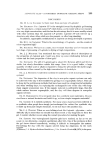
244 JOURNAL OF THE SOCIETY OF COSMETIC CHEMISTS ioo - 50- o i 2 3 4 cloy 5 0 0.5 1.0 .Cloy concentration, % Scd•um concentration, me cj -• --io - 20 - •o •, - 40 _ ,_ -- 50 0 -- 60 - 70 tZigure $ Effect of clay and electrolyte concentration on methanol/ vatcr (40/60) systems At 25% methanol concentration the optical density is little affected by increasing clay concentration, while the yield value increases sharply from 2% upwards. The addition of sodium chloride has a much greater effect on clarity than clay concentration, especially above 0.2 me g- 1. The yield value increases when electrolyte is added up to 0.2 me g-l. There is a further increase of the measured ESS value beyond this point, but this is accom- panied by a complete change of flow behaviour. Instead of being pseudo- plastic, the flow curve becomes that of a Bingham fluid, since the visco- meter measures the rheological properties of an inhomogeneous mixture containing floes. {This section of the curves is indicated by broken lines.) In general, it is easier to obtain dispersions of high clarity and yield value by increasing the clay, rather than the electrolyte concentration. If the presence of electrolyte is unavoidable, then Fig. 2 indicates the electro- lyte tolerance at the particular methanol concentrations tried. Electrolyte tolerance is improved as the water content increases, and is highest in distilled water {Fig. 12). All the above remarks apply also to the 40% methanol solution, except that the electrolyte tolerance is lower.
Purchased for the exclusive use of nofirst nolast (unknown)
From: SCC Media Library & Resource Center (library.scconline.org)