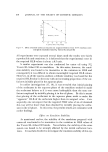
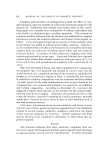
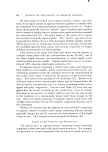
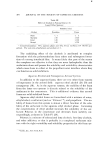
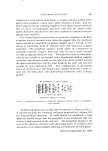
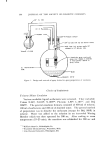
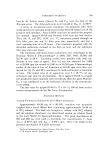
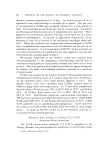
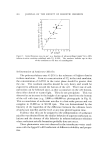
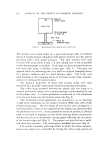
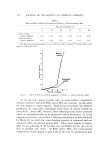
396 JOURNAL OF q'HE SOCIETY OF COSMETIC CHEMISTS I/4" Cu tube t Air or N 2 • Rubber corks Toluene + G-2151 Pressure exhaust $/4" Cu tube with top and bottom sealed. I 20 Luer-Lok syringe needle (6") soldered to I/4" delivery tube. 5 L. Round flask. Insecticide spray nozzle with screw cap- Needle is soldered in fixed position relative to spray orifice. MaGnetic stirrer Figure 1. Design and controls of spray device for spray preparatiot• o[ emulsions Choice of Surfactants Toluene/Water Emulsion Various available liquid surfactants were screened. They included: Triton N-54©, N-101©, N-128©• Pluronic L-92 ©, L-103*•* and Bri] 30SP©*. The general emulsion formula consisted of 450 ml of toluene, 100 ml of surfactant, and 450 ml of distilled water. The general method of preparation was to dissolve the surfactant (except for Bri] 30SP) in toluene. Water was added to the solution in an ice-cooled Waring Blendor which was then operated for 300 sec. After cooling to room temperature (15-25 min), the emulsion was reblended for 300 sec and Rohm & Haas Co., Philadelphia, Pa. Wyandotte Chemicals Corp., Wyandotte, Mich. Atlas Chemical Industries, Wihnington, Del.

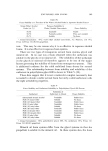
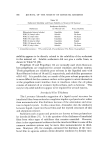
EMULSION STABILITY 397 cooled. If the emulsion had not broken, it was filtered through 5.3-, 1.2-, and 0.8-t• Millipore filters if possible. The 'Uriton N-54, N-101, and Brij 30SP emulsions broke immediately. Plttnmic 14-92 and Triton 128 produced fine W/O emulsions which passed through an 0.8-v filter but creamed rapidly. Oil separation was observed for the latter after 3,000 sec at 59,000 rpm in the ultracentri- fuge. Pluronic L-103 produced a thick emulsion that passed through a 5-v Millipore filter with considerable difficulty but no visible creaming or oil separation was observed. A 9• surfactant emulsion was found to be a water-in-oil emulsion. Polyoxyethylene sorbitan fatty acids were eliminated from considera- tion since they were colored and visible absorption photomerry was used to measure oil separation rates in the analytical ultracentrifuge. Co- polymers of the solid polyoxyethylenes and polyoxypropylenes formed stable toluene-in-water emulsions which were extremely viscous and unfilterable. The commercially available polyoxyethylene alkyl ethenes which were examined do not produce stable emulsions of toluene-in- water. High molecular weight polyoxyethylene aryl ethenes which pro- duced satisfactory emulsions of toluene-in-water had a noticeable yellow oil layer after centrifugation which interfered with coalescence rate studies. In addition, the compounds have a UV absorption spectrum which might possibly interfere with the polyoxyethylene assay. The polyoxyethylene stearates produced stable emulsions at low concentrations. Although solids, they met all the requirements as a surfactant for this system and possessed sut•icient solubility in toluene so that there was no precipitation of solid emulsifier in the centrifuged creams at low concentrations. The Allas G-2151©* Polyoxyethylene-30-Stearate (mol wt ca. 1,600) was chosen as a suitable surfactant. It is oil- and water-soluble and has a low critical micelle concentration (cmc). Tetradecane / |Fater Emulsion Tetradecane (mol wt 198.4, bp 252.50, Eastman Practical) was chosen to provide an alternative emulsion with a nonvolatile, pure, and economically available hydrocarbon. The following sets of surfactants were considered: * Alias Chemical Industries, Wilmington, Del.
Purchased for the exclusive use of nofirst nolast (unknown)
From: SCC Media Library & Resource Center (library.scconline.org)