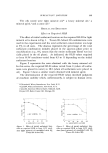
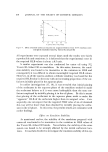
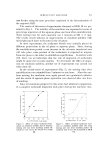
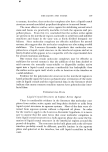
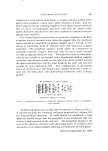
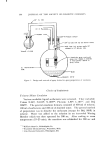
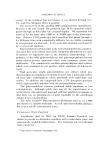
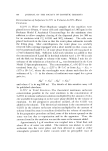
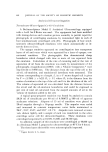
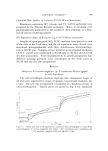
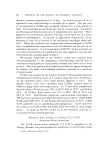
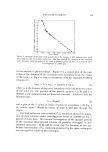
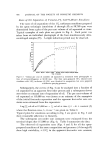
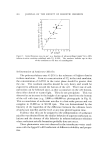
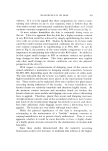
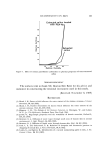
SURFACTANT LOCATION 371 tem further using the same procedure employed in the determination of the required HLB. The results of this series of experiments obtained at HLB 10 are pre- sented in Fig. 4. The stability of the emulsion was expressed in terms of percentage separation of the aqueous phase one hour after emulsification. Total mixing time for each emulsion was 3 minutes at 564 ----+ 2 rpm. The results clearly indicate an improvement in emulsion stability with initial placing of more surfactants in the oil phase. In these experiments, the surfactant blends were initially placed in different proportions in the oil phase or aqueous phase. Since, during the emulsification period, a vast increase in the oil-water interfacial area will take place, some portion of the surfactants is expected to migrate from one phase to the other to establish an equilibrium. In earlier work (19), there was an indication that the rate of migration of surfactants might be quite slow in some systems. To determine the effect of migra- tion on emulsion stability, another set of experiments was carried out with castor oil. In the second series of experiments (Fig. 5), the mixing time after emulsification was extended from 3 minutes to one hour. After the one- hour mixing, the emulsions were again poured into graduated cylinders and the extent of aqueous phase separation was observed after one hour of standing. Since all emulsions prepared in this series had identical composition, if a complete surfactant migration took place during the one-hour mix- • 40 • •o • 2ø I / 3 MIN. MIXING o 0 20 40 60 80 100 % SURFACTANTS IN AQ PHASE Figure 4. Effect of initial surfactant loca- cation on emulsion stability after $ minutes mixing and one hour standing (castor oil stabilized with Tween 80-Arlacel 80 at HLB 80 I I I I 7'0 _ • 60 I HR M I uJ 50 u• ,• 4O , 20 I 0 / 0 20 410 610 •gure •. Effect o[ initial surfactant loca- tion on emulsion stability alter one hour mixing and one hour standing (castor oil stab]ized with Tween 80-Ar]acel 80 at HLB 10)

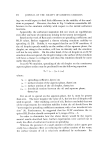
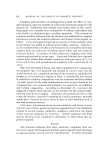
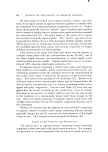
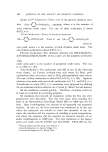
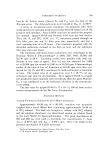
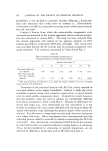
372 JOURNAL OF THE SOCIETY OF COSMETIC CHEMISTS ing, one would expect to find little difference in the stability of the emul- sions so prepared. However, the data in Fig. 5 indicate remarkable dif- ferences in the emulsion stability with respect to the initial surfactant locations. Apparently, the surfactant migration did not reach an equilibrium even after one hour of continuous mixing in the system investigated. Based on the work of Ross and coworkers on spreading coefficients and HLB values, Becher suggested a theory relating emulsion stability to spreading (8, 20). Briefly, it was argued that for an O/W emulsion, if the oil droplet spreads readily on the surface of the aqueous phase, the droplet, on rising to the surface, will lose its identity and the emulsion will not be very stable. On the other hand, if the oil droplet in an O/W emulsion does not spread, the droplet rising to the surface of the emulsion will have a chance to redisperse and thus this emulsion should be more stable than the first one. In an O/W emulsion, spreading of the oil droplet on the continuous aqueous phase surface may be predicted from the following equation: S1 = •a- (•0 + where: S• = spreading coefficient, dynes/cm •a = surface tension of the aqueous phase, dynes/cm v0 = surface tension of the oil droplet, dynes/cm visit = interfacial tension between the oil and aqueous phase, dynes/cm For an oil to spread on the aqueous phase, the S• must be greater than zero. The more negative the value of S•, the less the oil droplet will tend to spread. After studying a series of oils, Becher concluded that one of the requirements for emulsion stability is that the oil should have the "most negative spreading coefficient consistent with a low interfacial ten- sion" (8). Furthermore, he suggested that for O/W emulsions the re- quired HLB value should correspond to S• range of 0 to --5. In order to determine how the above theory would fit the experi- mental results described here, further experiments were carried out to study the effect of surfactant location on spreading. Whereas the presence of a small amount of surface active agent gen- erally has a dynamic effect on reducing the surface tension of the water, the surface tension of oil is relatively unaffected by surfactants. Ex-
Purchased for the exclusive use of nofirst nolast (unknown)
From: SCC Media Library & Resource Center (library.scconline.org)