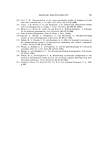
660 JOURNAL OF THE SOCIETY OF COSMETIC CHEMISTS (24) Kramer, A., and Hawbecker, J. v., Measuring and recording theological properties of gels, Ibid., 20, 111-5 (1966). (25) Kramer, A., Texture, in Basic Principles of Sensory Evaluation, American Society for Testing and Materials, Philadelphia, 1968, pp. 49-50. (26) Charm, S. E., The determination of the tensile strength of fluid food materials, ]. Food Sci., 29, 483-6 (1964). (27) Pryce Jones, J., through Overbeck, J. Th. G., Rheology of Lyophobic Systems, in Kruyt, H. R., Colloid Science, Vol. 1, Elsevier Publishing Co., Inc., New York, 1952, p. 364. (28) Bruss, H., tCber die Bedeutung der Rheologie in der kosmetischen und pharmazeutischen Industrie, Parfuem. Kosmet., 41, 141-6 (1960). (29) Bruss, H., personal communication (August 17, 1965). (30) Treloar, L. R. G., The Physics o! Rubber Elasticity, Oxford University Press, London, 1949, p. 56. (31) Flory, P. J., Principles o[ Polymer Chemistry, Cornell University Press, Ithaca, N.Y., 1953, pp. 432-4 482-3. (32) Charm, S. E., The direct determination of shear stress-shear rate behavior of foods in the presence of a yield stress, J. Food Sci., 28, 107-13 (1963). (33) Casson, N., A Flow Equation [or Pigment-Oil Sitspensions o[ the Printing Ink Type, in Mill, C. C., Rheology o[ Disperse Systems, Pergamon Press, New York, 1959, pp. 84-104.

]. Soc. Cosmet. Chem., 21,661-665 (Sept. 17, 1970) Effect of Valve Body Orifice Size on Propellant/Concentrate Ratio LLOYD T. FLANNER, B.S.* Presented January 13, 1970, Seminar, St. Louis, Mo. Synopsis--The effect of the size and ratio of VALVE BODY ORIFICE to VAPOR TAP ORI- FICE on fractionation of propellant and concentrate in cosmetic AEROSOL FORMULA- TIONS was studied. Fractionation of the propellant blends occurred after 75% of the product was consumed. Changes in the ratio of propellant to concentrate were also observed at this point. PROPELLANT FRACTIONATION was least where the ratio of valve body orifice to vapor tap orifice was greatest. Similarly, the alcohol content in the total product increased the most with the smallest valve body orifice and least with the largest valve body orifice. It is recommended that the discharge rate for cosmetic aerosols be reduced by re- stricting the actuator orifice rather than the valve body orifice. INTRODUCTION It is desirable to reduce the discharge rate of aerosol preparations for personal use to avoid excessive wetting. Such wetting is particularly undesirable with deodorant sprays and hair sprays. Previous studies showed that fractionation of propellant and a change in the ratio of pro- pellant to concentrate does occur when vapor tap valves are used (1). This effect increases as the size of the vapor tap orifice increases. These results raised questions of how the size of the valve body orifice and the ratio of valve body orifice to vapor tap orifice would affect fractionation and the propellant/concentrate ratio. Therefore, a series of tests was conducted on typical deodorant and hair spray formulations to determine this effect. * Technical Service Department, Allied Chemical Corp., Morristown, N. J. 07960. 661
Purchased for the exclusive use of nofirst nolast (unknown)
From: SCC Media Library & Resource Center (library.scconline.org)