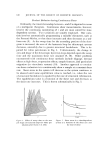
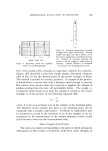
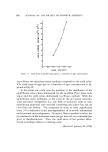
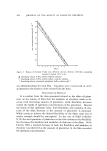
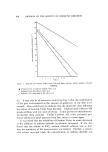
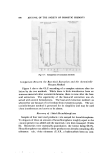
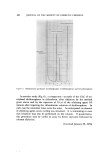
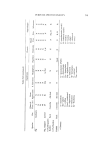
658 [OURNAL OF THE SOCIETY OF COSMETIC CHEMISTS ing to Bruss, the maximum meter reading corresponds to the yield value. The yield stress of agar gels as a function of agar concentration is de- picted in Fig. 12. At this point one could raise the question of the significance of the equilibrium stress values determined via the modified Pryce Jones tech- nique and the yield values determined via Bruss's method. With the equilibrium stress technique, as the stress in the gel system increases, some structural realignment (i.e., the shift of structural units to non- equilibrium positions) and cross-link wandering take place--but not all cross links are broken. The relaxation of stress to some equilibrium value •0 is indicative of the time-dependence of cross-link reformation and structural unit realignment. However, Bruss's method involves the determination of the maximum stress the gel network can withstand just prior to rheodestruction. Thus, the yield stress of the product deter- mined according to Bruss is a limiting value. (Received January 28, 1970)

RHEOLOGICAL EVALUATION OF SEMISOLIDS 659 REFERENCES (1) Wood, J. H., Giles, W. H., anti Catacalos, ( ., Problems in cosmetic rheology, J. $oc. Cosmet. Chem., 15, 564-77 (1964). (2) Sherman, P., Techniques for assessing the rheological properties ooe toiletry and cosmetic products, Ibid., 17, 439-65 (1966). (3) Martin, A. N., Banker, ( . S., and Chun, A. H. C., Rheology, Advan. Pharm. Sci., 1, 1-8.5 (1964). (4) Lin, T J., Rheology Fundamentals and Applicalion•s in Cosmetic Industry, in aleNavarre, M. G., The Chemistry and Manufacture of Cosmetics, Vol. i, D. Van Nos(rand Co., Inc., Princeton, N.J., 1962, pp. 315-38. (5) Chong, C. W., Eriksen, S. P., and Swintosky, J. V., Antithixotropic behavior of magnesia magma, J. Amer. Pharm. Ass., Sci. Ed., 49, 547-52 (1960). (6) Aoki, M., Fukuchi, H., and Nakaya, S., Studies on pharmaceutical suspensions. (1) On the structural viscosity of oil suspensions, Chem. Pharm. Bull., 16, 171-6 (1968). (7) Reincr, M., and Scott Blair, G. W., Rheological Terminology, in Eirich, F. R., Rheology --Theory and Applications, Vol. 4, Academic Press, Inc., New York, 1967, pp. 461-88. (8) UmstStter, H., Kolloid-Z., 70, 174-80 (1935) through Houwink, R., Elasticity, Plasticity, and Structure of Matter, 2nd ed., Dover Publications, Inc., New York, 1958, pp. 12-4. (9) Boylan, J. C., Rheological evaluation of the spreading characteristics of pharmaceutical semisolids, J. Pharm. Sci., 56, 1164-9 (1967). (10) Davis, S.S., Shotton, E., and Warburton, B., Some limitations of continuous shear meth- ods for the study of pharmaceutical semi-solids, ]. Pharm. Pharmacol., Suppl., 20, 157S- 167S (1968). (11) Ferry, J. D., Rheology in the world of neglected dimensions, J. Chem. Educ., gS, 110-• (1961). (12) Barry, B. W., and Warburton, B., Some rheological aspects of cosmetics, .l. Soc. Co3met. Chem., 19, 725-44 (1968). (13) Van Wazer, J. R., Lyons, J. w., Kim, K. Y., and Colwell, R. E., Fiscosity and Flow Measurement--A Laboratory Handbook of Rheology, Interscience Publishers, New York, 1963, pp. 362-3. (14) Vand, V., Viscosity of solutions and suspensions. I. Theory, J. Phys. Colloid Chem., 52, 277-99 (1948). (15) Merrill, E. W., Non-Newtoniauism in Thin Liquids: Molecular and Physical Aapects, in Acrivos, A., Modern Chemical Engineering, Vol. 1, Reinhold Publishing Corp., New York, 1963, pp. 180-1. (16) Whirmore, R. L., The Viscous Flow of Disperse-Suspensions in Tubes, in Mill, C. C., Rheology of Disperse Systems, Pergamon Press, New York, 1959, pp. 49-60. (17) Bantort, E., Some Measurements on Pigment-Plasticizer Dispersions, in Mill, C. C., Rheology of Disperse Systems, Pergamon Press, New York, 1959, pp. 105-26. (18) Barry, B. W., and Shot(on, E., Performance of the Ferranti-Shirley viscometer with automatic flow curve recorder, .I. Pharm. Pharmacol., 21), 167-8 (1968). (19) Warburton, B., and Barry, B. •N., Concentric cylinder creep investigation of pharma- ceutical semi-solids, Ibid., 20, 255-68 (1968). (20) Davis, S.S., Viscoelastic properties of pharmaceutical semisolids. I: Ointment bases, .1. Pharm. Sci., 58, 412-8 (1969). (21) Davis, S.S., Viscoclastic properties of pharmaceutical semisolids. II: Creams, Ibid., 58, 418-42 (1969). (22) Kramer, A., Burkhardt, G. J., and Rogers, H. P., Jr., The shear-press: a device for measuring food quality, Canner, 112, No. 5, 34-6, 40 (1951). (23) Decker, R. W., Yeatman, J. N., Kramer, A., and Sidwell, A. P., Modifications of the shear-press for electrical indicating and recording, Food Technol., 11, 3t3-7 (1957).
Purchased for the exclusive use of nofirst nolast (unknown)
From: SCC Media Library & Resource Center (library.scconline.org)