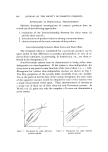
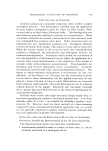
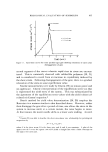
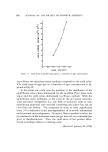
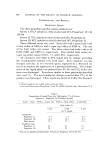
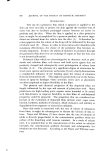
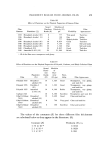
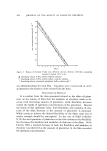
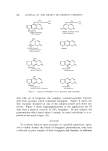
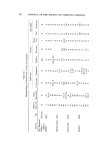
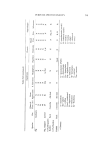
668 JOURNAL OF THE SOCIETY OF COSMETIC CHEMISTS INTRODUCTION The use of a polymeric film which is sprayed or applied to the skin can serve not only to protect the skin against the excessive loss of water but also to facilitate prolonged contact between an active in- gredient and the skin. When the film is applied in a thin protective layer as might be accomplished by a spray-on product, the active ingre- dients are released from the vehicle into the skin (1). It therefore be- comes apparent that the release of the drug will be influenced by the type of vehicle used (2). Hence, in order to treat various skin disorders with maximum effectiveness, the choice of the polymeric film becomes ex- tremely important. Further, the ability of moisture to permeate through the polymeric film allows [or an exchange of vapors so that the skin area is not hermetically sealed. Polymeric films which are electronegative in character, such as poly- amide and cellulose films, will attract and hold active agents that are positively charged and subsequently exert prolongation of release from the film (g, 4). The existence of a significant degree of interaction be- tween ionic species and nonionic sur[actants (5) very clearly demonstrates a considerable influence of the binding upon the release of substance from the formulation (6). This might be particularly true in the formu- lation of spray-on bandages where nonionic esters such as plasticizers are often employed to impart flexibility to the films. The physical and chemical properties of the deposited films are largely influenced by the type and amount of plasticizers used. Many plasticizers are high boiling point organic esters intended to be mixed with film-formers to improve flexibility so that films of well-balanced properties could be prepared. The properties that are considered im- portant in the evaluation of deposited films include water vapor trans- mission, hardness, modulus of elasticity, alkali resistance, and stability to degradation [Tom exposure to ultraviolet radiation. Since this study is concerned with the rate of release of substances from films, it might be advantageous to discuss the kinetics of this re- lease. Noyes and Whitney (7) have shown that the rate of solution of solids is directly proportional to the concentration gradient when the surface of the dissolving solid remains constant. In a study of release rates, it is assumed that as the concentration of the solute in solution increases, the concentration gradient decreases and subsequently the solution rate also decreases. According to the Noyes and Whitney equa- t ion:

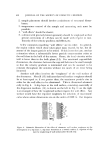
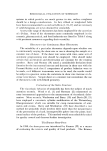
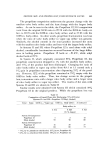
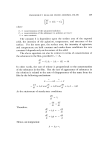
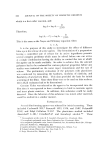
INGREDIENT RELEASE FROM AEROSOL FILMS 669 • here C• = concentration of the saturated solution Gt = concentration of the substance in solution at time t k = rate constant. The constant k is dependent upon the surface area of the exposed solid, the intensity of the agitation, temperature, and structure of the surface. For the most part, the surface area, the intensity of agitation, and temperature are held constant and under these conditions the rate constant k depends only on the nature of the solid. The above equation can also be written in terms of concentration of the substance in the film, provided C8 -- A0 #C dt In other words, the rate of release is proportional to the concentration of the substance in the film. But the rate of appearance of substance in the solution is related to the rate of disappearance of the same from the film by the following mechanism: k• A •B •C dA dC dB dt - klA and d•- = ko.B and di- = klA -- k2B At the attainment of steady state conditions dB dt = O, dA dC -- dt dt dC dA - k.4 - dt dt dC dA -- = kdt = A A Therefore, Hence, on integration' A = Aoe--kt•
Purchased for the exclusive use of nofirst nolast (unknown)
From: SCC Media Library & Resource Center (library.scconline.org)