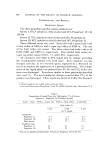
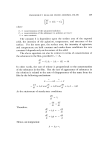
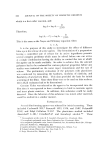
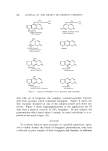
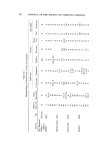
670 JOURNAL OF THE SOCIETY OF COSMETIC CHEMISTS which is a first order reaction, and kt log A = log A0 -- •.303 Therefore, kt log (A0 -- Ct) = log A0 2.303 This is the same as the Noyes and Whitney equation when C• = A0 It is the purpose of this study to investigate the effect of different films upen the release of active agents. The formulation of a preparation having a controlled rate of release [or its active in•edients presents several complex problems which must be solved be[ore one can arrive at a single combination having the ability to control the rate at which the agents can be made available. In order to achieve this, the selected polymers had to be evaluated for various physical properties before any studies were initiated on the water vapor transmission and the rate of release. The preliminary evaluation of the polymers with plasticizers was conducted by measuring the hardness, modulus of elasticity, and flexibility of several test films. This data provided the basis for initial screening of the films. Since these films were to be used on skin surfaces, their alkali resistance had to be determined. Gentian Violet was selected as the agent to be incorporated into the film since it was reported to have a tendency to bind to nonionic agents and inert plastic matrices. In addition, this substance could be easily detected. Once the behavior of this substance was noted, other materials could be studied in a similar manner. EXPERIMENTAL Several film-forming agents were selected for initial screening. These included Carboset© 525,* Emerez© 1533, 1536, and 15407 Polymid© 1155,* and Ethyl Cellulose N-10.• The plasticizers studied included Anierchol© L-101,II Citroflex©-4? and hexadecyl alcohol.** These * Tl•crmoplastic acrylic resin, B. F. Goodrich Chemical Co., Cleveland, Ohio. '• Thermoplastic polyamide resin, Emery Industries, Inc., Cincinnati, Ohio. :• rl'hcrmoplastic polyamide resin, Lawter Chemicals, Inc., Krumbhaar Resin Div., Chicago. õ Hercules Powder Co., Wilmington, Del. I[ Lanolin derivative, American Cholestrol Products, Inc., Edison, N.J. ô Trihutyl titrate, Pfizer & Co., Inc., New York, N.Y. ** Enjay Chemical Co., Elizabeth, N.J.

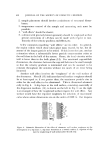
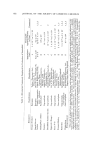
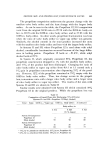
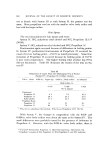
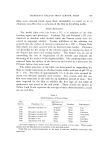
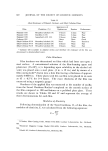
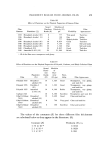
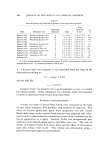
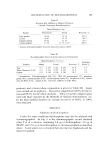
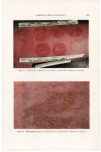
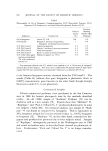
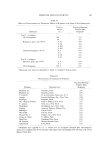
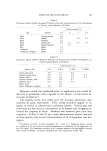
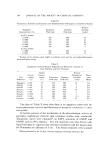
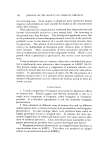
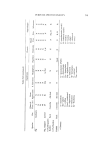
iNGREDIENT RELEASE FROM AEROSOL FILMS 671 films were selected based upon their insolubility in water so as to eliminate any effect due to solution of the film in desorbing media. d lkali Resistance The model films were cast from a 5% w/w solution of the film- forming agent and plasticizer. Carboset 525 and Polymid 1155 were dissolved in absolute ethyl alcohol while the Emerez resins were dis- solved in isopropyl alcohol. Twenty milliliters of the solution was potired onto the stirface of mercury contained in a 150- X 20-mm Petri dish which was then covered with an inverted glass funnel. Clearance was provided for the escape of the solvent vapors by raising the base of the funnel just above the resting surface. The hlnnel was an aid in controlling the rate of evaporation of the solvent and redriced the blistering of the surface of the deposited film. The resulting films were removed from the surface of the mercury and stored in a desiccator for 24 hours before they were used. The alkali resistance of the films was determined by suspending the films in a bath containing an alkaline borate buffer solution of pH 9.5 at 37 _+ IøC. The films of approximately 3 x 4 cm size were secured be- tween two 10-mesh stainless steel screens. The screens with the test film were immersed in the bath for an indefinite period of time. The time required by the film to exhibit the first sign of any kind of opalescence was noted as the end point. These results are shown in Tables I and II and represent the average of three determinations carried out on each film. Table I Alkali Resistance of Emerez Fihns Film Appearance of Emerez Plasticizer (%) Opalescence Erosion a Performance,, 1533 Hexadecyl alcohol (10) 49 hours None Fair 1536 ... 25 hours None Fair 1540 Hexadecyl alcohol (10) None None Excellent 1540 Hexadecyl alcohol (20) 5 days None Very good 1540 Hexadecyl alcohol (30) 4 days None Good 1540 Citroflex-4 (10) None None Excellent 1540 Amerchol L-101 (10) None None Excellent • All results reported as "None" were observed for a period of seven days. These results indicate that the films showed no solubility in the desorbing media. * Each film was evaluated physically on the basis of tackiness, flexibility, continuity, and appearance.
Purchased for the exclusive use of nofirst nolast (unknown)
From: SCC Media Library & Resource Center (library.scconline.org)