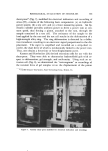
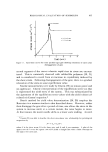
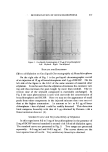
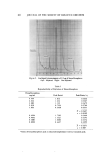
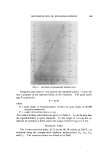
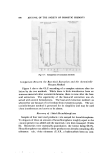
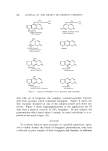
DEq'ERNIINATION OF HEXACHLOROPHENE 685 facing the contents. These are also used to cap injection ports to eli•ni- nate spurious peaks at high temperatures. The gas-liquid chromatograph * was equipped with a flame ioniza- tion detector. The column, 5 ft. X 0.25 in. aluminum, contained 5% SE-30 on acid-washed, DMCS-treated Chromosorb W (60/80 mesh). The column was programmed from 200øC up at 6øC/minute. Helium carrier flow was 60 ml/min. Methods Silylation and Gas-Liquid Chromatography A solution containing 10 mg or less of hexachlorophene in either acetonitrile or dichloromethane is obtained by isolation from the product (see isolation methods). This solution is evaporated in a silylation vial to dryness at 40ø-60øC in a stream of nitrogen. When the amount of sample is below I rag, 1.0 ml of a 0.02% DCHP solution in methanol is added to the silylation vial. When the amount of sample exceeds 1 mg, 1.0 ml of a 0.2% of DCHP is added. After the methanol is evaporated in a stream of nitrogen, silylation is accomplished by adding 1.0 ml of Tri-Sil BSA with a hypodermic syringe and needle through the septurn of the silylation vial. Reaction is immediate and 2.0 t•l of the resulting solution •nay be injected into the GI,C column under the conditions given above. Isolation of Hexachlorophene prior to Silylation Base-Acid Extraction--A sample equivalent to 10 mg or less of hexa- chlorophene is accurately weighed into a 125-ml separatory funnel con- taining 50 ml of benzene. The benzene solution is extracted twice with 50 ml of water. After separation, the water layer is discarded. Extrac- tion is carried out three times with 25-ml, 10-ml, and 10-ml aliquots of 1N sodium hydroxide. The alkaline extracts are combined in a 125-ml separatory funnel. Three drops of methyl orange indicator are added and the solution is acidified with concentrated hydrochloric acid. This solution is then extracted with two 30-ml portions of dichloro- methane and the extracts are combined in a 125-ml Edenmeyer flask. After concentration tO approximately 2 ml on a steam bath in a gentle stream of nitrogen, the residue is transferred with the aid of a pasteur * Hewlett Packard, 1501 Page Mill Rd., Palo Alto, Calif. 94304.

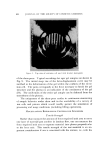
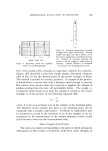
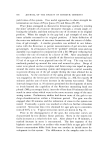
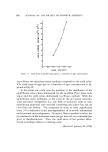
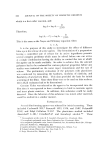
686 JOURNAL OF THE SOCIETY OF COSMETIC CHEMISTS pipet into a silylation vial. The flask and the pasteur pipet are washed with two 1-ml portions of dichloromethane. Next, 1.0 ml of dicyclo- hexylphthalate solution is added and the solution is evaporated to dryness on a sand bath at 40ø-60øC in a gentle stream of nitrogen. A standard containing 6 mg of hexachlorophene is also carried through the above procedure. For products containing solid particulate material, the following modification is useful: A sample containing 10 mg or less of hexachloro- phene is accurately weighed into a 150-ml beaker and 50 ml of methanol is added. After 0.5 hour of stirring on a magnetic stirrer, the solution is filtered through a medium-porosity sintered glass filter into another 150-ml beaker. The insolubles are transferred from the filter back into the original beaker and are mixed for 0.5 hour with 25 ml of methanol, then filtered again. Extraction and filtration are repeated once more. The flitrate is concentrated to less than 5 ml, but not to dryness, on a steam bath with a gentle stream of nitrogen. It is then transferred to a 125-ml separatory funnel with the aid of 50 ml of benzene, and the procedure is continued as with the benzene layer above. Acetonitrile-Hexane Method--A sample containing up to 10 mg of hexachlorophene is agitated with about 60 ml of acetonitrile for several minutes. If any material remains insoluble in the acetonitrile, it is filtered through a sintered glass funnel. The funnel is washed with more solvent. Extraction with three 50-ml portions of hexane follows. To save time, the hexane layers can be aspirated from the surface of the acetonitrile by vacuum. If hydrocarbons are absent, extraction by hexane is not needed. The acetonitrile solution is concentrated and transferred to the silylation vial as is done with the benzene solution in the base-acid extraction method above. Silylation is accomplished in the same way. A standard is carried through the identical procedure. Calculations-- Per cent hexachlorophene = where: 14/• = weight of standard, g 14/,• = weight of sample, g R• W•X R. X 100 = peak height of standard divided by peak height of dicyclohexylphtha- late internal standard = peak height of sample divided by peak height of dicyclohexylphthalate internal standard
Purchased for the exclusive use of nofirst nolast (unknown)
From: SCC Media Library & Resource Center (library.scconline.org)